


A solid restaurant marketing plan is more than just a document; it’s the playbook that guides every promotional dollar you spend. It is how you stop guessing and start building a loyal customer base that fills seats, night after night.
Laying the Groundwork for Your Marketing Plan
Before you spend a dime on an Instagram ad or print a single flyer, the real work begins. A powerful marketing plan starts with clarity, not tactics. It is about getting brutally honest about who you are as a brand and what you are trying to accomplish. This initial effort is your roadmap, making sure every marketing move is deliberate, strategic, and aimed at something you can actually measure.
This goes way beyond your menu. It’s about nailing down your restaurant’s core identity: the unique story and vibe that makes you different from the spot down the street. A great starting point for any modern restaurant is a simple guide to digital marketing for local businesses, which can help frame this crucial first step.
Define Your Brand Identity
What is your restaurant’s personality? Are you a cozy, farm-to-table bistro that is perfect for date nights? Or are you a loud, high-energy spot for after-work cocktails and shared plates? Your brand is the feeling guests get when they walk in, the voice you use online, and the values you operate by.
Nailing this down is everything because it informs every single choice you make in your marketing. It dictates the colors on your website, the style of photos you post, and even the kind of music on your playlist. To go deeper on this, check out our guide on how to turn your restaurant’s story into brand loyalty.
Your brand isn’t just a logo. It is the entire experience you deliver. A strong, consistent brand makes you memorable and attracts the right people, the ones who will become regulars.
Set SMART Marketing Goals
Saying you want to “get more customers” is a wish, not a goal. It is impossible to measure and even harder to achieve. Instead, the best marketing plans are built on SMART goals: Specific, Measurable, Achievable, Relevant, and Time-bound. This simple framework turns vague ideas into real targets.
Here is how that looks in the real world:
- Instead of: “Increase sales.”
- Try: “Increase weekday lunch sales by 15% within the next three months by launching a new express lunch menu targeting local office workers.”
- Instead of: “Be more active on social media.”
- Try: “Grow our Instagram follower count by 500 new, local followers this quarter by posting three times a week and running a targeted ad campaign for our weekend brunch.”
These kinds of specific targets give your marketing a clear purpose and make it dead simple to see what is actually working.
Conduct a Simple SWOT Analysis
Finally, it is time for an honest look in the mirror with a SWOT analysis. This classic framework helps you get a clear-eyed view of your position in the market, both internally and externally. It’s a quick but powerful exercise that shows you exactly where to focus your energy.
Grab a piece of paper and divide it into four sections:
- Strengths: What do you do better than anyone else? (e.g., a killer signature dish, a prime location with tons of foot traffic, an amazing front-of-house team)
- Weaknesses: Where are the gaps? (e.g., limited parking, outdated decor, slow service during the weekend rush)
- Opportunities: What is happening out there that you can jump on? (e.g., a new condo building opening nearby, an upcoming local festival, a competitor closing down)
- Threats: What external factors could hurt you? (e.g., rising food costs, a trendy new competitor opening, bad local press)
Once you have defined your brand, set real goals, and mapped out your market position, you have built the foundation. Now you are ready to build the rest of your marketing plan with confidence.
Identifying Your Most Valuable Customers
Great marketing should feel like a personal conversation. And just like any good conversation, you cannot have a meaningful one without knowing who you are talking to. This is why any solid restaurant marketing plan starts with a deep, almost obsessive, understanding of your guests.
We are talking way beyond basic demographics here. It’s about painting a clear picture of their lifestyles, their habits, and what they actually value when they decide to dine out.
Trying to appeal to everyone is one of the most common and costly mistakes operators make. It leads to bland, generic messaging and a lot of wasted ad spend. The real goal is to zero in on your most valuable customers. These are the folks who not only visit but come back again and again, becoming your restaurant’s biggest fans.
Are you serving busy professionals who need a quick, high-quality lunch? Or are you the go-to spot for families looking for a memorable weekend dinner? Each group has completely different needs, and they respond to completely different messages.
Beyond Demographics: Building Customer Personas
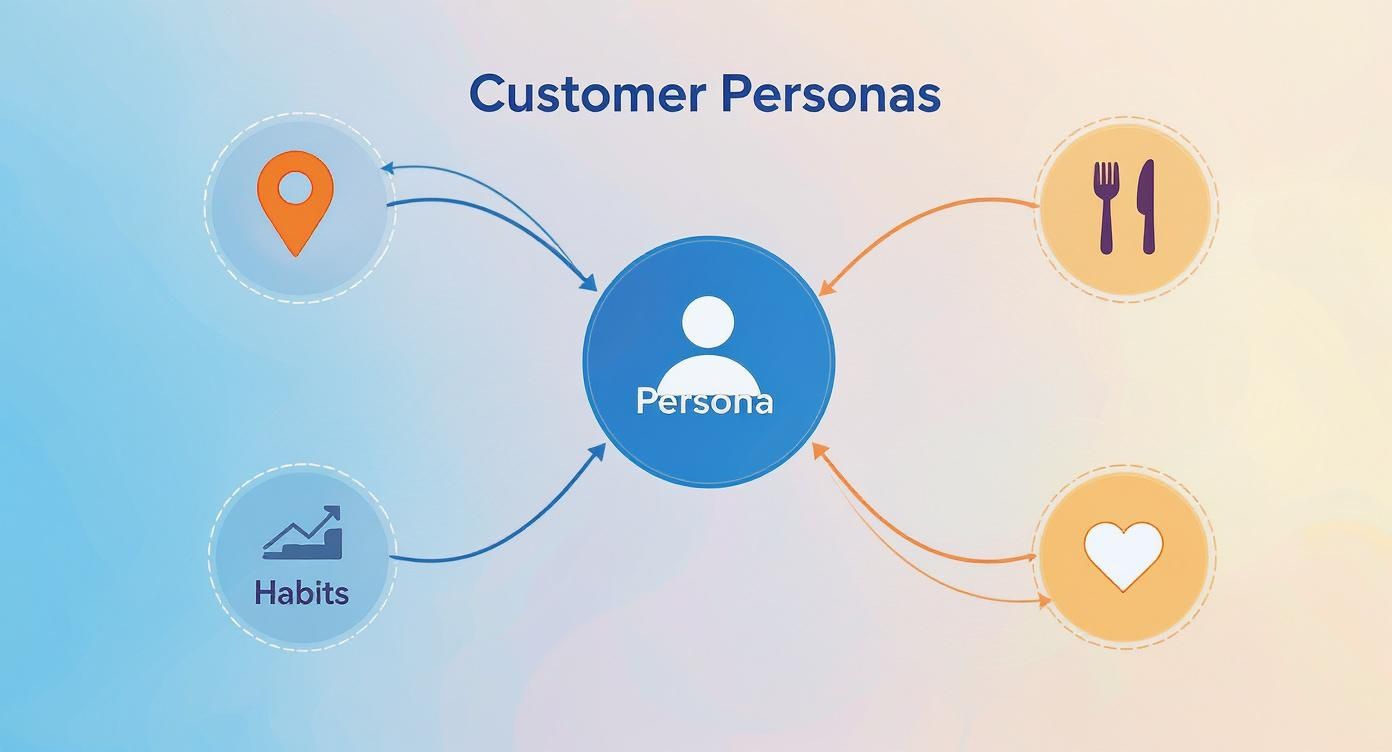
The best way to get this right is by creating customer personas. Think of these as detailed, semi-fictional profiles of your ideal guests, built from real data and gut instinct. A good persona brings your target customer to life, giving them a name, a backstory, and clear motivations.
To really nail this, you will need to dig in. Luckily, there are plenty of strategies for identifying your target audience that can guide you through the process. Start by thinking about a few distinct types of customers you see all the time.
For instance, a modern farm-to-table restaurant might develop personas like these:
- “Foodie” Felicia: She is 32, works in a creative field, and religiously follows local food bloggers. She gets excited about unique flavor combinations, where ingredients are sourced, and a great story behind the dish. Felicia is the one booking a reservation for a special occasion and posting the whole experience on Instagram.
- “Corporate” Chris: He is 45 and a business executive who needs a sophisticated but efficient spot for client lunches. He values privacy, flawless service, and a menu that can handle different dietary needs without a fuss. He isn’t big on social media, but he heavily relies on word-of-mouth recommendations from his peers.
With personas like these, you can tailor everything, from your menu descriptions to your social media content, ensuring your message always hits the mark.
How to Gather Customer Insights
Creating accurate personas requires real data, not just guesswork. The good news? You are probably sitting on a goldmine of information already.
Start by digging into your POS data. What are your top-selling dishes at different times of the day? Do you see a spike in large-party reservations on the weekends? Those patterns tell a story.
Next, you have to engage directly with your guests. A few simple tools can give you incredible insights:
- Short Surveys: Toss a QR code on your receipts that links to a quick online survey. Ask simple questions like, “What brought you in today?” or “What’s one thing we could do better?”
- Social Media Listening: Pay close attention to who is tagging your restaurant and what they are saying. Their profiles and comments are a direct window into their interests and lifestyle.
- Reservation Notes: This is a simple but powerful one. Train your staff to add small notes to reservation profiles. Details like “celebrating an anniversary” or “always orders the vegan pasta” help build a much richer picture over time.
Understanding your customers is the foundation for building loyalty. A 2018 Accenture report found that 91% of consumers were more likely to buy from brands that recognize and remember them.
By defining these personas, you can focus your efforts and your budget on attracting the right people. This knowledge doesn’t just sharpen your marketing; it can inform everything from menu development and service style to the very ambiance of your restaurant. That is how you turn first-time visitors into loyal fans.
For those ready to go deeper, our guide on strategies to increase repeat business is packed with actionable tips for fostering that kind of loyalty.
Choosing Your Most Effective Marketing Channels
Once you know who you are and who you are serving, the next question is obvious: where do you find them? The honest answer is you cannot be everywhere. Spreading yourself too thin is a fast track to burnout and wasted ad spend.
The real goal is to pick a few key channels where your ideal guests actually hang out and then show up consistently and well. Whether someone finds you through a Google search, a friend’s recommendation, or a local food blogger’s feed, the experience needs to feel like it is coming from the same place.
The game has changed for restaurants. McKinsey reports that the food-delivery market has more than tripled since 2017, a shift that highlights just how dramatically consumer behavior has moved toward digital ordering. This isn’t a small change; it is a fundamental rewiring of how people interact with restaurants. Younger diners are leading the charge; data from Restroworks shows that 84% of Gen Z say they would prefer to use an app when ordering food. That tells you a strong digital game is no longer optional.
Master Your Digital Front Door
Before a guest ever walks through your actual door, they will walk through your digital one. Your website and your Google Business Profile are the two most important pieces of real estate you own online. Get them right, and everything else gets easier.
A mobile-friendly website is table stakes. It has to load fast, be dead simple to navigate, and put your menu, hours, and location front and center. If you offer online ordering or reservations, those buttons should be the easiest things to find on the page.
Just as critical is your Google Business Profile (GBP). This free tool is what lands you on Google Maps and helps you show up in those “near me” searches. A well-managed profile includes:
- Spot-on Info: Triple-check your address, phone number, and hours. Nothing kills trust faster than showing up to a closed restaurant.
- Great Photos: Show off your best dishes, the vibe of your dining room, and your team. People eat with their eyes first.
- Fresh Reviews: Actively ask happy guests to leave reviews and make it a habit to respond to all feedback: the good, the bad, and the in-between.
The Power of Social Proof and Community
Social media is not just for posting pretty food pics. It is where you build your community. Platforms like Instagram, Facebook, and even TikTok are your stage for telling your story and talking directly with your guests.
The trick is to pick one or two platforms that actually fit your brand and your customers, not just the ones that are trending. Are you a high-end tasting menu spot? Instagram is probably your best bet. A rowdy sports bar? Facebook and TikTok might be a better fit.
Do not just broadcast your specials. Use social media to start a conversation. Ask questions, run polls, and share behind-the-scenes moments that show the real people behind the food.
The best marketing does not come from you, it comes from your guests. When a customer posts a photo of their meal and tags your restaurant, that is modern-day word-of-mouth, and it is gold. Encourage it. Create photo-worthy moments and re-share guest posts. It is free, authentic, and powerful.
Nurture Loyalty With Email Marketing
If social media is for finding new friends, email is for keeping your regulars close. An email list is an asset you own. You are not at the mercy of an algorithm; you have a direct line to your biggest fans.
You can build your list through your reservation system, online ordering platform, or a simple sign-up on your website. Use it to share exclusive offers, announce menu changes, or invite your best customers to special events. A well-timed email can turn a first-time visitor into a lifelong regular.
To help you decide where to focus your energy, here is a quick breakdown of the most common channels.
Key Restaurant Marketing Channels at a Glance
Choosing the right marketing channels can feel overwhelming. This table breaks down the most popular options to help you decide where to invest your time and money based on your specific goals.
| Channel | Primary Use Case | Key Performance Indicator (KPI) |
|---|---|---|
| Website | The digital hub for your brand, menu, online ordering, and reservations. | Website Traffic, Bounce Rate, Online Orders, and Reservations. |
| Google Business Profile | Local search visibility, attracting “near me” traffic, and managing online reputation. | Profile Views, Clicks to Call/Website, and Review Ratings. |
| Social Media | Building community, brand storytelling, engaging with guests, and driving awareness. | Engagement Rate (Likes, Comments, Shares), and Follower Growth. |
| Email Marketing | Nurturing loyalty, promoting specials, and driving repeat business from regulars. | Open Rate, Click-Through Rate, and Conversion Rate. |
| Paid Ads (Social/SEM) | Reaching new, targeted audiences quickly and promoting specific events or offers. | Cost Per Click (CPC), Return on Ad Spend (ROAS), and Conversions. |
| Influencer Marketing | Tapping into trusted voices to build credibility and reach new demographics. | Reach, Engagement, Referral Traffic, and Branded Hashtag Usage. |
| Online Reviews | Building social proof and trust, gathering direct customer feedback. | Average Star Rating, Number of Reviews, and Review Sentiment. |
Picking the right channels isn’t about being on every platform; it’s about being on the right ones for your restaurant. Start with one or two, master them, and then expand thoughtfully. This integrated approach ensures your marketing efforts work together, creating a system that brings new guests in the door and keeps your regulars coming back.
Setting a Realistic Budget and Calendar
A brilliant plan is just a theory without the resources and a timeline to make it real. This is where your marketing plan gets its hands dirty. It is time to talk about money and time, the two things every operator wishes they had more of.
Setting a budget and building a calendar is what turns your strategy from a document into a day-to-day action plan.
This process isn’t about restricting your creativity; it’s about channeling it. A clear budget forces you to spend smart, while a well-planned calendar helps you stay consistent, jump on opportunities, and avoid those last-minute marketing scrambles that never seem to pan out.
How to Build Your Marketing Budget
There is no magic number here, but there are a few proven ways to land on a realistic figure. For most established restaurants, a solid benchmark is to allocate three to six percent of total revenue to marketing.
New restaurants, on the other hand, often need to invest more heavily to build that initial buzz and get their name out there, sometimes closer to 10%.
Here are two common approaches to setting your number:
- Percentage of Sales: This is the most straightforward method. You just dedicate a fixed percentage of your past or projected sales to marketing. It is simple to calculate and scales up or down with your business.
- Goal-Oriented Budgeting: This approach is more strategic. You start with your SMART goals (like “increase weekday lunch sales by 15%”) and work backward to figure out what it will cost to get there. This ties every dollar directly to a specific outcome.
Whichever way you go, remember that marketing is an investment, not just an expense. Knowing your numbers is everything, and using a restaurant profit margin calculator can give you a clear picture of how your marketing spend fits into your overall financial health.
Do not lock your budget in stone. Think of it as a flexible guide. If you see incredible results from a specific Facebook ad campaign, be ready to shift more funds in that direction to ride the momentum.
A Sample Budget Breakdown
Once you have your total number, the next step is to carve it up. Where you put your money depends entirely on the channels you chose in the last section. A small, independent spot with a tight budget is going to focus on low-cost, high-impact activities.
Here is what a sample $1,650 monthly budget could look like:
- Social Media Ads ($600): Highly targeted ads on Facebook and Instagram to push things like a new brunch menu or upcoming holiday specials.
- Email Marketing Platform ($50): A subscription to a tool like Mailchimp to keep your list of regulars engaged. Pricing can vary widely depending on the platform you choose and the size of your email list. Many tools offer free plans with limitations, while paid tiers increase as your list grows. It’s important to leave room in your budget for this in case your subscriber base expands or your needs go beyond the free tier.
- Local SEO & Website ($200): A small retainer for an expert to keep your Google Business Profile humming or make essential website updates.
- Content & Photography ($300): Hiring a local photographer for one session a month to get those drool-worthy images for your website and social feeds.
- Community Events & Partnerships ($300): Sponsoring a local little league team or providing food for a neighborhood charity event.
- Contingency Fund ($200): Money set aside for unexpected opportunities, like a last-minute ad in a local publication or a collab with an influencer.
Every restaurant is different, and this breakdown is only meant to be a starting point. Your actual budget should reflect your size, goals, and resources. If you don’t have the full amount available, the strategy still works , you simply scale each line item to match what you can realistically invest.
Building Your Annual Marketing Calendar
Your marketing calendar is your game plan, plotting out your campaigns, promos, and content themes week by week, month by month. This proactive approach ensures you are always ahead of the curve, not playing catch-up.
Start by mapping out the entire year, plugging in the big-ticket items first.
- Major Holidays: Valentine’s Day, Mother’s Day, and New Year’s Eve.
- Local Events: City-wide festivals, marathons, and major concerts happening nearby.
- Seasonal Opportunities: Patio season, pumpkin spice everything, and cozy winter specials.
Once the big rocks are in place, you can fill in the gaps with your own restaurant-specific promotions. This could be your restaurant’s anniversary, a monthly trivia night, or a quarterly chef’s tasting menu.
This detailed calendar is the final piece that connects your goals and budget to consistent, real-world action.
Measuring What Matters and Adapting Your Plan
You have built the strategy, set the budget, and rolled out the calendar. But a restaurant marketing plan is not a “set it and forget it” document. The final, and arguably most critical, piece of the puzzle is knowing what is actually working.
This is where you trade assumptions for answers and let data guide your next move. Think of your marketing efforts as experiments. Some will be runaway successes, while others might fall flat. Without measuring performance, you are just guessing. Tracking the right metrics allows you to double down on what drives results and stop wasting money on what doesn’t.
Demystifying Your Marketing Metrics
The world of marketing analytics can feel intimidating, filled with acronyms and dashboards. But do not get overwhelmed. The good news is you only need to focus on a handful of key performance indicators (KPIs) that directly impact your restaurant’s bottom line. These are the numbers that tell you if your efforts are translating into more reservations, orders, and guests.
Start with the free, powerful tools you likely already have. Your website’s Google Analytics can show you where your traffic is coming from, which pages are most popular, and how many visitors are clicking your “Reserve Now” button. Similarly, the built-in insights on platforms like Instagram and Facebook reveal which posts get the most engagement and who your audience is.
Here are a few essential metrics every restaurant should track:
- Website Traffic and Conversions: How many people visit your site? More importantly, what percentage of them complete a desired action, like making a reservation or placing an online order? This is your conversion rate.
- Social Media Engagement: Look beyond follower count. Are people liking, commenting on, and sharing your posts? High engagement means your content is resonating with your community.
- Email Campaign Performance: Track your open rate (who is opening your emails) and click-through rate (who is clicking the links inside). This tells you how effective your subject lines and offers are.
- Customer Acquisition Cost (CAC): This one is simple but powerful. If you spend $500 on a social media ad campaign and get 50 new customers from it, your CAC is $10 per customer.
- Return on Ad Spend (ROAS): For every dollar you put into paid ads, how much revenue do you get back? A 4:1 ROAS means you are making $4 for every $1 spent, a clear winner.
For a deeper dive into what to measure, our guide on the top restaurant KPIs every manager should track is an excellent resource.
From Data to Decisions
Gathering data is only the first step. The real value comes from using those insights to make smart, timely adjustments to your marketing plan. This is what it means to have a living, breathing strategy that evolves with your business and your customers.
A marketing plan is a hypothesis. The data you collect is the experiment that proves or disproves it. Do not be afraid to be wrong; be afraid to stay wrong.
Creating a Rhythm of Review and Refinement
To make this practical, build a simple review process into your routine. You do not need to get lost in spreadsheets every single day. A structured approach keeps you informed without feeling overwhelmed.
Here is a simple schedule you can adapt:
- Weekly Check-in (One hour): A quick glance at your social media engagement, website traffic, and any active ad campaigns. Are there any unusual spikes or dips? This is about spotting immediate issues or opportunities.
- Monthly Review (Two Hours): This is a more thorough look. Pull a report on your key KPIs for the month. How did you perform against your goals? What was your most successful social media post? Did your email newsletter drive reservations?
- Quarterly Overhaul (Half a Day): Zoom out and look at the bigger picture. Based on the last three months of data, what needs to change? This is when you might decide to reallocate your budget, experiment with a new marketing channel, or retire a campaign that is underperforming.
By regularly measuring what matters and adapting your plan, you transform your marketing from an expense into a powerful engine for growth. This continuous loop of action, measurement, and refinement is what separates the restaurants that just survive from the ones that truly thrive.
Your Questions, Answered
Navigating the world of restaurant marketing brings up a lot of questions. We get it. Here are a few of the most common ones we hear from operators, with straightforward answers to help you build and execute your plan with confidence.
How much should a restaurant spend on marketing?
There is no magic number here, but a solid rule of thumb is to set aside three to six percent of your total revenue for marketing. This gives you a steady, predictable budget for the consistent stuff, social media ads, email marketing, and local promotions that keep you top-of-mind.
Now, if you are a brand-new spot, you will need to make a bigger splash. Plan on investing more heavily right out of the gate, maybe 10% to 20% in your first year, just to build that initial awareness from scratch.
The most important thing? Treat marketing as an investment, not an expense. Start with a number you are comfortable with, track what is actually bringing people through the door, and then double down on what works.
What is the best marketing for a small restaurant?
For a small, independent restaurant, the game is won hyper-locally and digitally. You are looking for cost-effective tactics that punch way above their weight.
Your first move, before anything else, is to claim and completely trick out your Google Business Profile. It is free, it is powerful, and it is nonnegotiable for showing up when someone nearby searches for “restaurants near me.”
Beyond that, here are a few high-impact plays:
- Go All-In on Online Reviews: Actively, shamelessly ask your happy customers to leave you reviews on Google, Yelp, and TripAdvisor. Positive reviews are the digital equivalent of word-of-mouth, and they build massive trust.
- Master One Social Platform: Do not spread yourself thin trying to be everywhere. Pick the one or two channels where your ideal guests hang out and go deep. Consistent, genuine engagement on one platform beats mediocre content on five.
- Run Hyper-Targeted Local Ads: You can run incredibly effective ads on Facebook and Instagram that target people within a few miles of your front door, sometimes for just a few bucks a day.
- Build Your Email List from Day One: Start collecting email addresses from the moment you open. That list is gold. It’s a direct line to your most loyal customers that no algorithm can mess with.
For a small restaurant, the goal is to own your neighborhood. A focused, local strategy will always outperform a scattered approach that tries to be everything to everyone.
How often should I update my marketing plan?
Your restaurant marketing plan should be a living, breathing document, not something you write once and shove in a drawer. The market changes, new competitors pop up, and guest habits shift. Your strategy has to keep up.
A good rhythm is to review your plan quarterly. These are your tactical check-ins. Are your social ads hitting their mark? Is that email newsletter actually driving reservations? This is your chance to fine-tune things in real time.
Then, once a year, do a more comprehensive overhaul. This is when you set big new goals for the year ahead, reassess your overall budget, and decide if any new trends or channels are worth jumping on. A proactive approach is what keeps your strategy sharp and effective.
Ready to stop guessing and start running a smarter, more profitable restaurant? MAJC is the community-driven platform built by operators, for operators. Gain access to expert-led training, practical tools, and a peer network dedicated to helping you hire better, retain longer, and build a thriving business. Join the MAJC community today.