


How to Calculate Labor Cost Percentage starts with a simple formula: divide your total labor costs by your total revenue for a set period, then multiply by 100. That number is your labor cost percentage, but knowing how to interpret it is where the real insight comes in.
Understanding Labor Cost Percentage
Your labor cost percentage reveals how much of every dollar earned goes toward paying your team. For restaurants, retail shops, and other service-driven businesses, this metric is a direct indicator of operational health. When the percentage is balanced, your business is sustainable. When it climbs too high, it’s a warning sign that staffing, pricing, or efficiency may be out of sync.
Tracking this number consistently turns a simple calculation into a powerful management tool.
Why This Metric Is So Important
Monitoring your labor cost percentage helps you make smarter decisions across your operation:
-
Financial Health: It’s a core KPI tied to both profitability and efficiency.
-
Better Decision-Making: It guides staffing adjustments, pricing updates, and operational improvements.
-
Performance Benchmarking: It shows how you compare to industry averages — and to your own past performance.
For example, if your restaurant spent $80,000 on labor and generated $200,000 in revenue, your labor cost percentage would be 40%. But calculating this number correctly requires more than hourly wages.
Here’s what you need to include for an accurate total.
Key Components of Your Labor Cost Calculation
This table is a quick reference guide to the essential inputs for an accurate labor cost percentage. Don’t leave anything out!
| Component | What It Includes | Example |
|---|---|---|
| Direct Wages & Salaries | Hourly wages, manager salaries, bonuses, and commissions. | An employee earns $18/hour, and a manager is on a $60,000 annual salary. |
| Payroll Taxes | Your share of FICA (Social Security & Medicare), federal and state unemployment taxes (FUTA/SUTA). | Employer contributions for FICA include 6.2% for Social Security and 1.45% for Medicare. |
| Benefits & Insurance | Health insurance premiums, workers’ compensation, and retirement plan contributions (like a 401k match). | You contribute $200 per month toward an employee’s health insurance plan. |
| Overtime Pay | Any wages paid at a premium rate (typically 1.5x the regular hourly rate). | A cook works 45 hours in a week; five of those hours are paid at the overtime rate. |
Nailing these components is the difference between a rough estimate and a number you can actually run your business on.
This single metric connects your team’s performance directly to your bottom line. When you see the percentage change, you can immediately investigate whether it’s due to sales fluctuations, scheduling inefficiencies, or rising wage pressures. Ultimately, mastering this calculation is fundamental for any operator. It’s one of the most vital metrics you can track to ensure your business remains profitable and competitive. For a deeper look into similar metrics, check out our guide on the top restaurant KPIs every manager should track.
By consistently measuring and analyzing this figure, you gain the insight needed to steer your business toward sustained success.
Finding Every Component of Your True Labor Cost
If you want an accurate labor cost percentage, you have to look beyond the number on an employee’s paycheck. It’s a classic mistake: operators use gross hourly wages and call it a day, but that paints a dangerously incomplete picture of their financial health.
Your true labor cost is the sum of every single expense tied to employing your team. Getting this right is the only way to land on a number you can actually trust to make smart business decisions. A good starting point is to calculate your hourly rate for each employee, as that’s the foundation. From there, you start adding all the other associated costs.
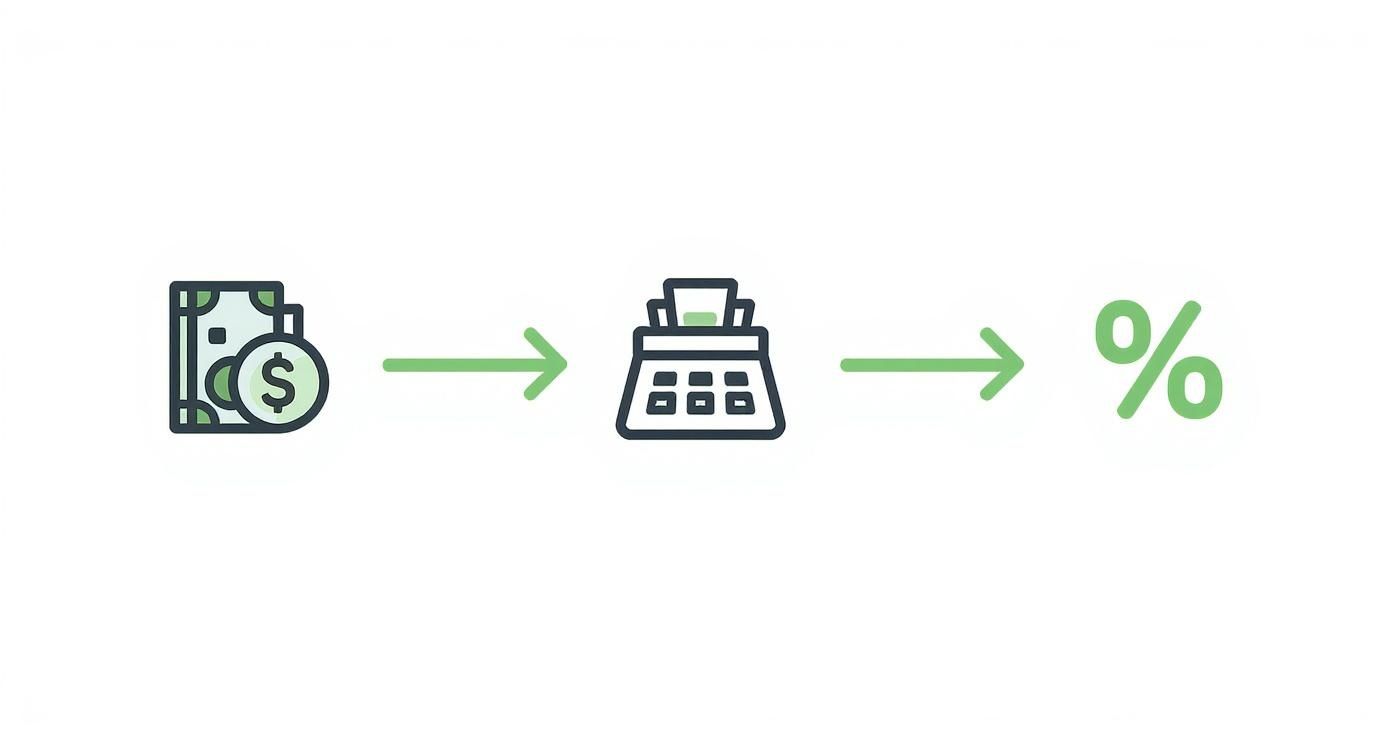
As you can see, getting the percentage itself is easy. The hard part is making sure the numbers you plug in are complete and accurate.
Uncovering Direct Payroll Costs
Direct payroll is the most obvious part of your labor spend, but even this has layers that are easy to miss. This isn’t just base pay; it’s the full amount your team earns.
- Wages and Salaries: This is the straightforward stuff—hourly pay for your front-line staff and fixed salaries for managers.
- Overtime: Any hours worked beyond the standard week get paid at a premium, usually 1.5 times the regular rate. During busy seasons, this can sneak up on you fast.
- Bonuses and Commissions: Performance-based pay, like quarterly manager bonuses or sales commissions, is direct labor expense.
You can usually pull these figures straight from your payroll software reports for whatever period you’re measuring.
Adding Indirect Labor Expenses
These are the “hidden” costs that can seriously inflate your labor spend. They represent your investment in your team’s welfare and your legal obligations as an employer. If you ignore them, your labor cost percentage will be artificially low.
Think of these as the costs of having employees, not just paying for their time.
A common blind spot is overlooking the labor “burden”, all the extra costs beyond the hourly wage. These indirect expenses can easily add another 25% to 40% to your base payroll, completely changing your financial picture.
Key indirect costs to track down include:
- Payroll Taxes: As the employer, you’re on the hook for your share of FICA taxes (Social Security and Medicare), plus federal and state unemployment taxes (FUTA/SUTA).
- Employee Benefits: This is a big one. It covers health, dental, and vision insurance premiums, retirement plan contributions (like a 401(k) match), and life insurance.
- Paid Time Off (PTO): When an employee is on vacation, sick leave, or holiday, you’re paying them for not working. That cost has to be factored in.
- Workers’ Compensation Insurance: This is legally required insurance that protects both your business and your team in case of workplace injuries. The premiums are a direct labor-related cost.
Accounting for Other Staff-Related Costs
Finally, you have all the other miscellaneous costs tied to your staff that might live in different parts of your accounting ledger. For a truly accurate number, you need to hunt these down.
These often-overlooked items can include everything from staff meals and uniform allowances to the cost of training programs and certifications. They might seem small on their own, but they add up.
Don’t forget the cost of churn, either. Constantly replacing and training new staff is a major expense. Figuring out how to reduce staff turnover isn’t just a culture goal; it’s a financial strategy that directly impacts your labor line item.
By pulling data from your payroll system, benefits portal, and accounting software, you can finally build a complete and honest picture of your true labor cost.
Putting the Labor Cost Formula into Practice
Theory is one thing, but running the numbers on your own business is where the real clarity comes from. Let’s move past the abstract formula and walk through a few practical, real-world examples. This is how you’ll build the confidence o calculate labor cost percentage in different scenarios.
We’ll start with a simple weekly calculation for a small business and then tackle a slightly more complex monthly example that includes salaried staff. Each one uses realistic figures and breaks down the math, step-by-step.
A Weekly Calculation for a Coffee Shop
Imagine you run a local coffee shop called “The Daily Grind.” You need to calculate your labor cost percentage for last week to keep a close eye on spending. This helps you react fast if costs are starting to creep up.
First, pull together all the key numbers for the week.
- Total Revenue: Your POS system shows you brought in $8,500 from Monday to Sunday.
- Hourly Wages: Your four baristas worked a total of 150 hours at an average rate of $16 per hour, for a total of $2,400.
- Payroll Taxes: Your payroll provider shows your employer contribution for FICA, FUTA, and SUTA for the week was $210.
- Workers’ Compensation: The weekly premium for your workers’ comp insurance is $40.
- Employee Benefits: You contribute $50 per week towards a health stipend for each employee, totaling $200.
With these figures in hand, you can find your true labor cost.
Remember, every single associated cost needs to be included. Forgetting something as simple as the weekly insurance premium or benefit contribution will give you a misleadingly low number. You might think your operations are more efficient than they actually are, and that’s a dangerous blind spot.
Let’s add it all up:
- Total Labor Cost = $2,400 (Wages) + $210 (Taxes) + $40 (Insurance) + $200 (Benefits) = $2,850
Now you have the two pieces of the puzzle: your total labor cost ($2,850) and your total revenue ($8,500). The final step is simple.
Formula: (Total Labor Cost / Total Revenue) x 100 = Labor Cost Percentage
Calculation: ($2,850 / $8,500) x 100 = 33.5%
That number tells you that for every dollar The Daily Grind earned last week, 33.5 cents went toward labor. This is a pretty healthy figure for a coffee shop. More importantly, you now have a baseline to track against, week after week.
Comparing Departments in a Restaurant
One of the most powerful ways to use this formula is to get more granular. Calculating a single labor cost percentage for your whole business is useful, but breaking it down by department can reveal hidden inefficiencies or opportunities.
Take a restaurant with two distinct teams: Front of House (FOH) and Back of House (BOH).
Let’s say the restaurant’s total weekly revenue is $50,000.
| Metric | Front of House (FOH) | Back of House (BOH) |
|---|---|---|
| Gross Wages | $7,000 | $8,500 |
| Taxes & Benefits | $1,500 | $1,800 |
| Total Labor Cost | $8,500 | $10,300 |
Now, calculate the labor cost percentage for each department against the total revenue.
- FOH Labor Cost %: ($8,500 / $50,000) x 100 = 17%
- BOH Labor Cost %: ($10,300 / $50,000) x 100 = 20.6%
This breakdown immediately shows that the kitchen (BOH) eats up a larger portion of labor costs than the dining room staff (FOH). This isn’t necessarily a problem; in fact, it’s pretty common in full-service restaurants.
The real value here is in tracking these numbers separately over time. It allows the manager to see if one department’s costs are rising faster than the other’s, which might signal an issue with scheduling, overtime, or productivity that needs a closer look.
How Your Labor Cost Stacks Up Against Industry Averages
So, you’ve run the numbers and have your labor cost percentage. Maybe it’s 28%, maybe it’s 35%. But what does that number actually tell you? Is it good? Bad? Somewhere in the middle?
The honest answer: it depends entirely on your industry. Context is everything here.
A number that signals incredible efficiency for a full-service restaurant could be a massive red flag for a retail shop. Knowing where you stand against your peers is the first real step toward setting financial goals that make sense and spotting opportunities to tighten up your operation.
Benchmarks for Food and Beverage
The restaurant world is notoriously labor-intensive, which makes this metric absolutely critical. Next to what you spend on food and drinks, your team is almost always your biggest expense.
- Full-Service Restaurants: These businesses typically see labor costs floating between 30% and 35% of total revenue. When you factor in servers, hosts, bartenders, and a full kitchen crew, those numbers add up fast.
- Quick-Service Restaurants (QSR): Your fast-food and fast-casual spots usually run leaner, with labor costs often landing between 25% and 30%. Their counter-service model and streamlined operations just don’t require as many hands on deck for every dollar that comes in.
See how the business model changes the story? A full-service spot hitting 28% labor might be running an incredibly tight ship. A QSR at that same number could actually be a bit overstaffed. If you want to dig deeper into your restaurant’s financial health, our restaurant profit margin calculator can give you some extra clarity.
What Else Moves the Needle?
Industry is the biggest piece of the puzzle, but other forces can push your labor cost percentage up or down. Your location, for one, plays a massive role. A business in a high-cost city is going to face way more wage pressure than one in a small town.
These trends are also constantly shifting on a global scale. In most major markets, labor costs are trending upward thanks to wage inflation and broader economic changes. For example, in the European Union, the average hourly labor cost recently ticked up by about 5% year-over-year.
Smart Ways to Manage and Reduce Your Labor Costs
Calculating your labor cost percentage is like getting a diagnosis; now it’s time to talk about the cure. Once you have a clear picture of where your money is going, you can start making smart moves to trim those costs, without killing team morale or letting service quality slide.
The goal here isn’t just about slashing hours. It’s about building a smarter, more efficient operation that’s built to last. This means looking past the easy cuts and finding ways to boost productivity, getting everyone pulling in the same direction.
Use Sales Forecasts to Build Smarter Schedules
One of the most powerful tools you have for managing labor is right there in your POS system: historical sales data. Stop scheduling based on gut feelings or last week’s numbers. Use your data to predict busy and slow periods with real accuracy.
A data-driven schedule means you staff up for that Friday night rush you know is coming and run a leaner crew during the predictably dead Tuesday afternoon. This gives you exactly the coverage you need, when you need it. It’s the best way to control costs while preventing a burnt-out, overworked team. If you want to take it a step further, digging into the best restaurant scheduling software can show you tools that automate this whole process.
Build a Flexible Team with Cross-Training
Cross-training is one of the smartest ways to reduce labor costs. When employees can cover multiple roles, you’re not stuck scrambling when someone calls out, your team becomes more adaptable, efficient, and easier to schedule.
A flexible, cross-trained crew helps you:
-
Avoid extra labor by filling gaps without calling in additional staff
-
Handle rushes smoothly when demand spikes
-
Keep operations running even when you’re short-handed
Examples of high-impact cross-training:
-
Front of House: Servers who can bartend or host when needed
-
Back of House: Line cooks who can work multiple stations
-
Retail: Sales associates who can receive inventory or handle merchandising
Cross-training doesn’t just make scheduling easier. It builds stronger teams, boosts morale, and gives employees a clear path for growth, all of which support long-term labor cost control.
Embrace Technology and Automation
Look around your operation for the repetitive, soul-crushing tasks that eat up your team’s time. Automation isn’t about replacing people; it’s about freeing them up to focus on what actually matters, delivering a great customer experience.
Even small automations can make a huge impact. Think about modern POS systems that let guests order and pay at the table, which lets your servers focus on genuine hospitality. Or inventory software that handles reordering automatically, saving your managers hours of administrative work.
Align Incentives with Productivity
Incentives can be a powerful tool for reducing labor costs. When employees are rewarded for efficiency, they start thinking like owners, and that mindset drives better performance across the board.
Effective examples include:
-
Manager bonuses tied to hitting labor targets
-
Team-wide profit-sharing when the business meets monthly goals
The goal is simple: create a system where everyone benefits when the operation runs efficiently. When incentives align with productivity, you improve morale and control labor spend.
Managing labor will always be a balancing act, but smart incentives help you shift from reacting to rising costs to building a more profitable, sustainable, and motivated team.
Answering Your Top Labor Cost Questions
Once you start crunching the numbers, the real-world questions always follow. Let’s tackle some of the most common ones head-on so you can get clear answers and avoid any confusion.
How often should I calculate labor cost percentage?
For any business with fluctuating sales, like restaurants or retail, weekly is the gold standard. Calculating your labor cost percentage every week lets you spot trends as they happen. You can make smart scheduling adjustments before a small issue snowballs into a big problem.
If sales dip unexpectedly on a Wednesday, you’ll see the impact on your labor percentage by Friday, not a month later when it’s too late to do anything about it.
At an absolute minimum, run the numbers monthly as part of your regular financial review. The most important thing is consistency. A regular cadence is what gives you the power to compare performance over time and make smarter, data-backed decisions.
What is the difference between labor cost and prime cost?
This is a critical distinction, especially if you’re in the food and beverage world. Prime cost is a broader metric that bundles your two biggest expenses: your total labor cost and your Cost of Goods Sold (COGS). For a restaurant, COGS is simply the cost of all your food and beverage inventory.
Think of it this way: Labor cost tells you how efficiently you’re managing your people. Prime cost tells you how efficiently you’re managing your core operation, both people and product. A healthy prime cost is often the truest sign of a restaurant’s profitability, typically staying below 60% of total revenue.
So, while labor cost percentage zooms in on your staffing expenses, prime cost gives you a more complete picture of your main operational spending. Both are vital, but they tell slightly different stories about your business’s financial health.
How do I account for salaried employees in my calculation?
Including salaried employees is pretty straightforward once you break down their pay to match your reporting period. You can’t just drop an entire monthly paycheck into a weekly calculation; you have to prorate it.
To get it right, take their annual salary and divide it by the number of pay periods in a year.
- For a weekly calculation, divide their annual salary by 52.
- For a monthly calculation, divide their annual salary by 12.
This gives you their base salary cost for that specific period. But don’t stop there. You also need to add the prorated costs of their benefits, employer-paid payroll taxes, and any bonuses for that same period. Only then will you have their true total labor cost to fold into your formula.
Should overtime pay be calculated differently?
Yes and no. Overtime pay is absolutely part of your total labor cost, but you should track it as a separate line item before rolling it into your final calculation.
Why? Because overtime is often a red flag for scheduling inefficiency or understaffing. By monitoring it separately, you can pinpoint exactly when and why it’s happening.
A sudden spike in overtime can be a warning that you need to adjust schedules, cross-train more staff, or even hire another team member. While the final labor cost percentage includes all wages, keeping a close eye on overtime as its own metric gives you a powerful diagnostic tool. It helps you find the root cause of rising costs, not just see the symptom.
Ready to turn these insights into action? MAJC is a community-driven platform built by operators, for operators, to help you run a smarter, more profitable business. We provide the tools, training, and expert network you need to master your finances, build a stronger team, and achieve sustainable growth. Learn more about MAJC and join our community today.