


Think of food cost percentage as the financial pulse of your kitchen. It is the simple ratio of what your ingredients cost versus the revenue you bring in from selling them. A healthy percentage means a healthy business; a high one can be an early warning sign of trouble.
Why Food Cost Percentage Is a Critical Metric
Think of it like your personal budget. You would not spend 90% of your paycheck on groceries because you still have to pay rent. In the same way, a restaurant cannot survive if the cost of its ingredients eats up too much of its sales.
This one number takes a lot of complicated data and turns it into something you can actually use. It directly impacts your menu pricing, your profitability, and the financial health of your entire operation. Without a firm handle on it, you are basically flying blind.
The Foundation of Profitability
Food cost percentage is one half of your prime cost, the other half being labor. These are the two biggest and most controllable expenses you have. Nailing your food cost is the first step toward building a business that actually lasts.
Getting it right helps you:
- Set Smart Menu Prices: You will know that every dish is actually making you money.
- Spot Operational Issues: It is a red flag for problems like waste, sloppy portioning, or even theft.
- Make Better Purchasing Decisions: You can fine-tune your ordering to stop ingredients from spoiling and find better deals.
- Boost Overall Profit: Even a tiny improvement in your food cost percentage can lead to a significant jump in net profit.
Mastering food cost is not just about saving money on ingredients. It is about optimizing the entire flow of food through your business, from purchasing and prep all the way to the final sale. This metric gives you the clarity you need to make those optimizations happen.
A Benchmark for Success
Knowing your number is one thing. Knowing how it stacks up is another.
Most restaurants aim for a food cost percentage between 28% and 35%. But this is not a hard-and-fast rule. A fine-dining spot using premium, imported ingredients is naturally going to have a higher food cost than a quick-service restaurant built for volume. The key is knowing what is healthy for your specific concept.
Tracking this key performance indicator (KPI) helps you set realistic goals and see if you are moving in the right direction. It is a vital sign telling you whether your kitchen is efficient and your menu is profitable.
While it is just one metric, it provides a powerful lens through which to view your entire financial picture. For a complete view of your restaurant’s financial health, you can also explore our helpful guide and use a restaurant profit margin calculator. This allows you to see how food costs fit into the bigger picture of your profitability.
How to Calculate Your Restaurant’s Food Cost Percentage
Before we jump into the formula, you need to get familiar with one key term: Cost of Goods Sold (COGS). This is simply the total cost of all the ingredients your kitchen actually used during that period. It is not what you bought, it is what came off the shelves and ended up on a plate.
The Standard Formula
To get to your food cost percentage, you have to nail down your COGS first. The formula is refreshingly straightforward and hinges on accurate inventory counts.
Food Cost Percentage = (Cost of Goods Sold / Total Food Sales) x 100
And to find that COGS number, you will use this simple calculation:
- COGS = (Beginning Inventory + Purchases) – Ending Inventory
Let’s break that down so it makes perfect sense.
- Beginning Inventory: This is the dollar value of all the food you have in-house at the start of the period. Think of it as your stock on the morning of January 1.
- Purchases: This is the total cost of all the new ingredients you bought during that time. Just add up your supplier invoices from January 1 to January 31.
- Ending Inventory: This is the value of whatever food you have left at the very end of the period. You will need to do a physical count to find out what is on your shelves on the night of January 31.
Getting your inventory right is everything here. If your counts are off, your food cost will be, too. To get a better handle on this, check out our guide on the inventory days on hand formula.
A Real-World Example
Let’s walk through this with a small cafe calculating its food cost for January.
- Beginning Inventory: The cafe starts the month with $10,000 worth of food in stock.
- Purchases: Throughout January, the owner spends another $8,000 on ingredients.
- Ending Inventory: At the end of the month, a physical inventory count shows $9,000 worth of food is left.
- Total Food Sales: The cafe’s POS system reports $27,000 in food sales for January.
First, let’s calculate the Cost of Goods Sold (COGS):
(Beginning Inventory: $10,000 + Purchases: $8,000) – Ending Inventory: $9,000 = $9,000 (COGS)
Easy enough. Now, we just plug that COGS number into our main formula:
($9,000 COGS / $27,000 Food Sales) x 100 = 33.3%
Boom. The cafe’s food cost percentage for January is 33.3%. That number falls right in the sweet spot for the industry, giving the owner a solid benchmark to track against for the rest of the year.
Calculating Individual Plate Costs
While the big-picture percentage is essential, you also need to get granular and figure out the cost of each dish on your menu. This is your plate cost, and it is the foundation of a profitable menu.
Getting this right means listing every single ingredient in a recipe, down to the pinch of salt and dash of oil, and calculating the exact cost for the portion used in one serving.
Let’s take a simple burger, for example:
- Beef patty (8 oz): $2.50
- Bun: $0.50
- Cheese slice: $0.30
- Lettuce, tomato, onion: $0.45
- House sauce: $0.15
- Total Plate Cost: $3.90
If you sell that burger for $14.00, its individual food cost percentage is:
($3.90 / $14.00) x 100 = 27.8%
Knowing both your overall and per-item food costs is a game-changer. It is what allows you to build a menu that does not just taste good but consistently makes you money.
Why Is My Food Cost So High? A Look at the Hidden Causes
Calculating your food cost percentage is just the starting point. The real insight comes from understanding why that number is high. If it starts creeping above the 28%–35% benchmark, it usually signals an operational issue, not just higher supplier prices.
Think of a high food cost percentage like a check engine light. It’s not the problem itself, but a warning that something behind the scenes is quietly draining your margins.
The Problem with Inconsistent Portioning
One of the most common causes of high food cost is inconsistent portion control.
Small over-portioning feels harmless in the moment, but it adds up fast. Without strict use of scales, scoops, and standardized recipes, costs spiral before the plate even leaves the pass.
For example, if a pasta dish is costed for six ounces but cooks regularly serve seven or eight, that single plate’s food cost jumps 15%–30%. Multiply that by hundreds of covers a week, and your profitability is literally walking out the door.
The Silent Profit Killer: Kitchen Waste
Food waste is one of the most expensive problems restaurants overlook. A global study led by Champions 12.3, which analyzed 114 restaurants across 12 countries, found that for every $1 invested in reducing kitchen food waste, restaurants saved an average of $7. That single figure highlights just how much profit is quietly ending up in the trash.
This waste shows up in a few key areas you need to watch like a hawk:
- Over-prepping: Making too much prep that does not get used and has to be tossed at the end of the night.
- Spoilage: This is a direct result of poor inventory rotation or just buying too much of a perishable item that goes bad before you can sell it.
- Kitchen Errors: A burnt steak, a dropped plate, a misread ticket; each mistake is wasted product and pure loss.
A high food cost percentage often points directly to operational friction. It is not just about the price of tomatoes; it is about how efficiently those tomatoes move from your delivery truck to a customer’s plate. Every misstep along that path adds to your final cost.
Poor Inventory Management
Your walk-in, freezer, and dry storage are essentially shelves of cash. Without a disciplined inventory system, that cash disappears fast. If you don’t clearly know what you have, what’s selling, and what’s about to expire, you’re making purchasing decisions blind.
This is where issues like broken FIFO systems, spoilage, and chronic over-ordering creep in. New product gets stocked in front of old, cash gets tied up in excess inventory, and suddenly you’re out of key items mid-service. Regular, accurate inventory counts are essential if you want real control over your food cost percentage.
The Difficult Topic of Employee Theft
It’s uncomfortable, but theft can quietly inflate food costs. And it’s rarely just about the register. More often, it shows up as unauthorized staff meals, over-pouring drinks, or high-value items leaving the building unnoticed.
These losses, often grouped as shrinkage, increase your Cost of Goods Sold without generating any revenue. The solution isn’t paranoia. It’s clear policies, smart inventory tracking, and a culture where accountability and trust go hand in hand.
Proven Strategies to Control and Reduce Food Costs
Understanding why your food cost is high is the first step. Fixing it requires systems, not shortcuts. This isn’t about lowering quality or chasing cheaper ingredients. It’s about tightening purchasing, portion control, and menu decisions so profit doesn’t leak out of the kitchen.
These aren’t quick fixes. They’re foundational habits that give you long-term control. Let’s break down the strategies that actually work.
Master Your Purchasing and Inventory
High food costs often start the moment an order is placed. Your relationship with suppliers and how you manage stock are your first lines of defense. Smart purchasing is about more than just the lowest price; it is about making strategic calls that protect your margins every single day.
- Negotiate with Suppliers: Do not be afraid to have real conversations with your vendors. Strong relationships can unlock better pricing, bulk deals, or more flexible payment terms. Make it a habit to compare prices from a few different suppliers to keep everyone honest and ensure you are getting a competitive rate.
- Embrace Seasonal Buying: This is a win-win. Aligning your menu with what is in season means you are getting ingredients at their peak freshness and lowest cost. It is a simple move that lowers your expenses while making your food taste better.
- Implement a Strict FIFO System: The First-In, First-Out (FIFO) method has to be nonnegotiable. It is a simple rule: use the older stuff before the new stuff. This alone can drastically cut down on spoilage and waste from expired products. Train your team until it is second nature.
- Conduct Regular Audits: Do not wait for the end-of-the-month inventory count to find out you have a problem. Do weekly or even daily spot-checks on your big-ticket items like proteins and dairy. This helps you catch over-ordering, spoilage, or theft before they do real damage to your food cost.
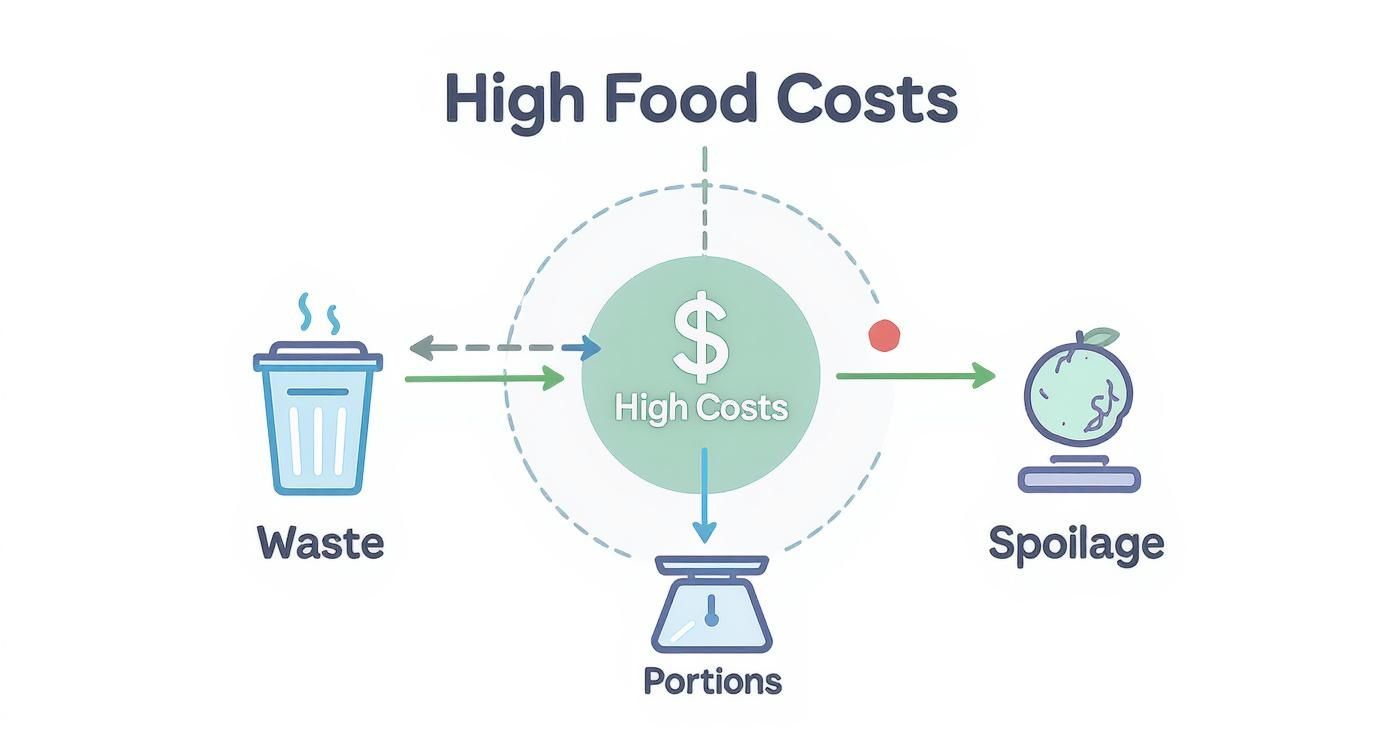
As you can see, waste, spoilage, and portioning are the usual suspects. This is where your profits are most likely to bleed out, making tight operational controls an absolute must.
Perfect Your Portion Control
The fix is precision. Standardized recipes with exact weights and measurements keep costs predictable and the guest experience consistent. Back that up with the right tools—digital scales, portioned scoops, and measured ladles, so your team isn’t guessing on the line. When portion control is built into the workflow, protecting your food cost percentage becomes automatic.
Engineer Your Menu for Maximum Profit
Menu engineering is how you turn it into a profit-generating machine by analyzing what sells best (popularity) and what makes you the most money (profitability). This data lets you make smart moves on pricing, item placement, and promotions.
The classic approach breaks your menu into four categories:
- Stars (High Profitability, High Popularity): These are your champions. Feature them prominently, tell their story, and never let the quality slip.
- Plowhorses (Low Profitability, High Popularity): Everyone loves these, but they do not make you much cash. Look for small tweaks like pricing, portions, or ingredient swaps to improve margins.
- Puzzles (High Profitability, Low Popularity): These are profitable but are not selling. Why? Maybe the name is weird, the description is confusing, or the price scares people off. Try renaming it, training servers to recommend it, or running it as a special.
- Dogs (Low Profitability, Low Popularity): They are not making you money, and nobody is ordering them. Consider removing them to make room for stronger performers.
Using this approach turns your menu into a profit-control tool, helping you lower overall food cost percentage and strengthen margins without sacrificing quality.
Track and Minimize Waste
Finally, you cannot fix what you do not measure. Food waste is a direct shot to your profits, so you have to track it obsessively. For a deeper dive, check out our guide on how to start reducing food waste in your restaurant.
A simple waste tracking sheet in the kitchen is a great place to start. Every time something gets tossed, spoilage, a line cook’s mistake, or a returned dish, it gets logged. The data will quickly show you where the problems are, whether it is over-prepping a certain ingredient or a recurring error on the line.
Using Technology to Manage Food Costs Intelligently
Managing food costs manually leaves too much room for error. Spreadsheets, handwritten counts, and after-the-fact calculations make it hard to stay in control. Today, technology is the most effective way to proactively manage your food cost percentage instead of reacting when margins are already gone.
Modern restaurant tools automate the heavy lifting, giving you real-time visibility into costs and performance. These systems are no longer just for big chains; they are essential for any operator serious about protecting profitability.
Key Technologies for Cost Control
Think of restaurant tech as an ecosystem where every part talks to the others, giving you a complete picture of your operation. Three types of software work together to put you in control:
-
Inventory Management Systems: Track stock in real time, reduce spoilage, and streamline ordering.
-
Recipe Costing Software: Calculate exact plate costs and model margin changes before adjusting menus.
-
POS Systems: Provide accurate sales data to support smarter menu engineering decisions.
The real game-changer is getting these systems to talk to each other. When your POS is integrated with your inventory software, every sale automatically deducts the right ingredients from your stock counts. This gives you a live look at your food cost, not a historical guess. To see how these systems fit into the bigger picture, you can learn more about how to improve restaurant operations with integrated tools.
Moving from Guesswork to Data-Driven Decisions
With the right tech, you can finally stop guessing. Instead of wondering why costs were high last month, you can pinpoint the exact cause, whether it was a spike in produce prices or a specific dish that was consistently over-portioned.
Ultimately, embracing technology empowers you to run a smarter, leaner, and more profitable business. It gives you the visibility and control you need to manage your food cost percentage with confidence.
A Few Common Questions About Food Cost Percentage
This section tackles the most common questions from owners and managers. The goal is to give you quick, straight answers you can put to work with confidence.
What’s the difference between actual and ideal food cost?
This is a big one, and the distinction is critical. Think of it like your personal budget versus what you actually spent last month. One is the plan, the other is reality.
- Ideal Food Cost: This is your “on paper” number. It is what your food cost percentage should be in a perfect world, zero waste, no comps, perfect portions, every single time. You figure this out using your standardized recipes and current ingredient prices.
- Actual Food Cost: This is the real deal. It is the percentage you get after counting your real-world inventory and looking at your actual sales. This number includes all the messy stuff: waste, employee meals, spoilage, theft, and that line cook who is a little heavy-handed with the cheese.
The gap between these two numbers tells a story. A small variance is normal, but a big one is a flashing red light that operational issues are eating your profits. The whole game is getting your actual cost as close to your ideal cost as humanly possible.
How often should I calculate my food cost percentage?
Consistency is everything, but the right rhythm depends on your operation. A monthly calculation is the bare minimum for your P&L, but if you wait that long, you are flying blind for weeks at a time. A problem could fester and do serious damage before you even spot it.
For real control, most operators we talk to calculate their overall food cost weekly. This gives you a much tighter feedback loop. You can spot a sudden spike in chicken prices or notice a new cook is over-portioning and fix it now, not a month from now. For your most expensive items, like prime steaks or fresh seafood, some operators even do daily spot-checks to keep a tight rein on their highest-value inventory.
Should I lump beverage costs in with my food costs?
Short answer: no. Always calculate food and beverage costs separately. Tossing them into the same bucket just muddies the water and makes it impossible to see what is really going on.
Beverages, especially alcohol, have a completely different cost structure and usually run at a much lower percentage than food. For example, a healthy beverage cost might be between 18% and 24%, while your target food cost is likely closer to the 28% to 35% range.
By tracking them as separate line items, you can:
- Price your food and drinks more accurately.
- Pinpoint if a profitability issue is coming from the kitchen or the bar.
- Manage purchasing and inventory for each category way more effectively.
What is a good food cost percentage for my restaurant?
This is the million-dollar question, but there is no single “right” answer. The ideal food cost percentage depends entirely on your concept.
A fine-dining spot using premium, imported ingredients might be perfectly profitable at 35%, while a high-volume pizza joint would go out of business with that number and needs to be closer to 28%. It is all about context.
Instead of chasing some universal number you read online, figure out what is healthy for your business model. Look at your prime costs (food and labor), your overhead, and your profit goals to land on a target that actually makes sense for you. The key is to set a benchmark for your own operation and then track your performance against it religiously.
Running a profitable restaurant is about more than great food; it is about smart systems and a supportive community. At MAJC✨, we provide hospitality operators with the tools, expert-led training, and peer network needed to hire better, retain longer, and run smarter. Learn how MAJC can help you build a more sustainable and successful business today.