

Delegation is not just about handing off tasks you do not want to do. It is about empowering the right people with clear expectations, the right tools, and the trust to execute. When done well, delegation shifts you from doing the work yourself to leading the work, freeing your time while building your team’s capabilities.
Why does this matter? Because many hospitality leaders get stuck in the daily grind. Between scheduling issues, inventory counts, and guest problems, managers often spend their days reacting instead of leading. The result is burnout, stalled growth, and a team that relies too heavily on one person.
How to delegate tasks effectively means making a deliberate shift from doer to leader. Instead of thinking, “It’s faster if I just do it myself,” you invest time in training and ownership. That investment pays off quickly, creating a stronger, more confident team and an operation that doesn’t depend on you for every decision.
To help frame this, let’s look at the core components of what makes delegation work. This is not just theory; these are the foundational pillars you will build your system on.
The Four Pillars of Effective Delegation
| Pillar | Core Principle | Why It Matters for Hospitality |
|---|---|---|
| Clarity | Everyone knows exactly what success looks like. No ambiguity. | In a busy service, unclear instructions lead to mistakes, wasted product, and inconsistent guest experiences. |
| Trust | You genuinely believe in your team’s ability to execute without micromanagement. | Trust builds confidence and ownership. A trusted team member is more likely to take initiative and solve problems on their own. |
| Resources | The team has the tools, training, and authority needed to complete the task. | Asking someone to do a job without the right tools is setting them up to fail. This could be anything from proper equipment to access to sales data. |
| Accountability | There is a clear understanding of who is responsible for the outcome. | Accountability closes the loop. It ensures tasks do not fall through the cracks and creates a culture where results matter. |
With these pillars in mind, the impact becomes much easier to see and measure.
The Measurable Impact of Delegation
This is not just some feel-good management theory; the impact on the bottom line is real and significant. Research on CEO performance uncovered a powerful link between delegation and business growth. A Gallup study found that CEOs with high “delegator” talent achieved an average three-year growth rate of 1,751%.
Empowering your team through delegation does not just boost productivity; it has a massive effect on job satisfaction and loyalty. When your people feel trusted and see opportunities to learn new skills, they are far more likely to stick around.
To learn more about this crucial connection, check out our guide on how to improve employee retention.
Deciding What to Delegate and What to Keep
This is not about randomly throwing tasks at your team to clear your own to-do list. It’s about a strategic look at where your time actually moves the needle, freeing you up for the big-picture work while giving your team real responsibility.
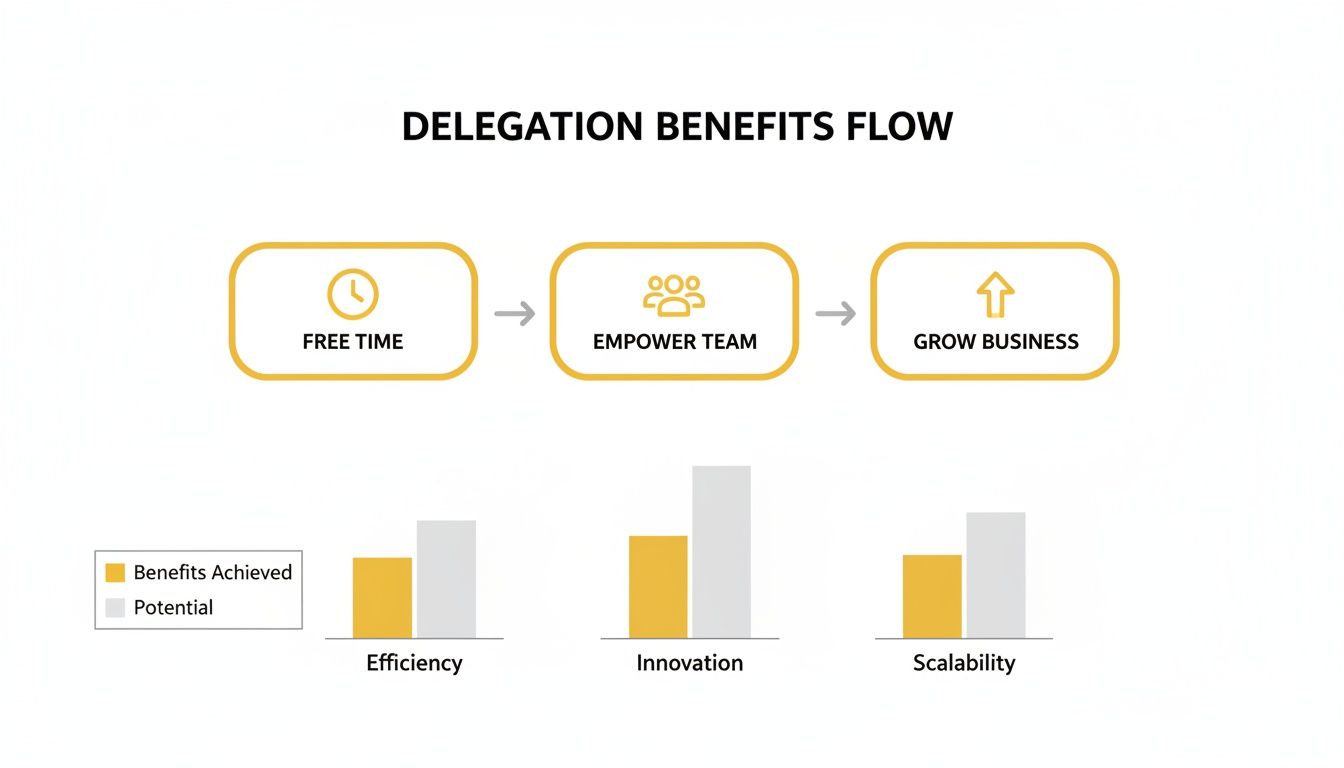
When you get this right, the benefits compound quickly.
Using the Impact vs Effort Matrix
A simple but powerful tool to bring clarity to this is the Impact vs. Effort Matrix. It’s a basic quadrant that forces you to analyze your tasks by asking two blunt questions: How much effort does this take? And what impact does it actually have on the business?
Plotting your tasks on this grid removes the emotion and guesswork. It gives you a clear roadmap for what to do yourself, what to hand off, and what to stop doing altogether. Let’s walk through each quadrant with some real-world examples from the floor.
High Impact, Low Effort (Delegate These First)
These are your Quick Wins. They deliver a ton of value without a massive time suck, which makes them the perfect tasks to delegate first. Handing these off gives a team member a chance to make a visible impact and build their confidence fast.
- Example one: Responding to positive online reviews. This is a huge part of guest relations but can be handled beautifully by a trusted host or front-of-house leader who has the right guidelines.
- Example two: Supporting social media content creation. That bartender who’s always taking great photos of cocktails? Ask them to collect photos, short videos, or content ideas, while management or a marketing partner handles scheduling and approvals.
High Impact, High Effort (Keep and Focus on These)
These are your Strategic Projects. They’re the big moves that only you can make, the ones that require your vision, your relationships, and your authority. This is where your time should be concentrated.
- Example one: R&D for the new seasonal menu with your executive chef. This touches everything: costing, sourcing, training, and marketing. These are high-level decisions.
- Example two: Negotiating a new contract with your primary food supplier. Your leadership is what secures the terms that protect your margins for the next year.
The entire goal of delegation is to free up your time to live in this quadrant. Every task you successfully offload from the other three boxes buys you more bandwidth for these game-changers.
Low Impact, Low Effort (Delegate and Systematize)
Think of these as your Routine Tasks. They have to get done for the restaurant to run smoothly, but they do not require your direct oversight. These are prime candidates for delegation, often to junior staff who are eager to learn and take ownership.
The trick here is to build a rock-solid system, a checklist, a template, a clear process, so the task gets done the right way, every time, without you.
- Example one: Daily linen inventory. It’s essential, but it’s a simple count-and-record task that follows a repeatable process.
- Example two: Placing the weekly produce order based on established pars. Once the system is built, a line cook can easily take over management.
Low Impact, High Effort (Eliminate or Automate)
These are the Time Wasters. They eat up hours of your week with almost nothing to show for it. Before you even think about delegating these, ask a harder question: “Why are we even doing this at all?”
If a task is truly necessary, find a way to automate it or simplify it dramatically. Don’t just hand a broken process to someone else.
- Example one: Manually pulling POS data to build a complex daily sales report that nobody ever reads. Find an automated report in your POS that delivers the headline numbers you actually need.
- Example two: Spending hours cross-checking paper invoices against receiving logs. Modern inventory software can digitize and automate most of this grunt work.
Matching the Right Task to the Right Person
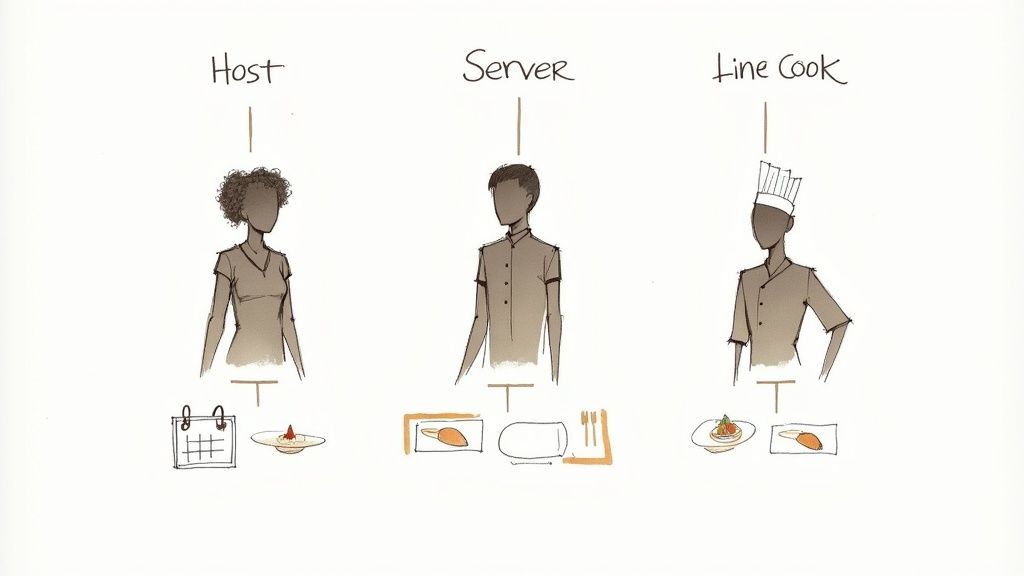
Great delegation isn’t about job titles; it’s about understanding your people and spotting strengths that don’t always show up on the schedule.
When the right task goes to the right person, delegation becomes a development tool. The work gets done better, and your team feels more engaged and invested.
Look Beyond the Obvious
The easiest choice isn’t always the smartest. Handing every extra task to the same “reliable” employee leads to burnout and limits growth across the team.
Instead, start watching your team with fresh eyes.
- Who is always tidying the dry storage shelves without being asked?
- Which line cook has a natural talent for plating?
- Is there a host who seems genuinely curious about the reservation system’s analytics?
These are clues. They point to untapped potential that goes way beyond a job description. Your job is to spot these sparks and give them some oxygen.
Have Proactive Conversations
You don’t need a formal career plan to get this right. Use one-on-ones to ask a few direct questions:
- “What part of your job are you enjoying the most right now?”
- “Is there a skill you have seen someone else use that you would like to learn?”
- “If you could take on a new project here, what would get you excited?”
When you align tasks with someone’s strengths and interests, delegation stops feeling like extra work and starts building trust, capability, and loyalty. You’re not just offloading tasks, you’re developing future leaders.
The Art of a Successful Handoff
A clumsy or incomplete handoff is a recipe for disaster. It creates confusion, kills confidence, and almost guarantees the task will boomerang right back to you.
A great handoff is not a command; it is a conversation. It’s about building a shared understanding of what success looks like and turning a simple task assignment into a collaborative agreement. This is how you set your team up to take real ownership.
The Five Ws of Delegation: Your Handoff Framework
To make every handoff crystal clear and truly empowering, you can use a simple framework called the Five Ws of Delegation. This structure forces you to cover all the bases, leaving zero room for guesswork.
- Who has ownership? Start by explicitly stating they are the new owner. It’s not just about doing the work; it is about being responsible for the final outcome.
- What does success look like? Get ridiculously specific. Use numbers, deadlines, and quality standards so they know exactly what the finish line is. Do not leave “done” up for interpretation.
- When is it due? Provide a firm deadline and any smaller milestones or check-in points along the way. This helps them manage their time and lets you track progress without micromanaging.
- Where are the resources? Point them to everything they need. This could be tools, templates, contact info for other team members, or key documents. Your best bet is to reference your operational playbook. You can learn more about how to create Standard Operating Procedures in our guide.
- Why does this matter? This is the most important W and the one most managers skip. Explain how this task connects to the bigger picture. When people understand the “why,” they are more engaged, they make smarter decisions on their own, and they’re way more motivated to crush it.
Putting the Five Ws into Action
Let’s make this real. Imagine you’re a General Manager handing off the end-of-night closing duties to a newly promoted shift lead, Alex.
Instead of a quick, “Hey Alex, you are on closing duty now,” you pull him aside for a structured conversation.
The Handoff Script
You: “Alex, thanks for chatting. I’m officially handing over ownership of the nightly close to you. (Who) I picked you for this because I’ve seen how detail-oriented you are, and I know you’re ready for the responsibility. (Why) Getting this right is absolutely critical; it keeps us secure, sets up the morning team for a smooth service, and ensures our labor numbers are spot on.”
You: “Success here means three things every single night: the cash deposit matches the POS report to the penny, the entire closing checklist is completed and signed, and the closing email is sent to me and the owners by midnight. (What)“
You: “The hard deadline for that final email is midnight. For the first two weeks, let’s also do a quick five-minute check-in around 10:00 p.m. so I can answer any questions before the final push. (When)“
You: “Everything you need is in the manager’s office. The closing checklist is on the clipboard, the safe codes are in the sealed envelope I gave you, and the closing email template is saved on the desktop. The alarm company’s number is posted by the back door, just in case. (Where)“
This clarity is empowering. Alex walks away not with a new chore, but with a clear mission. He knows exactly what to do, why it’s important, and that you trust him to nail it.
How to Stay Accountable Without Micromanaging
Once you hand off a task, the real leadership begins. It is the tightrope walk between staying in the loop and becoming a micromanager. Finding that balance is tough, but it is where trust gets built, and your team starts to operate with real autonomy. The goal is a system of accountability that empowers, not suffocates.
This isn’t about looking over their shoulder; it is about agreeing on how you’ll both stay connected to the result. Get this right, and you build confidence, foster independence, and create a team that can solve problems on its own.
Focus on Outcomes, Not Methods
The single biggest shift you can make is to manage the result, not the process. You delegated the task to a specific person for a reason; you trust their skills. Now, you have to let them use those skills.
Dictating every single step of how something gets done is the definition of micromanagement. It screams, “I do not trust you,” and kills any chance for creativity or growth. Instead, pour your energy into the final, measurable outcome you both agreed on.
This outcome-oriented approach gives your team the freedom to find the most efficient way to get things done. Often, they’ll discover a better process you had not even considered.
Implement Lightweight Checkpoints
Staying out of the weeds does not mean disappearing. Real accountability needs structure, which you can build with simple, consistent checkpoints. These are not surprise “gotcha” moments; they are pre-planned touchpoints that keep everyone aligned.
The key is to make them brief, purposeful, and part of the daily flow.
- Daily Huddles: A quick, five-minute stand-up at the start of a shift is perfect. “Hey, Sarah, how’s the prep for that new cocktail batch coming along?” is all it takes to stay in the loop without hovering.
- Shared Project Trackers: For bigger projects, a shared digital tool is your best friend. It lets you see progress in real-time without constantly asking, “Where are we on this?” When you are managing sensitive projects, it is critical to think about choosing a secure task manager that fits your team’s needs.
- End-of-Day Recaps: A simple one-line email or message at the close of business can provide the update you need without a formal meeting. “Inventory spreadsheet is updated and saved” is a perfect example.
These methods respect your employees’ time and ownership while giving you the visibility to feel confident.
Accountability is not about control; it is about clarity. When you set up clear, predictable checkpoints, you remove anxiety for both you and your team member. They know when and how to report in, and you know you will get the information you need.
Standardize Expectations in Writing
Clear, written standards are one of the simplest ways to ensure consistency without hovering. Documented procedures set a shared definition of what “good” looks like and remove ambiguity from day-to-day decisions.
When expectations for things like cash handling, opening duties, or guest recovery are written down, accountability is based on agreed standards, not personal preferences. This also gives new hires a clear roadmap from day one. A solid restaurant employee handbook template is often the best place to anchor these expectations.
Clear systems create trust: your team knows what success looks like, and you gain the space to focus on leading, not policing.
The Boomerang Task: When It Comes Right Back to You
Reverse delegation happens when a task hits a small obstacle and lands back on your desk. It usually starts with “Can you just take a quick look?” and ends with you finishing the work.
This often comes from prioritizing speed over development.
The fix: coach instead of reclaiming. Ask guiding questions like “What have you tried?” or “What do you think the next step is?” Helping them think through the solution builds independence and prevents the same issue next time.
The Warm Body Problem: Delegating to the Available, Not the Able
When things get busy, it’s tempting to hand tasks to whoever is free. That’s how you end up fixing half-baked results later.
Delegation should be strategic, not reactive.
The fix: pause for 60 seconds and match the task intentionally:
-
Skillset: Who can actually do this well?
-
Interest: Who’s shown curiosity or enthusiasm?
-
Growth: Who would benefit most from the challenge?
Better matches mean better outcomes and less rework.
The Control Trap: “If You Want It Done Right…”
Holding onto tasks because “no one can do it like I can” leads straight to burnout and signals a lack of trust. Micromanagement kills ownership faster than almost anything else.
The fix: delegate the what, not the how. Define the outcome clearly, then give your team room to execute.
For example, instead of controlling every step of inventory, set the expectation:
“I need the final variance report by Friday at 9 a.m. with less than a 1% discrepancy.”
You stay accountable for results while empowering your team to own the process, and often improve it.
Your Toughest Delegation Questions, Answered
Even the best delegation plans run into real-world friction. Here are some of the most common questions that come up in the middle of a busy shift, and how to handle them without losing your mind (or your momentum).
“What happens if they mess it up?”
Mistakes are part of the process. They are not failures; they are training opportunities in disguise. The moment a mistake happens, your first move is triage: fix any immediate guest-facing issue. Get the right order out, comp the dish, do whatever it takes to make it right for the customer.
Then, pull that team member aside for a private, constructive conversation. The goal is not to assign blame but to figure out the why. Were the instructions fuzzy? Did they not have the right tool? Use it as a coaching moment to build their problem-solving skills. If you freak out over every error, your team will stop taking risks, and you will be stuck doing everything yourself forever.
“How can I delegate to someone who’s already drowning?”
This is a huge one. Your top performers are often your busiest people. Just dropping another task on their plate is a recipe for burnout. This calls for a strategic conversation, not just another assignment.
First, get on the same page. Is their workload truly at capacity, or does it just feel that way? Sometimes a quick look at their task list reveals things that can be reprioritized. If they really are swamped, you have to play a little Tetris with their responsibilities. What can you take off their plate to make room for this new, more important task? Can a lower-impact duty be delegated to someone else, automated, or paused for now?
Do not frame it as adding more work. Frame it as elevating the quality of their work. You are trusting them with something bigger and swapping out something smaller to make it possible.
“Isn’t it just faster to do it myself?”
In the next 10 minutes? Yes, absolutely. But that thinking is a trap. It is the single biggest reason leaders stay buried in low-impact work, unable to focus on the things that actually grow the business.
Every hour you invest in properly training someone to handle a task is an hour you get back week after week, for months or even years.
Think about it. Delegating a single, five-hour weekly task, like inventory counts or writing the schedule, saves you over 250 hours in a year. That’s more than six full work weeks. See delegation for what it is: a long-term investment in your time, your team’s skills, and the health of your restaurant.
Ready to build a stronger team and a smarter operation? At MAJC✨, we provide the tools, training, and community support hospitality leaders need to excel. Get started with MAJC today and transform how you lead.