


Think of the front of house manager as the conductor of the guest experience. They ensure that every moment of service, from the first greeting to the final goodbye, flows smoothly. As the face of the restaurant, they connect guests, the service team, and the kitchen into one cohesive operation.
While the kitchen focuses on execution, the FOH manager shapes the atmosphere and energy of the dining room. Their role balances sharp operational thinking with real human connection. One moment, they’re managing reservations and floor flow; the next, they’re resolving a guest issue with empathy and speed.
How well a front-of-house manager performs directly impacts guest satisfaction, online reviews, team morale, and ultimately, the restaurant’s bottom line.
The Core Responsibilities
At its heart, the FOH manager’s job is all about delivering consistent, high-quality service, every single shift. They own everything happening in the dining room, the bar, and at the host stand. This goes way beyond just watching over the team during a chaotic dinner rush.
Their key responsibilities usually boil down to this:
- Leading the Team: They are in charge of hiring, training, scheduling, and keeping the entire service staff motivated, from hosts and servers to bussers and bartenders.
- Controlling the Environment: This manager sets the vibe. They control everything from the lighting and music to the overall cleanliness and feel of the room.
- Ensuring Guest Satisfaction: They are the go-to person for guest feedback, skilled at gracefully handling complaints and turning a potentially bad experience into a positive one.
- Driving Operational Excellence: A great FOH manager is always looking for ways to make service smoother, manage reservations better, and keep the lines of communication wide open between the dining room and the kitchen.
A Day in the Life of a FOH Manager
If you think the Front of House Manager role is a standard nine-to-five job, think again. No two days ever look the same, but they all run on a rhythm of intense planning, quick decisions, and non-stop human interaction. It’s a job that blends pre-game strategy with live performance.
This career isn’t just demanding; it is a cornerstone of the industry, and it’s growing. According to the U.S. Bureau of Labor Statistics, employment for food service managers is projected to increase by 6% from 2024 to 2034. In addition, the BLS estimates about 42,000 openings for food service managers each year, largely driven by turnover and career movement across the industry. That demand highlights how essential strong front-of-house leadership remains in today’s fast-paced restaurants.
Before the Doors Open
The real work starts hours before the first guest even thinks about dinner. This quiet time is everything; it is where a manager sets the entire shift up for success. They are a strategist, a scheduler, and a coach all before service begins.
During these early hours, it is all about the details. They are digging into reservation logs, flagging large parties, VIPs, or special requests that need a personal touch. They are also looking at last night’s sales data, hunting for patterns or opportunities. And, of course, they are solving the daily puzzle of staff scheduling, making sure every station is covered without bleeding the labor budget.
But the most important pre-service ritual is the team briefing. This is way more than just a meeting; it is where the manager sets the energy for the entire shift. It is their moment to:
- Fire Up the Team: They will share wins from the last shift, give shout-outs for great work, and get everyone focused and energized.
- Share the Game Plan: This is where they cover daily specials, 86’d items from the kitchen, and highlight key reservations.
- Dial In the Standards: They might run a quick drill on upselling a new wine or do a quick refresher on service steps.
This pre-shift huddle is what ensures the entire team moves as one, ready to deliver a sharp, consistent guest experience.
When Service Is in Full Swing
Once the doors open, the FOH manager shifts from planner to conductor. The dining room becomes their stage, and they are the calm anchor in the middle of a swirling storm of activity. They are constantly moving, a visible, reassuring presence for both the team and the guests.
Their eyes are everywhere. They are managing the flow from the host stand, making sure wait times are accurate, and the floor plan is optimized. A great manager sees problems before they happen, spotting a wobbly table from across the room or noticing a server is in the weeds and needs a hand. A great FOH manager doesn’t just solve problems; they empower their team to prevent them.
They are also the chief problem-solvers. When an order is wrong or a guest is unhappy, the manager steps in with a mix of empathy and authority. The ability to listen, offer a real apology, and find a fast solution can turn a bad moment into a reason for that guest to come back.
After the Last Guest Leaves
The day isn’t over just because the last table paid their check. After service, the manager switches gears again, overseeing all closing duties to make sure the restaurant is clean, restocked, and secure for the morning crew.
This is also when they tackle administrative tasks, cashing out servers, finalizing nightly reports, and shooting a shift summary over to the owners or GM. It is a long day, but for a true hospitality pro, it is a rewarding one. They are the person who pulls all the strings, turning a simple meal into an experience people remember.
The Skills That Define Great FOH Leadership
What is the real difference between a front-of-house manager who just gets by and one who truly leads? It’s a blend of concrete, teachable skills and those harder-to-define qualities that separate managers from leaders.
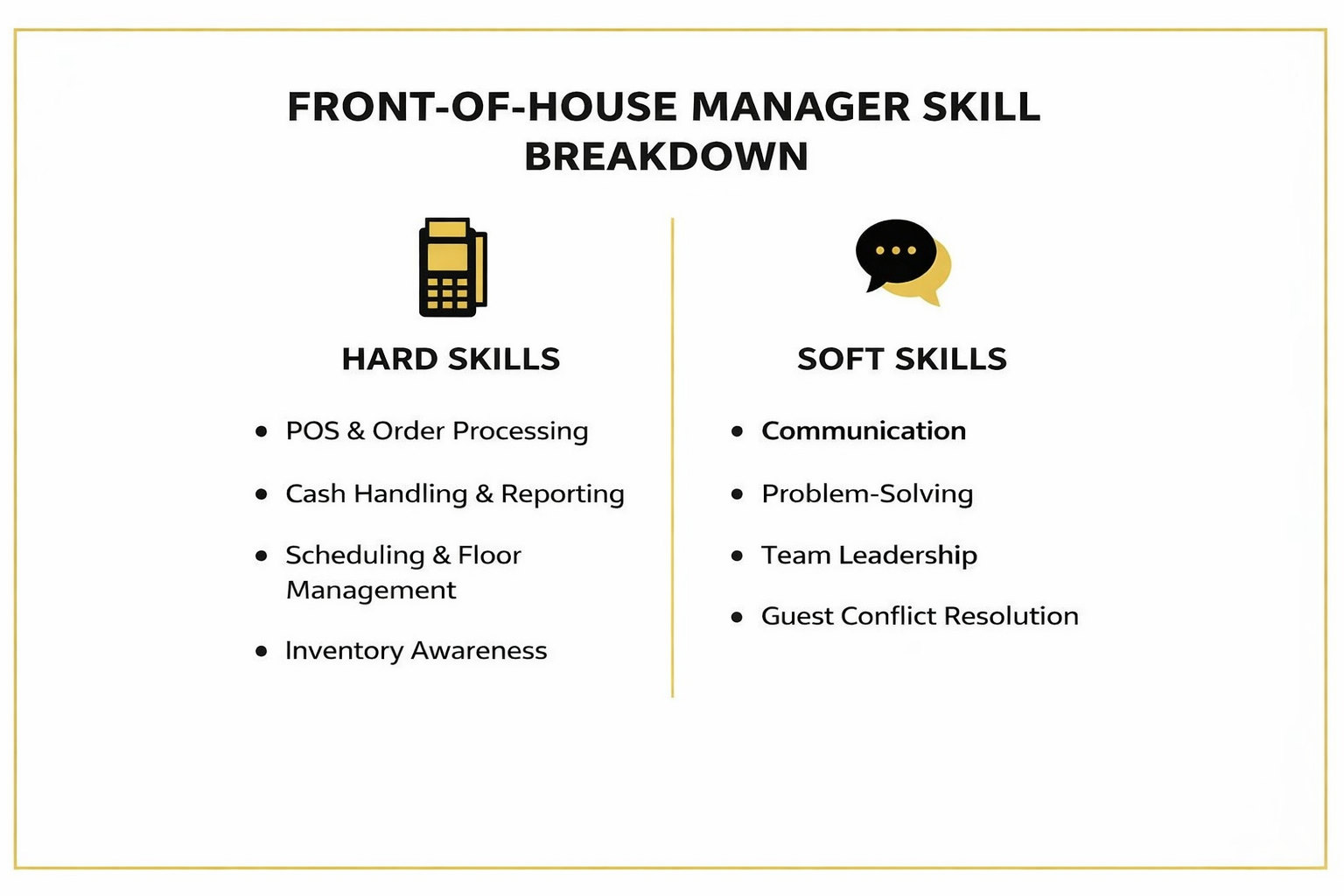
These abilities fall into two camps: the hard skills that run the business and the soft skills that guide the people. A truly exceptional FOH manager is fluent in both. They can break down a P&L with an accountant’s eye and, seconds later, turn a guest’s complaint into a moment of connection. That dual mastery is the foundation of a healthy, profitable, and genuinely welcoming restaurant.
Mastering the Hard Skills
Hard skills are the nuts and bolts of the operation. These are the technical, measurable abilities a manager needs to keep the doors open, the service flowing, and the business profitable. Without a solid grip on these fundamentals, even the most inspiring leader will find themselves struggling against chaos.
Think of these as the manager’s toolbox, the specific, functional skills required to handle the mechanics of service day in and day out.
Some of the most crucial hard skills include:
- POS and Reservation Software Proficiency: A manager needs to be a power user of the restaurant’s tech stack. This isn’t just about taking orders; it is about pulling sales data, training new hires, and troubleshooting a glitch in the middle of a Saturday night rush.
- Inventory and Cost Control: Keeping a close eye on FOH inventory, from napkins and glassware to the bar’s liquor stock, is essential for protecting margins. This means tracking what you have, ordering smart, and minimizing waste.
- Cash Handling and Financial Reporting: The FOH manager owns the financial integrity of every shift. This includes precise cash drawer management, handling credit card transactions, and compiling the nightly sales reports that tell the story of the day.
- Staff Scheduling and Labor Management: Building a schedule that covers every shift without blowing the labor budget is a constant puzzle. It demands a sharp understanding of peak hours, your team’s strengths, and ever-changing labor laws.
The Power of Soft Skills
If hard skills keep the restaurant running, soft skills are what make it special. These interpersonal abilities are tougher to measure, but they are the real X-factor for a great front-of-house manager. They shape how a manager builds their team, navigates pressure, and makes every single guest feel seen.
These skills are the very soul of hospitality leadership. They transform a simple meal into a memorable experience and turn a crew of individuals into a tight-knit team. Nurturing these strengths is a critical part of any effective restaurant leadership development, as they have a direct line to both staff retention and guest loyalty.
You can teach tasks, but you can’t easily teach temperament. Below is a breakdown of the skills that separate the good from the great.
Essential Skills for FOH Management
| Skill Category | Essential Skill | Why It Matters |
|---|---|---|
| Hard Skills | Financial Acumen | Understanding P&Ls, prime costs, and labor percentages turns a manager from a floor supervisor into a business operator. |
| Hard Skills | Tech Proficiency | Expert-level knowledge of POS, reservation, and scheduling software keeps the operation smooth and efficient. |
| Hard Skills | Inventory Management | Smart ordering and waste reduction directly protect the restaurant’s bottom line. |
| Hard Skills | Compliance Knowledge | Knowing labor laws and health codes isn’t just good practice; it’s essential for avoiding costly fines and legal trouble. |
| Soft Skills | Exceptional Communication | This is about active listening during one-on-ones, delivering clear pre-shift notes, and handling guest issues with grace. |
| Soft Skills | Emotional Intelligence | The ability to read the room, sense team morale, and stay calm under fire prevents small problems from escalating. |
| Soft Skills | Decisive Problem-Solving | When the kitchen is backed up or a server calls out sick, a great manager assesses the situation and acts quickly, without panic. |
| Soft Skills | Resilience and Composure | Hospitality is a high-pressure game. A manager’s calm demeanor sets the tone for the entire team, keeping everyone focused during the rush. |
Ultimately, hard skills build the machine, but soft skills provide the heart. A leader who cultivates both is building a restaurant that’s not just successful, but sustainable.
Mapping Your Career Path and Salary Potential
Nobody just wakes up one day as a great Front of House Manager. It is a role you earn, built on a foundation of experience, long nights, and a genuine love for the controlled chaos of hospitality. The career path isn’t a straight shot; it is a journey that usually starts on the floor and offers serious growth for those willing to master the craft.
Most of the best leaders started out as hosts, servers, or bartenders. They learned the rhythm of service from the ground up, getting a firsthand education in what makes guests tick. From there, the natural next step is often a supervisory role, a shift lead, or assistant manager, where you start taking on more responsibility, guiding the team, and putting out small fires. That is where you build the confidence to run the whole show.
The Ladder to Senior Leadership
Once you’ve proven you can handle the FOH Manager role, the path doesn’t stop. Think of it as a launchpad to senior leadership. When you have a track record of building strong teams, keeping costs in line, and making guests happy, you become a go-to candidate for the next level.
The most common moves up from here include:
- General Manager (GM): A sharp FOH Manager is perfectly positioned to become a GM, overseeing everything from the front door to the back of house and taking full ownership of the venue’s P&L.
- Director of Operations: In larger restaurant groups or hotel chains, this is where you manage multiple locations, making sure the brand’s standards and operational flow are consistent everywhere.
- Regional Manager: Similar to a Director of Ops, this role oversees a cluster of venues in a specific area, focusing more on high-level strategy and hitting performance targets.
The skills you sharpen every single day as an FOH Manager, leadership, financial acumen, and an almost psychic ability to solve problems, are the exact skills needed for these bigger roles.
Understanding Your Salary Expectations
So, what can you expect to earn? A Front of House Manager’s salary can swing wildly based on a few key things. Location is a huge factor; a manager in a major city is almost always going to make more than one in a smaller town. The type of restaurant matters, too. Running the floor at a fine-dining spot or a luxury hotel typically comes with a bigger paycheck than managing a casual cafe.
And, of course, experience is king. A manager with ten years under their belt and a history of boosting revenue is going to command a much higher salary than someone just stepping into the role.
Looking at the data, we’ve seen a steady climb in what managers are making. According to Zippia, the average salary jumped from $35,000 in 2016 to $41,200 by 2025. That is an increase of nearly 18%.
If you are mapping out your long-term career, it helps to know which roles offer the highest rewards. Check out our guide on the highest-paying restaurant jobs to see what your future could look like.
How to Hire and Retain Top FOH Managers
Finding and keeping a great Front of House Manager is one of the toughest and most important challenges for any operator. The right leader stabilizes your team, delights your guests, and protects your bottom line.
Getting this hire right, and then building an environment where they actually want to stay, is a direct investment in your restaurant’s long-term health.

Hospitality is known for high turnover, and that pain is sharpest in leadership roles. The cost to replace a front-of-house manager is staggering, averaging around $2,611 per hire, a 147% premium compared to front-of-house staff roles.
Simply put, holding onto just one skilled manager saves you the equivalent cost of replacing two or three other team members.
Finding the Right Candidates
Before you can keep top talent, you have to find it. Casting a wide net is fine, but a targeted approach is way more effective. You’re looking for someone who not only has the right experience but also fits your restaurant’s culture.
Where to look for your next great hire:
- Industry-Specific Job Boards: Platforms dedicated to hospitality attract more serious, career-minded professionals than the giant, general job sites.
- Internal Promotions: Don’t overlook the talent already on your payroll. Promoting from within rewards loyalty, slashes the ramp-up time, and sends a powerful signal to your team that growth is possible.
- Networking and Referrals: The best people usually know other great people. Tap into your professional network and ask your most trusted staff for recommendations.
Once you have a pool of candidates, the interview becomes your most critical tool.
Asking the Right Interview Questions
A solid interview goes way beyond the resume. You need to dig into how a candidate thinks on their feet, solves problems, and leads when the pressure is on. Mix up questions that test their technical skills with situational prompts that reveal their character.
Here are a few questions designed to get you the full picture:
- “Walk me through how you’d handle a sudden dinner rush with two servers calling out sick.” This question tests their ability to triage, prioritize, and manage a crisis without panicking. You are looking for calm confidence.
- “Describe a time you had to give difficult feedback to a team member. How did you approach it, and what was the outcome?” This reveals their communication style, emotional intelligence, and ability to manage people with respect.
- “How do you use data from the POS system to make decisions about staffing or menu performance?” This assesses their business savvy. Can they connect the dots between daily operations and the restaurant’s financial health?
A candidate’s answers should show a balance of empathy for the team, a focus on the guest experience, and a firm grasp of the business’s operational needs.
Strategies for Long-Term Retention
Hiring a star manager is only half the battle. Keeping them is where the real work begins. High turnover is almost always a symptom of burnout, a lack of growth, or feeling undervalued.
To fight this, you need a proactive retention strategy. Focus on creating an environment where leaders can actually thrive, not just survive. This involves more than a competitive salary; real retention is built on support, respect, and opportunity. To learn more about building a loyal team, check out our guide on how to improve employee retention.
Key retention tactics include:
- Provide Clear Paths for Growth: Show your managers what is next. Talk about their career goals, offer mentorship, and invest in their development through training and workshops.
- Foster a Supportive Culture: Create a culture where managers feel safe to make decisions, ask for help, and maintain a healthy work-life balance. Burnout is the number one enemy of retention.
- Offer Competitive Benefits: Go beyond the paycheck. Health insurance, paid time off, and performance bonuses show you value their well-being and their contribution to the business.
- Empower Them with Technology: Give them modern tools for scheduling, inventory, and communication. The right tech reduces administrative headaches, freeing them up to focus on what matters: leading their team and serving guests.
Common Questions About the FOH Manager Role
Think of this as the final check-in, clearing up the common questions that pop up before you hire your next FOH leader or take that next step in your career.
What s the biggest challenge for a new FOH manager?
The hardest part is usually the shift from peer to leader. Being a great server is one thing; leading former coworkers, setting boundaries, and making tough calls is another. Earning respect through consistency and fairness without damaging team morale is a real test of emotional intelligence.
Close behind is learning to juggle it all. New FOH managers must balance admin work, staff supervision, and guest issues at the same time, often in the middle of a slammed service. Prioritizing and delegating quickly is essential to avoid burnout.
How does technology impact the modern FOH manager?
Technology is no longer optional for FOH managers. In U.S. restaurants, it’s a core part of running smooth service, controlling labor, and improving the guest experience.
Managers who know how to use the right tools can reduce friction, make faster decisions, and spend less time buried in admin work and more time on the floor.
Here’s where tech truly matters:
-
Reservation and Table Management: Tools like OpenTable or Resy help optimize seating, manage waitlists, and personalize the guest experience.
-
POS Systems: Modern POS platforms go beyond payments, giving managers visibility into sales trends, menu performance, and staff productivity.
-
Scheduling Software: Platforms like 7shifts or Homebase simplify scheduling, time-off requests, and labor cost control.
-
Guest Feedback and CRM: Digital reviews and feedback tools allow managers to track patterns, respond quickly, and address issues before they escalate.
When used well, these systems free FOH managers from constant firefighting and allow them to focus on leadership, service quality, and team performance.
What educational background is best for this role?
There is no single “right” degree for becoming a front-of-house manager. In U.S. restaurants, success usually comes from a mix of hands-on experience and practical business knowledge.
Some operators value a background in hospitality management or business because it supports better decisions around labor, costs, and team management. But real-world experience carries even more weight.
Many of the best FOH managers started as hosts, servers, or bartenders. That time on the floor builds instincts around service flow, guest expectations, and leadership under pressure. The strongest candidates combine that experience with practical training or industry certifications, such as ServSafe Manager, which are often required or strongly preferred.
Ready to find your next great leader or take the next step in your career? MAJC✨ is the community-driven platform where top hospitality talent and leading operators connect. Access templates, powerful tools, and a network of peers dedicated to building smarter, more profitable businesses. Join MAJC today and build the team you’ve always wanted.