


Running a restaurant often feels like controlled chaos. A restaurant employee handbook is one of the most effective tools you have to bring structure to that chaos. More than a legal requirement, it’s your operational playbook, clearly defining expectations, standards, and how your team works together day to day.
When turnover is high, confusion is usually close behind. Inconsistent rules, unclear expectations, and “learning on the fly” leave new hires frustrated and disengaged. A well-built restaurant employee handbook changes that dynamic. It turns onboarding from guesswork into clarity and gives your team the confidence to perform, stay longer, and grow with your operation.
Defining Your Culture and Protecting Your Business
A well-crafted handbook does more than just list rules. It solidifies your restaurant’s identity. By clearly defining everything from your mission statement to your code of conduct, you build a foundation of fairness and respect that everyone can see.
This clarity has a direct impact on retention. The restaurant industry continues to face high employee turnover, particularly in front-of-house and management roles. Industry data shows that management positions alone can see year-over-year turnover rates near 30%, depending on region and operation size. A clear, comprehensive handbook helps fight this by cutting down on the misunderstandings that cause good people to quit.
More importantly, your handbook serves as your first line of defense against legal headaches. It establishes clear, documented policies on the big issues:
- Anti-harassment and nondiscrimination procedures.
- Wage, hour, and tip-pooling rules.
- Health and safety standards.
- At-will employment status.
When you put these policies in writing and get a signed acknowledgment from each employee, you create a clear record. It proves you have communicated expectations and done your part to comply with legal requirements.
Turning New Hires into Loyal Team Members
Ultimately, your handbook is a promise. It shows your team they are joining a professional organization that values clear communication and consistent management. It answers their questions before they even have to ask, empowering them to succeed from day one.
This proactive approach is a game-changer when you’re looking for ways to reduce staff turnover in your restaurant. When employees feel secure and informed, they are far more likely to invest themselves in your restaurant’s success, turning what could be a temporary gig into a long-term commitment.
Alright, you have the “why” down. Now for the “how.” It’s time to pour the concrete foundation for your handbook. This is where you move from the big-picture culture talk to the nuts-and-bolts rules that keep your restaurant running smoothly, safely, and legally.
Think of this section as the blueprint for your team. It’s not about fuzzy ideas; it’s about the nonnegotiables that protect your people and your business. You are creating a single source of truth that cuts through assumptions and gets everyone on the same page.
The goal here is to be thorough but not overwhelming. You want a clear framework that covers all the bases without making your team’s eyes glaze over from dense legalese.
The Nonnegotiable Legal Stuff You Can’t Skip
Before you get into the rhythm of service, you have to cover your legal bases. These policies are the protective shield for your business, and they set a clear tone of fairness and compliance right from the start. Trust me, these are not just suggestions, they are absolutely essential for avoiding legal headaches down the line.
Kick off your handbook with these core policies:
- Equal Employment Opportunity (EEO) Statement: This is your public commitment to providing equal opportunities and prohibiting discrimination based on legally protected classes like race, color, religion, sex, age, or disability. It’s a powerful first step in building a fair workplace.
- Anti-Harassment and Nondiscrimination Policy: Do not just stop at the EEO statement. Go deeper. Clearly define what harassment and discrimination look like with real-world examples. Most importantly, lay out a clear, confidential process for reporting issues without fear of retaliation.
- At-Will Employment Disclaimer: In most states, employment is “at-will.” This means either you or the employee can end the relationship at any time for any legal reason. Including this disclaimer is critical so your handbook is not mistaken for an employment contract. Always have a lawyer review this part to make sure the wording is correct for your state.
Tackling these policies first in your restaurant employee handbook sends a clear message: you take your team’s rights and your responsibilities as an employer seriously. It builds a foundation of professionalism and trust.
Essential vs. Recommended Handbook Sections
Building a handbook can feel like a massive project. This table helps you see the difference between what is legally required versus what is smart to include for a strong culture and smooth operations.
| Section Category | Essential (Legally Required) | Recommended (Culture & Operations) |
|---|---|---|
| Legal & Compliance | EEO, Anti-harassment, At-Will Employment, Workers’ Compensation (State-Specific) | Mission & Values, Open-Door Policy |
| Compensation | Pay Schedules, Overtime Rules, Tip Policy (State/Fed Law) | Employee Meal & Discount Policy, Bonus Structures |
| Conduct & Ethics | Anti-Discrimination, Safety Rules | Social Media Policy, Cell Phone Use, Conflict Resolution |
| Attendance & Leave | State/Federal Mandated Leave (FMLA, Sick Leave) | Attendance & Punctuality, Time Off Requests, Scheduling |
| Health & Safety | Food Safety, Accident Reporting | Drug & Alcohol Policy, Emergency Procedures |
Think of the “Essential” column as your nonnegotiable starting point. The “Recommended” column is where you build on that foundation to create a workplace where people actually want to stay.
Defining Your Restaurant’s Day-to-Day Rules
With the legal framework solid, you can shift your focus to the policies that shape daily service. This is your chance to turn all those gray areas into black-and-white rules, stopping small misunderstandings before they blow up into bigger problems.
These operational policies are the engine of your handbook. They are the practical, specific guidelines that help your team deliver a fantastic guest experience every single shift.
Policies for a Seamless Service
Your FOH and BOH teams are two sides of the same coin, and they need clear guidelines to work together without friction. The rules you set here have a direct impact on efficiency, safety, and morale.
- Health and Safety Protocols: This is arguably the most critical section for any restaurant. Get specific about your rules for food handling, handwashing, sanitation, and what to do if someone gets hurt. Always reference your local health department codes to ensure you’re 100% compliant.
- Uniform and Dress Code: Vague instructions do not work here. Instead of “professional attire,” spell it out: “Clean, pressed, black button-down shirt; black, nonslip, closed-toe shoes; and a company-provided apron.” Crystal-clear instructions prevent confusion and keep your brand looking sharp.
- Scheduling, Attendance, and Time Off: Lay out the whole process. How is the schedule made and sent out? How do staff request time off? What’s the procedure for calling out sick? Define what “late” means and what the consequences are. A solid policy keeps things fair and helps managers keep the floor staffed.
These policies are directly tied to the expectations you set from day one. For more on getting that alignment right, our article on how to write a job description can help you connect your handbook policies to the roles you are hiring for.
Getting Ahead of Common Restaurant Problems
Finally, let’s tackle the issues that pop up all the time in restaurants. Being proactive with these policies will save you a world of hurt.
- Cell Phone and Personal Device Use: A server scrolling through Instagram can kill the vibe and compromise safety. Create a simple, firm rule: “Personal cell phones are not allowed on the floor during service. All devices must be silenced and stored in your locker.”
- Tip Pooling and Gratuity Policy: Money drama is the fastest way to kill team morale. Clearly explain your system, whether it’s tip-sharing, pooling, or direct tipping. Detail exactly who is in the pool and how it is split, making absolutely sure your policy follows federal and state laws.
- Employee Meals and Breaks: Be clear about your staff meal policy. Is there a discount? A free meal? Are certain items off-limits? Do the same for meal and rest breaks, ensuring they line up with your state’s labor laws.
When you carefully build out this foundation, your handbook becomes more than just a list of rules. It becomes a practical guide that helps every single person on your team succeed.
Crafting Policies That Define Your Culture
A great restaurant employee handbook does more than just list the rules. It tells the story of your restaurant, what you stand for, how you treat people, and what it feels like to work there. This is where you move beyond the legal necessities and infuse your unique philosophy into the document.
It’s your chance to define the employee experience, from how you handle conflict to how you support growth. When you get this right, these policies become a magnet for the kind of dedicated, passionate people you want on your team.
From Compliance to Community
Every handbook needs a code of conduct, but its tone can either feel like a list of punishments or an invitation to build something positive together. Instead of just listing what employees cannot do, frame your policies around the respectful, collaborative environment you want to build.
Think about conflict resolution. A policy that just forbids arguments is useless. A great one provides a clear, constructive path for employees to address disagreements respectfully, maybe by talking to a manager or following a specific open-door process. This approach shows you trust your team to handle issues maturely. The same goes for bigger problems; knowing how to handle difficult employees with a clear, fair process outlined in the handbook prevents small issues from blowing up.
Your code of conduct should be a guide to succeeding together, not just a list of ways to get fired. It is about creating a workplace where people feel safe, valued, and respected.
Putting Your Values into Action with Specific Policies
Think about the common friction points in a restaurant and create clear, fair systems to solve them.
Here are a few real-world examples:
- Shift Swapping and Coverage: A messy shift-swapping process breeds resentment. Your handbook should outline a simple, fair procedure. For instance, require all swaps to be approved by a manager through your scheduling software. This ensures the floor is always covered by a qualified person and holds everyone accountable. No more last-minute scrambles.
- Social Media Guidelines: In today’s world, your staff are your brand ambassadors. A social media policy should not be a gag order. Instead, encourage positive sharing while setting clear boundaries, like prohibiting posts that disclose confidential info, bash guests, or show behind-the-scenes content without permission. Frame it as protecting the restaurant’s reputation and the privacy of your team.
- Employee Meals and Breaks: This policy says a lot about how you care for your people. Clearly detail your system for staff meals, discounts, and breaks. A well-defined policy that ensures everyone gets a real chance to rest and refuel shows a genuine commitment to their well-being.
A Powerful Tool for Attraction and Retention
In this labor market, your handbook can be a surprisingly effective recruiting tool. The policies you write around professional development and work-life balance show potential hires that you offer more than just a paycheck; you offer a place to grow.
The industry is still facing huge staffing challenges. In fact, 70% of operators report they have job openings that are tough to fill, and 45% do not have enough staff to meet demand. With many viewing hospitality as a temporary gig, a handbook that details career paths and supports a healthy work-life balance can change that perception.
Here’s how to turn your handbook into a career-building document:
- Outline Growth Opportunities: Dedicate a section to professional development. Talk about your cross-training programs, opportunities for advancement, or support for certifications. Show employees a clear path from server to shift lead or from line cook to sous chef.
- Detail Your Benefits: Go beyond the legal minimums. Enthusiastically present your entire benefits package, whether it includes health insurance, paid time off, flexible scheduling, or retirement savings plans.
- Commit to Work-Life Balance: Use your scheduling policy to show you respect employees’ personal time. Mention your approach to creating predictable schedules or your process for honoring time-off requests.
When you thoughtfully craft these culture-defining policies, your handbook becomes a living document that guides your team and builds a loyal crew ready to grow with you.
Navigating Critical Legal and Compliance Issues
Okay, let’s talk about the serious stuff. While your values give your restaurant its personality, your legal policies are what protect it. This is where your restaurant employee handbook stops being about culture and starts being your single most important risk management tool.
Ignoring legal and compliance issues is a gamble you cannot afford to take. The world of labor law is a minefield, especially for restaurants, with wage and hour disputes being one of the most common and costly traps. Getting these policies right is not just about dodging lawsuits; it’s about building a fair, transparent, and legally sound operation from day one.
Untangling Wage and Hour Laws
No single area of restaurant management causes more headaches or sleepless nights than wage and hour compliance. The rules are notoriously complex, they change constantly from state to state, and a simple mistake can lead to a lawsuit. Your handbook is the place to get this crystal clear for your entire team.
Get specific about the fundamentals of how and when people get paid:
- Pay Schedules: Do not be vague. State exactly when pay periods start and end, and the specific day everyone can expect their paycheck.
- Overtime: Explain your state’s overtime rules and exactly how overtime pay is calculated. Your policy needs to be unambiguous: all overtime must be approved in advance by a manager. No exceptions.
- Tip Credits and Tip Pooling: If you take a tip credit against the minimum wage, you have to spell it out clearly, ensuring you meet all federal and state requirements. Detail your tip pooling arrangement, who is in, who is out, and how the tips are divvied up.
Mismanaging wages is the fastest way to find yourself in legal hot water. Proper tracking is everything. Using one of the best restaurant payroll software options can automate a ton of this, reducing the risk of human error and keeping you compliant.
Meal and Rest Break Compliance
Meal and rest break rules are a perfect example of why you cannot just download a generic handbook template and call it a day. The regulations change dramatically depending on where you operate.
For instance, California has incredibly strict rules about break durations based on the hours an employee works. Other states might have no legal requirements at all for adult employees. Your handbook absolutely must reflect the specific laws for your location. Getting this wrong can result in penalties.
Your break policy needs to be airtight. Define when employees are eligible for breaks, how long those breaks are, and the process for clocking in and out for them. This written policy, enforced consistently, is your proof of compliance if you are ever questioned.
The Danger of Accidental Contracts
Here’s a sneaky legal risk many operators overlook: using language in your handbook that could accidentally be seen as an employment contract. Innocent-sounding phrases like “you’ll become a permanent employee after your 90-day probationary period” can unintentionally blow up your at-will employment status.
This is why a clear at-will employment disclaimer is not just a good idea, it’s nonnegotiable. It should state plainly that both the employee and the restaurant can end the employment relationship at any time, for any lawful reason, with or without notice.
Example of an Accidental Contract Statement: “As long as you meet performance standards, your job is secure.”
Better, At-Will Language: “This handbook is not a contract of employment. Employment at [Restaurant Name] is on an at-will basis.”
The difference is subtle, but from a legal standpoint, it’s massive. It protects your flexibility as a manager and is a critical piece of your legal defense strategy.
Your First Line of Defense: The Acknowledgment Form
Your handbook is only useful if you can prove your employees actually received it. An employee acknowledgment form, signed and dated by every single person on your team, is the most important evidence you can have.
This form should be the very last page of your handbook. It needs to confirm that the employee has:
- Received a copy of the handbook.
- Understood it’s their job to read and follow the policies inside.
- Acknowledged their at-will employment status.
- Agreed that the handbook can be updated by management at any time.
Keep this signed form in each employee’s personnel file. If a dispute ever comes up, this simple piece of paper proves you clearly communicated your policies and expectations from the very beginning. It’s a small step that offers an incredible amount of protection.
Finally, while this guide gives you a solid foundation, always follow the golden rule: have your finished handbook reviewed by a qualified employment attorney. This final check ensures your policies are 100% compliant with all current federal, state, and local laws, giving you the peace of mind to focus on running your business.
Bringing Your Handbook to Life
You did it. You created a brilliant restaurant employee handbook. That’s a huge accomplishment, but the document itself is just the starting point.
A handbook that lives in a drawer or as an unread email attachment is not just useless, it’s a missed opportunity. To make it a powerful management tool, you have to actively weave it into your restaurant’s daily operations.
This starts the second a new hire walks through your door. The goal is not to hand them a list of punishments, but a guide to success. Frame it as the playbook that will help them thrive in their new role, understand the culture, and feel like part of the team from day one.
Making a Great First Impression During Onboarding
The way you introduce the handbook during onboarding sets the tone for everything that follows. If you just slide it across the table with a mumbled, “you should probably read this,” you are telling them it’s an unimportant formality.
Instead, make it an active, engaging part of their first day.
Carve out real time to walk new hires through the key sections. You do not need to read it word-for-word, but you should absolutely hit the highlights:
- Your Mission and Values: Start here. It shows the handbook is about more than just rules; it’s about who you are.
- Key Operational Policies: Give them the quick version of scheduling, time-off requests, and your cell phone policy. These are the things they will need to know right away.
- Safety Procedures: Emphasize the sections on health, safety, and what to do in an emergency. This is not negotiable.
- Reporting Procedures: Clearly explain how to report harassment or other concerns. This reinforces your commitment to a safe workplace and builds trust from the jump.
This initial walkthrough turns a dense document into a practical resource. It shows new team members you are invested in their success and are giving them the tools they need to excel.
The Handbook as a Living Document
Your handbook is not a one-and-done project. It has to be a living document that evolves with your business and the law.
Think about it: labor laws shift, new technologies change how you operate, and your own internal processes will be refined over time. An outdated handbook is not just unhelpful; it’s a significant legal risk.
Plan for a comprehensive review of your entire handbook at least once a year. This annual check-in is the perfect time to get feedback from your management team, update policies that are not working, and make sure everything is still legally compliant.
Beyond the annual review, be ready to make immediate updates whenever major changes happen, like a new federal labor law or a shift in your state’s minimum wage. Before you finalize any changes, it is smart to follow a simple review process to keep yourself protected.
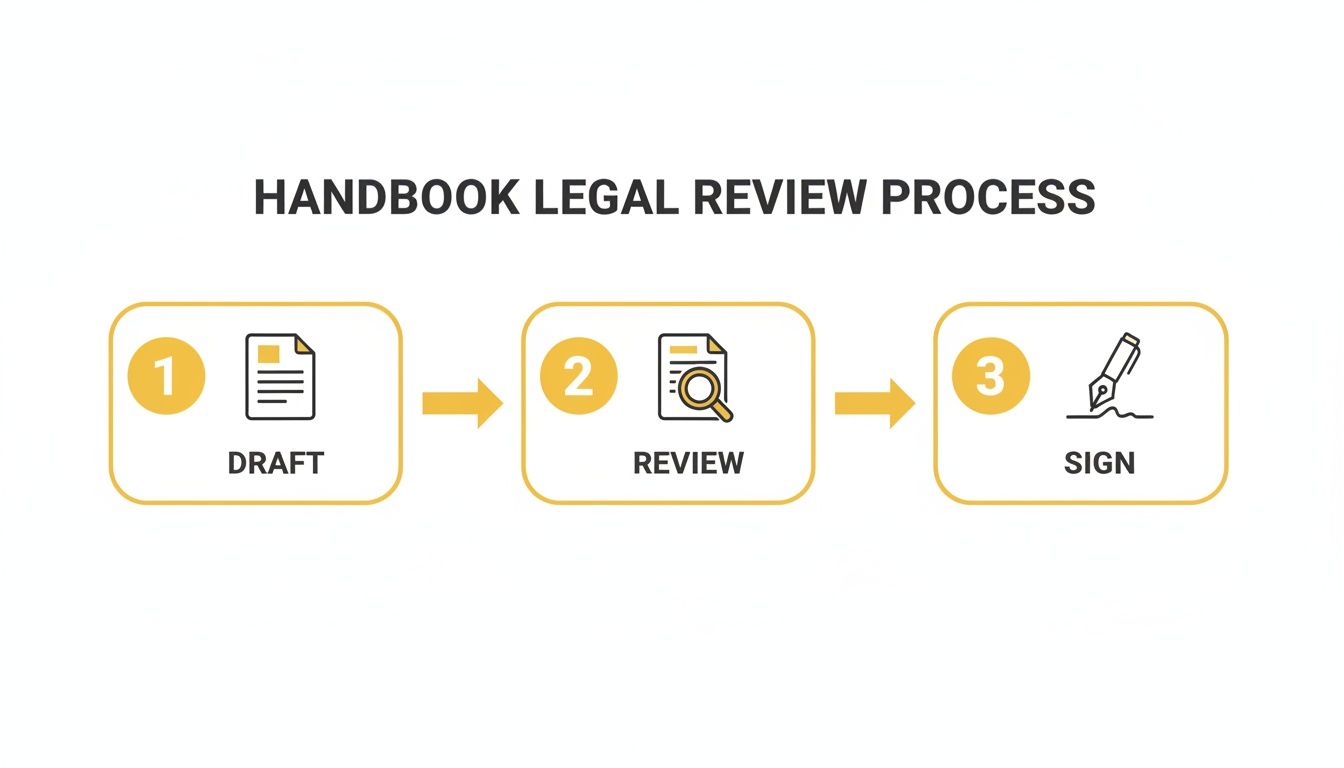
This simple draft, review, and sign-off cycle ensures your handbook is always accurate and defensible.
Distribution and Consistent Enforcement
Once your handbook is finalized, you need a reliable system for getting it into people’s hands and getting their signature on it. Digital distribution is almost always the most efficient route. Email it to new hires as part of their onboarding packet and use HR software to track digital signatures on the acknowledgment form. No more chasing down paperwork.
But consistent enforcement is where the handbook truly comes to life. Your managers are on the front lines. They have to be trained to apply the policies fairly and uniformly to every single employee.
When rules are enforced selectively, it undermines the entire purpose of the handbook. Worse, it can open you up to claims of favoritism or discrimination.
By investing in manager training, you empower them to use the handbook as a tool for clear communication and fair decision-making. That’s how you transform it from a set of rules into the foundation of a strong, professional culture.
Common Handbook Questions Answered
Even with the best plan, building a restaurant employee handbook brings up questions. This is your quick-hit guide to the most common ones.
How often should I update my handbook?
Best practice? Give it a full review and update at least once a year. That annual check-in is your chance to tweak policies, add what you have learned from your team, and make sure it still feels like your restaurant.
But once a year is just the minimum. You will need to jump on updates immediately when:
- Labor Laws Change: Federal, state, or even city rules can shift on everything from minimum wage and tip credits to paid sick leave.
- You Roll Out New Policies: Bringing in a new scheduling system or changing your social media rules? The handbook has to reflect it right away.
- Your Business Changes: If you launch a catering arm or update your benefits package, those details need to be in writing.
An outdated handbook is not just confusing; it’s a real legal risk. Keeping it current is not optional, it’s just part of running a smart business.
Can I just use a generic online template?
Grabbing a generic template online feels like a fast, easy win, but it’s a huge gamble. While a template can give you a decent structure to start with, you absolutely cannot use one “as is.”
The reason is simple: your restaurant is not generic. Standard templates almost always miss the nitty-gritty details of hospitality, like:
- Specific tip pooling and tip credit laws in your state.
- Nuances around meal and rest breaks for service staff.
- Critical health code and food safety protocols that are unique to your operation.
A generic template has no soul. It cannot capture your restaurant’s culture or voice. Your handbook should sound like you, not like a corporate lawyer. Always, always have a qualified employment attorney review your final draft before it goes out.
Do I really need a signed acknowledgment form?
Yes. One hundred percent. This is probably the most critical piece of the puzzle. A signed acknowledgment form is your proof that an employee received the handbook, had the chance to read it, and understood the policies inside.
This simple one-page form is your first line of defense if a wrongful termination claim or legal dispute ever comes up. It shows you did your part to communicate expectations clearly. It also typically confirms the employee’s at-will status and their agreement to follow the rules.
What is the biggest handbook mistake to avoid?
The biggest mistake is writing a great handbook and then letting it collect dust. You cannot enforce policies selectively. If the rule on cell phone use only applies to some servers but not others, you’re creating a culture of resentment and opening the door to discrimination claims.
A handbook is only as good as its enforcement. Your managers need to be trained to apply every policy fairly and consistently across the board. The book should be their guide for making calls, not something they only pull out when it’s convenient.
Another classic error is using language that accidentally creates an employment contract, which can kill your at-will employment relationship. Vague promises like “job security” or “permanent employee” can land you in serious legal hot water. This is exactly why a crystal-clear at-will disclaimer and a final review by your lawyer are nonnegotiable.
Ready to build a stronger team and a more profitable restaurant? MAJC✨ provides the tools, training, and community you need to hire better, retain longer, and run smarter. Join a community of hospitality leaders and access the resources to take your operation to the next level. Learn more about MAJC and join today.