


To figure out your employee turnover cost, you simply add up four key expenses: separation costs + vacancy costs + recruitment costs + training costs. This formula captures every dollar spent from the moment an employee leaves until their replacement is fully productive.
Why You Need to Know Your Turnover Cost
Employee turnover is more than just a staffing headache; it is a silent profit killer. In hospitality, where margins are thin and every shift counts, losing a key player, like a line cook quitting before a busy weekend, creates an immediate financial drain.
You aren’t just losing a person; you are triggering a chain reaction of hidden costs. Research from the Cornell Center for Hospitality Research shows that replacing a single front-line hospitality employee costs an average of $5,864. This includes everything from management time spent on interviews to the “invisible” loss of productivity, which often accounts for 50% to 70% of the total cost.
A Tool for Smarter Management
Calculating this impact isn’t just an accounting chore; it is a critical tool that empowers you to:
- Justify Investments: Putting a real dollar amount on the problem makes it easier to approve budgets for better training or culture initiatives.
- Spot Problem Areas: Pinpoint exactly which departments or roles are bleeding the most money.
- Make Data-Driven Decisions: Guide your hiring and onboarding strategies to build a more stable and profitable team.
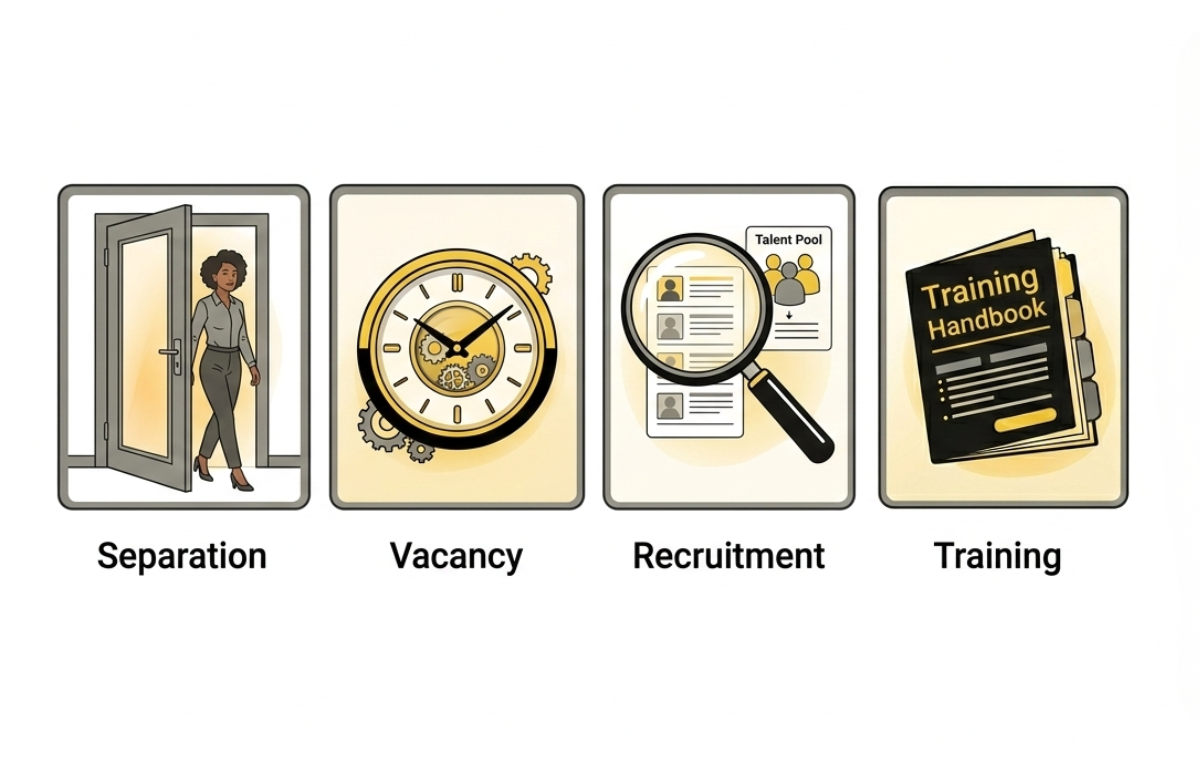
A Quick Look at the Core Formula
The formula itself is straightforward. The real work is in accurately identifying and adding up the costs for each component. You have to track the entire event, from the moment an employee gives notice until their replacement is performing at 100%.
Calculating your turnover cost transforms an abstract problem into a tangible number. It shifts the conversation from “we are losing too many people” to “losing a server costs us $[X], and here is our plan to fix it.”
Turnover Cost Formula Overview
Here is a simple breakdown of what goes into the calculation. We will dive deeper into each of these areas, but this gives you a clear map of the road ahead.
This table summarizes the four main buckets of expenses you will need to track.
| Cost Category | Description | Hospitality Examples |
|---|---|---|
| Separation | The immediate, administrative costs incurred when an employee leaves. | An HR manager’s time processing final paperwork, conducting an exit interview, and paying out unused vacation for a departing front desk agent. |
| Vacancy | The cost of lost productivity and the strain on the remaining team while a position is empty. This is often the most damaging category. | Lost sales from an empty server station on a busy night, plus the overtime paid to other servers who had to cover those tables. |
| Recruitment | The direct and indirect expenses of finding, interviewing, and hiring a replacement. | The cost of posting a line cook job on multiple boards, plus 20 hours of a head chef’s time spent sifting through résumés, doing phone screens, and conducting interviews. |
| Training | The investment required to get a new hire up to speed, from initial onboarding to full productivity. | A new bartender’s wages during their first two weeks of training, the cost of their uniform, and the senior bartender’s time spent showing them the ropes instead of serving guests. |
By tracking these specific categories, you can see how a single departure quickly snowballs into a multi-thousand-dollar problem. Now, let’s dive into the nitty-gritty of each one.
Separation Costs
Separation costs are the first financial hit you take the moment an employee leaves. While they might seem like the smallest piece of the puzzle, they represent time and resources that could have been spent serving guests or growing the business.
These expenses typically include:
- Administrative Time: Think about the hours your manager or HR person spends on termination paperwork, exit interviews, and processing the final paycheck, including any accrued PTO or severance.
- Benefit Continuation: Costs tied to managing benefits like COBRA for the employee who left.
- Legal Fees: In messy situations, you might need to involve a lawyer, and those fees fall right into this bucket.
For a boutique hotel, this might look like the three hours a general manager spends doing paperwork for a departing concierge. It feels small, but those are three hours of a highly paid leader’s time that could have been spent coaching the team or interacting with guests.
Vacancy Costs
Once someone leaves, the clock starts ticking on vacancy costs. This is where the real damage happens. It is the silent killer of profitability because it is not just about the work that is not getting done. It is about the ripple effect it has on your entire operation.
An empty role leads directly to:
- Lost Productivity: The most obvious cost is the value of the work that person would have done. In a restaurant, an empty server station on a Saturday night is a direct hit to your sales.
- Overtime for Your Team: Your existing staff has to pick up the slack, which means burnout and bloated overtime pay. If you are not tracking this, it can completely throw off your labor cost percentage.
- Service Takes a Nosedive: An overworked, stressed-out team simply cannot deliver the kind of experience that creates regulars. This leads to bad reviews, fewer repeat visits, and a tarnished reputation.
An empty spot on the line during a dinner rush is a direct assault on your revenue. Every minute service slows down, you are losing sales. The overtime you pay the remaining cooks is a tangible vacancy cost that eats away at your margins.
Recruitment Costs
Next up are the active, out-of-pocket expenses for finding a replacement. Recruitment costs are usually the easiest to track because they involve clear invoices and payroll hours.
These are the costs of getting from a job post to a job offer:
- Advertising: Fees for job boards, social media ads, or paying a recruiter to find candidates.
- Screening and Interviewing: This is the “soft cost” of the hours your managers and senior team members spend reading résumés, doing phone screens, and holding interviews instead of running the floor.
- Background Checks: Costs for background checks, drug tests, or any other pre-employment screening you run.
Hiring a new Sous Chef might cost $200 in targeted job board fees, 15 hours of your Executive Chef’s time for interviews, and $40 for a standard background check. While these numbers seem small individually, they represent a direct hit to your monthly budget.
Training Costs
You finally made a hire. Great. But the spending does not stop there. Training costs cover everything needed to turn that new person into a productive member of your team. It is a necessary investment, but it is a huge part of the turnover equation.
Consider the money and time spent on training employees. These costs can include:
- Onboarding and Supplies: Uniforms, handbooks, training manuals, and access to any software they will need.
- The Trainer’s Time: The hours a manager or senior employee spends training the new hire are hours they are not spending on their own high-value tasks.
- Wages During Training: You are paying the new hire from day one, but they will not be fully productive for weeks, sometimes months. Those wages are a direct training cost.
- The Inevitable Productivity Dip: New hires are slower and make more mistakes. That is natural, but it temporarily affects service speed, ticket times, and team morale.
When you add it all up, the numbers are staggering. By methodically adding up every expense in these four categories, you can finally see the true financial story behind every “Help Wanted” sign.
Putting the Formula to Work: The “Data Detective” Approach
Now that you understand the four buckets, the final step is putting them together:
Total Turnover Cost = Separation + Vacancy + Recruitment + Training
Think of this formula as a roadmap that tracks the entire event, from the moment an employee gives notice until their replacement is performing at 100% capacity.
To get an honest number, you’ll need to do a little “data detective” work. Most of this information is already hiding in plain sight within your operation:
-
Payroll & HR Logs: For final payouts, overtime spent covering shifts, and training wages.
-
POS Reports: To estimate lost revenue from decreased service capacity during vacancies.
-
Invoices: For job boards and background check fees.
The goal isn’t to get a perfect, down-to-the-penny number. It is to build a repeatable process that gives you a reliable estimate. When you track these figures over time, you can finally see the true ROI of your retention efforts and move from “guessing” to “managing” your bottom line.
Seeing the Real Cost: A Practical Example
The Baseline Numbers
-
Line Cook: $21.63/hour ($45,000/year)
-
Restaurant Manager: $30/hour
-
Head Chef: $35/hour
With these numbers in hand, we can start adding up the real costs for each of those three empty positions.
Sample Turnover Cost Calculation for a Restaurant
Let’s focus on just one person first: the line cook who left. The table below gives you a detailed look at how quickly the expenses add up for just a single departure. It is often more than operators think.
| Cost Item | Calculation/Notes | Estimated Cost |
|---|---|---|
| Separation Costs | ||
| Manager’s Time (Exit Interview) | 1.5 hours of the manager’s time for the exit interview and final paperwork. (1.5 hours x $30/hour) | $45 |
| Accrued PTO Payout | The cook had 20 hours of unused paid time off. (20 hours x $21.63/hour) | $433 |
| Vacancy Costs | ||
| Overtime for Other Cooks | The remaining kitchen staff worked an extra five hours of OT per week for four weeks. (20 hours x $32.45 OT rate) | $649 |
| Head Chef Covering Shifts | The Head Chef had to work the line for an extra 10 hours per week for four weeks. (40 hours x $35/hour) | $1,400 |
| Lost Productivity and Errors | Industry “Killer”: Slower ticket times and food waste during the transition. | $1,150 |
| Recruitment Costs | ||
| Job Board Advertisements | Cost for premium listings on two industry-specific job boards for one month. | $250 |
| Manager and Chef Interview Time | The Head Chef spent 10 hours screening and interviewing; the manager spent four hours. (10x$35 + 4x$30) | $470 |
| Background Check | Standard pre-employment screening for the final candidate. | $40 |
| Training Costs | ||
| New Hire Wages (Training Period) | The new cook’s wages for their first 80 hours of training before they are fully productive. (80 hours x $21.63/hour) | $1,730 |
| Trainer’s Time (Head Chef) | Head Chef’s time dedicated to hands-on training for the first two weeks. (30 hours x $35/hour) | $1,050 |
| Uniforms and Supplies | Cost for two sets of chef coats, pants, and non-slip shoes. | $350 |
| Total Cost for One Line Cook | Sum of all the costs above. | $7,567 |
As you can see, the little things become big things very quickly.
The True Financial Hit
Just replacing that one line cook cost The Corner Bistro over $7,567. That is a staggering 17% of the cook’s annual salary gone in a flash. When you are operating on thin margins, that kind of number is a wake-up call.
Now, what about the two servers? Their turnover cost is typically lower due to a different wage structure and less intensive technical training, but it is far from zero. According to industry benchmarks, replacing a front-of-house employee costs an average of $4,500 to $5,000.
The biggest mistake operators make is ignoring the “soft costs” of a vacancy. While overtime pay is easy to spot on a P&L, the real damage comes from the strain on your remaining team, the dip in service quality, and the customer frustration that follows. These are real financial drains that must be part of your equation.
At The Corner Bistro, the combined cost for both servers was $9,000 ($4,500 each). This covers the manager’s time sifting through resumes, wages paid during onboarding, and the inevitable lost sales from having less experienced staff on the floor.
Quarterly Breakdown:
-
One Line Cook: $7,567
-
Two Servers: $9,000
-
Total Quarterly Turnover Cost: $16,567
Losing just three people in three months cost the business over $16,500. If that pattern continues, you are looking at more than $66,000 walking out the door every year. That is money that could have gone toward new equipment, marketing, or bonuses for the people who stick around.
This simple exercise makes one thing crystal clear: knowing your turnover cost is not just an accounting task. It is the first and most critical step toward stopping the bleed and building a team that stays.
From Data to Action: Improving Your Bottom Line
Calculating your turnover cost does more than spit out a startling number; it hands you a powerful tool for change. Once you have this baseline, you can shift from reacting to turnover to proactively preventing it.
Targeting the Root Causes
Different cost categories point to different operational leaks. By analyzing where your money is going, you can choose the right solutions:
-
High Vacancy Costs? This is a red flag for team burnout. You need better cross-training and a “deeper bench” to prevent service meltdowns.
-
High Recruitment Costs? Your hiring funnel is likely inefficient. It’s time to refine your interview process or candidate screening.
-
High Training Costs? Your onboarding isn’t “sticking.” New hires are likely to leave before they reach 100% capacity, wasting your initial investment.
Building the Business Case
Armed with specific numbers, you can turn abstract HR ideas into tangible financial goals. Instead of asking for a “better culture,” you can present a data-driven proposal:
“Our high kitchen turnover costs us $7,567 per departure. A $5,000 investment in a professional development program could cut these losses in half, saving us over $20,000 this year.”
Knowing your turnover cost is the first and most critical step toward stopping the bleed. It transforms a vague “staffing headache” into a manageable financial KPI. By tracking these numbers quarterly, you can finally measure the real ROI of your leadership and build a team that stays.
Common Questions About Turnover Costs
Once you start digging into the numbers, a few questions always come up. Here are the most common ones and some straight answers based on experience.
How often should I run this calculation?
Do it quarterly. Anything less frequent, and you are flying blind.
A quarterly check-in is the sweet spot. It is frequent enough to spot trends before they become disasters, but not so often that it feels like a massive administrative chore. It lets you see if that new retention bonus is working, helps you anticipate seasonal staffing dips, and flags a problem in a specific department before it bleeds cash for a whole year.
If quarterly feels like too much right now, you must do a full calculation once a year. Use it to build your annual budget and set your strategic goals for the coming year.
Does this change for my part-time staff?
The formula stays the same, but the final number will almost always be lower for part-time employees. It just makes sense. Costs tied to salary, like separation pay, and the value of lost productivity, are naturally smaller for part-time roles.
But do not make the mistake of ignoring part-time turnover. High churn, even in these roles, adds up. It creates a constant drag on your resources and, more importantly, can destabilize the consistency of your service. A revolving door is a revolving door.
What is a “Good” turnover rate for a restaurant, anyway?
The honest answer? A “good” rate is any number that is consistently getting smaller for your business. The industry average is a staggering 75%, so fixating on a single magic number is a losing game.
Instead, focus on continuous improvement. A well-run independent spot might fight to get its rate below 50%. A top-tier restaurant group with a powerful culture and great benefits might even get down into the 30% range.
The key is to benchmark against yourself. Use your own past performance as the standard and use this cost calculation to justify the investments you need to make to drive that number down, year after year.
Ready to stop the financial drain of turnover and build a team that stays? MAJC✨ provides the complete ecosystem you need to thrive. Through MAJC Jobs, we help you find the right talent from the start, while our community, expert-led training, and exclusive resources, like templates and podcasts, empower you to lead better.
From smarter hiring to effective retention strategies that protect your margins, we help you build a more profitable and sustainable business. Don’t let your profits walk out the door, join the MAJC✨ ecosystem and start running a smarter restaurant today.