

Let’s get one thing straight right away: most bartenders do not need a state-issued “license” in the same way a driver needs one to get behind the wheel. That is a common myth that causes a ton of confusion for new bar owners and aspiring bartenders alike.
What is almost always required, however, is an alcohol server certification or permit. Think of it less like a driver’s license and more like a food handler’s card; it is not a government ID, but proof that you have been trained on how to do your job safely and legally.
Uncorking the Truth About Bartender Licensing
When people ask, “do bartenders need a license?” they are hitting on a critical piece of compliance for any business serving alcohol. The difference between a formal license and a server certification is not just semantics; it is fundamental to how our industry is regulated.
That little card is your first and most important line of defense against liability. It proves your team knows the law and has the skills to prevent dangerous situations, like serving a minor or over-serving a guest. For any bar or restaurant owner, making sure every single person pouring drinks has a valid certification is a nonnegotiable part of managing risk.
To clear things up, let’s break down the key differences between a “license” and the certification your team actually needs.
License vs. Certification: What Your Bar Really Needs
This table clarifies the key differences between a formal license and the more commonly required server certification, helping operators understand the specific requirements they need to meet.
| Aspect | Bartender License (Rare) | Alcohol Server Certification (Common) |
|---|---|---|
| What It Is | A formal, government-issued credential is required to practice a profession. Very uncommon for bartenders in the U.S. | A certificate showing completion of a state-approved responsible beverage service training program. |
| Purpose | To grant legal permission to work in a highly regulated field (e.g., medicine, law). | To ensure servers and bartenders understand liquor laws, liability, and how to serve alcohol responsibly. |
| How to Get It | Typically involves extensive education, exams, and background checks administered by a state licensing board. | Complete a short training course (often online) and pass a final exam. Courses take a few hours. |
| Who Requires It | A state or local government licensing authority. Only a handful of jurisdictions require this. | State or local Alcohol Beverage Control (ABC) agencies. Required in most states for anyone serving alcohol. |
| Example | A “Pourer’s License” in some specific counties or cities. | A TIPS Certification, ServSafe Alcohol, or other state-approved server permit. |
| Renewal | Usually renewed annually or biennially, sometimes with continuing education requirements. | Typically renewed every two to five years by retaking the certification course. |
As you can see, the focus is squarely on education and safety, not on creating a barrier to entry. The goal is to equip your team, not to gatekeep the profession.
Understanding the Core Requirements
So, what does this certification process actually cover? Unlike a formal degree, this training is all about practical, on-the-job skills. The U.S. Bureau of Labor Statistics notes that bartenders do not need formal education to get started, though most states require anyone serving alcohol to be at least 18 years old. You can find more career insights on the BLS website.
Instead of years in a classroom, the skills are learned through short-term training that focuses on responsible service. The curriculum usually hits a few key areas essential for daily operations and staying on the right side of the law.
- Legal Knowledge: This is ground zero. It is about knowing your local and state liquor laws inside and out, from legal pouring hours to what forms of ID are acceptable.
- Intoxication Prevention: Your team will learn how to spot the behavioral signs of intoxication, slurred speech, poor coordination, and aggressive behavior, and gain strategies to cut someone off professionally and safely.
- ID Verification: This goes way beyond just glancing at a driver’s license. Training covers how to spot fake or altered IDs to keep alcohol out of the hands of minors.
- Liability Awareness: Staff learn about their personal legal responsibility and the establishment’s. This includes understanding the serious consequences of over-serving, which can lead to fines, lawsuits, or even jail time.
This foundational knowledge does way more than just check a legal box. It builds a culture of safety and professionalism that protects your guests, your staff, and your business from fines, lawsuits, or the loss of your liquor license.
Navigating State and Local Alcohol Serving Laws
Think of alcohol regulations in the United States as a patchwork quilt. Each state, county, and even city adds its own unique square, creating a legal landscape that is anything but uniform. What is standard procedure for serving drinks in one town could be a serious violation just a few miles down the road.
This is why there is no simple, one-size-fits-all answer to the question of whether bartenders need a license. The rules that apply to you are hyper-local. Getting this right is the only way to protect your business from costly fines, legal trouble, and potentially losing your liquor license.
Three Types of Regulatory Environments
Generally, states fall into one of three buckets when it comes to alcohol server training. Figuring out which category your state is in is the first step toward compliance. This framework will help you pinpoint exactly what is required of your team.
-
States with Mandatory Certification: In these states, the law is simple and direct. Anyone serving or selling alcohol must have a valid, state-approved server certification. There is no gray area here. California, with its Responsible Beverage Service (RBS) training mandate, is a perfect example. Fail to comply, and you are looking at direct penalties for both the employee and your business.
-
States Where Certification is Optional (But Recommended): Some states, like Texas, take a different approach. While certification might not be a legal requirement for every server, getting it provides a powerful legal shield known as “safe harbor.” This means if an employee serves a minor or an intoxicated person, your business’s liquor license is protected from revocation, as long as the server holds a valid certification and you have not encouraged illegal behavior.
-
States with No Specific Mandates: A handful of states have no statewide laws requiring server certification. Do not get too comfortable, though. Even in these places, individual counties or cities can, and often do, impose their own training rules. On top of that, smart operators in these states still make certification a priority. It is just good business for managing risk and keeping insurance premiums down.
Even when it is not legally required, having a certified team is your best defense against liability. It shows a commitment to safety that can significantly lower your insurance costs and protect you if an incident ever occurs.
Finding Your Local Regulations
So, how do you find the specific rules for your bar or restaurant? Your single source of truth is your local Alcohol Beverage Control (ABC) board, which might go by a different name like a liquor control commission. This is the government agency in charge of regulating alcohol sales and service in your area.
Their website is the best place to start. Look for sections covering server training, permits, or employee licensing. These pages will spell out which training programs are approved, how often certifications need to be renewed, and the specific legal hoops your business needs to jump through.
For a deeper dive into setting clear policies for your crew, our guide on creating a solid restaurant employee handbook template can be a game-changer.
Why Local Rules Matter Most
It is absolutely critical to understand that even within a single state, the rules can change from one town to the next. A statewide “optional” policy can easily be overruled by a mandatory city ordinance.
For instance, a state might not require certification, but a city within that state could have its own local law making it mandatory for every bartender. This is why you cannot rely on general advice; you have to verify the rules for your specific business address. A quick call or a visit to your local ABC board’s website will give you the clear, actionable information you need to operate legally and responsibly.
The Most Common Bartending Certifications Explained
Once you have figured out your local requirements, the next step is picking the right training program. Think of these responsible beverage service (RBS) certifications as the industry-standard driver’s ed for serving alcohol. They give every bartender the practical skills and legal know-how to work safely and confidently behind the bar.
Let’s break down the big players.
ServSafe Alcohol
Developed by the National Restaurant Association, ServSafe Alcohol is one of the most recognized certifications in the country. The whole curriculum is built around real-world situations, preparing bartenders for the tough calls they have to make on every shift.
Because it is known everywhere, ServSafe is a solid choice for businesses with locations in multiple states. Just be sure to double-check that it meets your local ABC board’s specific rules.
TIPS (Training for Intervention ProcedureS)
TIPS (Training for Intervention ProcedureS) is another industry leader, and it is famous for its skills-based approach. The program is all about giving servers the confidence to step in before a situation gets out of hand. It is about being proactive, not just reactive.
TIPS is built around a simple idea: prevent alcohol-related problems before they start. The training focuses on teaching staff to read the subtle behavioral cues and intervene early to keep everyone safe.
The curriculum gives bartenders practical tools they can use right away. This means learning how to assess a guest’s intoxication level, manage tricky interactions, and work with the rest of the team to maintain control. It is also a smart financial move, as many insurance companies offer discounts to establishments with TIPS-certified staff.
State-Specific RBS Programs
While national programs like ServSafe and TIPS are fantastic, many states require their own specific certification. California is a perfect example, mandating that every server completes a state-approved Responsible Beverage Service (RBS) training program. These programs are tailored to local laws and regulations.
This ensures bartenders are trained on the exact legal details of their state, from last-call times to specific rules about happy hour promotions. You can find more details on various professional credentials in our complete guide to hospitality industry certifications.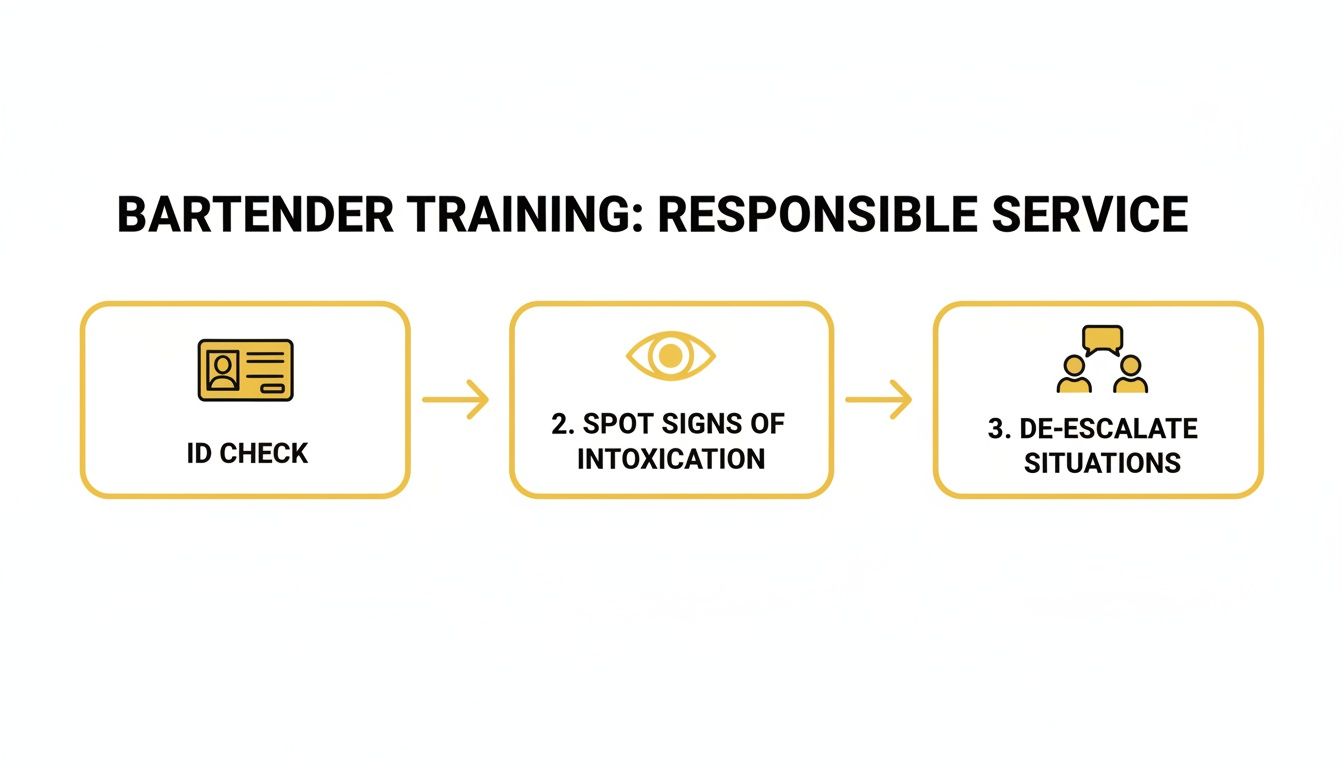
Beyond Compliance: The Business Case for Advanced Training
Investing in your team’s ongoing education is one of the most powerful levers you can pull to drive revenue and build a stronger business. This is where you move past just being compliant and start cultivating true hospitality professionals. Advanced training turns your bar staff from order-takers into expert guides who can elevate the guest experience and directly pad your bottom line.
Turning Skills Into Revenue
Upskilling is not just about making better drinks; it is about building a more profitable and resilient operation. When your team gains expertise in areas beyond the basics, you will see tangible returns across the business. This is not just a feel-good investment; it translates directly into measurable financial gains.
-
Advanced Mixology and Product Knowledge: A bartender who can confidently explain the difference between a Speyside and an Islay scotch, or who can craft a perfectly balanced, off-menu cocktail based on a guest’s preferences, creates unforgettable moments. That expertise leads directly to higher check averages as guests feel comfortable exploring premium spirits and signature creations.
-
Elevated Guest Service: Real hospitality training teaches staff to read the room, anticipate needs, and turn first-time visitors into loyal regulars. A team that masters the art of conversation and upselling makes it feel less like a sales pitch and more like expert guidance, which builds trust and keeps people coming back.
-
Operational Excellence: Training in skills like inventory management, waste reduction, and efficient bar setup empowers your team to run a tighter ship. They become partners in profitability, actively working to control costs and maximize margins on every single pour.
Investing in advanced training transforms your bar from a simple point of sale into an experience destination. Your bartenders become your most effective brand ambassadors, driving loyalty and word-of-mouth marketing with every interaction.
The High Cost of Noncompliance: Fines and Liabilities
Thinking about ignoring alcohol service regulations? That is not just a small oversight; it is a high-stakes bet against your business, your team, and your future. The risks here go way beyond a simple slap on the wrist. We are talking about tangible, business-ending penalties that can wipe out years of hard work in a single night.
One slip-up can set off a chain reaction of problems. Blowing off these requirements is the fastest way to find yourself sidestepping huge financial penalties and legal liabilities. Think of proper certification as the cornerstone of your entire risk management plan.
Understanding Dram Shop Laws
One of the biggest financial minefields for any bar or restaurant comes from something called dram shop laws. These laws are on the books in most states, and they hold businesses financially responsible for what happens when they over-serve a customer.
Let’s play that out. Imagine a bartender keeps pouring for a guest who is clearly intoxicated. That guest gets behind the wheel and causes a horrific drunk driving accident. Under dram shop laws, your business could get sued for millions in damages. The training you get for a server permit is designed specifically to prevent this exact nightmare.
Dram shop liability means your responsibility does not end when a guest pays their tab. A single bad decision by an uncertified server can put your entire business on the hook for immense financial and legal damages.
The Full Spectrum of Penalties
The fallout from noncompliance is brutal, and it hits everyone, from the server right up to the owner. It is not just about the money, either; it is about your freedom to even stay in business.
Here is a taste of what you could be up against:
- Steep Fines: Getting caught serving a minor or an intoxicated person can cost you anywhere from a few hundred to tens of thousands of dollars for each violation.
- Criminal Charges: The server who poured the drink and the manager on duty can both face criminal charges. That could mean probation or even jail time.
- Liquor License Suspension or Revocation: Your local ABC board can pull your ability to sell alcohol, which will cripple your revenue stream overnight. If it is a serious offense or a repeat problem, they can revoke your license for good, effectively shutting your doors forever.
This is not about scaring you; it is about showing you the reality of the stakes. Every single responsible server certification is another layer of protection against these devastating outcomes, helping ensure your establishment can thrive for the long haul.
Your Questions on Bartender Licensing Answered
Let’s wrap up by tackling some of the most common questions managers and aspiring bartenders have about certification.
How long does an alcohol server certification last?
Most alcohol server certifications are good for two to five years, but this really depends on your state and the specific program you use. A TIPS certification, for example, is typically valid for three years.
The key thing for managers is to track these expiration dates for every single staff member. In the eyes of the law, a lapsed certification is no different than having no certification at all.
Can I use a certification from one state in another?
Usually, the answer is no. Alcohol laws are incredibly local, so a certification you earned in one state almost never transfers to another. Your TABC certification from Texas will not do you any good in California, which has its own mandatory training.
Even with national programs like ServSafe or TIPS that are recognized in many places, you absolutely have to check with your local Alcohol Beverage Control (ABC) board. They are the final authority on whether a program meets their specific state requirements.
Who is responsible for paying for the bartender Certification?
While some state laws might technically put the responsibility on the employee, the sharpest hospitality businesses choose to cover the cost of certification themselves. This is widely seen as a best practice and a smart investment.
Covering your team’s certification costs removes a barrier for new hires, fosters loyalty, and signals a strong commitment to safety and professional development. It is a small expense that pays significant dividends in compliance and team morale.
This approach ensures everyone gets trained the right way from day one, without asking your staff to pay out of pocket just to do their job properly.
What happens if my bartender’s certification expires?
If a bartender’s certification expires, they are no longer legally allowed to serve alcohol in any place that requires it. Period.
Letting them work with an expired card can bring on serious heat for the business, including hefty fines, personal liability for the manager on duty, and even action against your liquor license. You need a rock-solid system for tracking expiration dates and ensuring everyone gets recertified before their current credentials expire. There cannot be any gaps.
Ready to build a certified, professional, and profitable team? MAJC✨ is the all-in-one platform for hospitality operators, offering expert-led workshops and a community of peers to help you run a smarter business. Learn more about how MAJC can support your team’s growth and compliance.