


Losing a key manager can throw off your entire operation overnight. That is why learning how to identify high-potential employees early is not optional. It is essential.
The best operators do three things consistently: they pay attention during service, have real conversations about growth, and give small opportunities to step up. That is what turns potential into leadership.
Why You Cannot Afford an Empty Leadership Pipeline
An empty leadership pipeline quickly impacts service, team stability, and the guest experience.
When a key leader leaves, the gaps show up fast. Standards slip, pressure builds, and the team feels it immediately.
The only real defense is building internal talent that is ready to step up.
When your team sees a clear path to grow, engagement and retention improve. In an industry known for turnover, that matters.
In the end, creating a place where your best people want to stay is a competitive advantage.
The Three Pillars of HiPo Identification: Observe, Converse, and Test
Spotting these rising stars does not require a complex HR system. It just requires a simple, intentional framework focused on three key areas of evaluation.

By consistently observing behavior, holding meaningful conversations, and testing skills, you build a complete picture of an employee’s readiness for what is next. This moves you beyond gut feelings and into a more deliberate approach to talent management.
High-Potential vs. High-Performer Snapshot
It is easy to confuse a great employee with a future leader. Your best server might be a rockstar on the floor, but that does not automatically mean they are ready to manage the team. Understanding the difference is critical. This table breaks down the key distinctions.
| Trait | High Performer | High-Potential Employee (HiPo) |
|---|---|---|
| Focus | Masters their current role. | Masters their role while looking ahead to the next one. |
| Motivation | Driven by personal achievement and recognition. | Driven by impact on the business and team success. |
| Mindset | “How can I do my job better?” | “How can we do this better as a team?” |
| Feedback | Accepts feedback to improve performance. | Actively seeks feedback and applies it to grow. |
| Contribution | Delivers excellent results. | Elevates the performance of those around them. |
Your high performers are the backbone of your daily operations, and you need them. But your HiPos are the ones who will help you build the future. They are the employees who see the bigger picture and have the desire and potential to influence it.
The stakes are higher than most operators realize. Many teams operate with a thin leadership bench, which becomes obvious the moment a key person leaves.
This is especially true in hospitality, where promoting from within is often faster, more cost-effective, and less disruptive than hiring externally.
Ultimately, identifying and nurturing your high-potential employees is about building a more resilient, self-sustaining operation. It ends the frantic scramble to fill vacancies and cuts down the huge expenses tied to turnover. If you are curious about the real financial hit, check out our guide on how to calculate employee turnover cost.
It turns your team into your greatest asset for long-term growth.
Look Beyond the Daily Grind for Hidden Potential
To find your future leaders, you have to look past the usual performance reviews and spot the signals that show real leadership aptitude.
These actions are not just signs of a good employee. They are proof of problem-solving, resilience, and a grasp of the bigger operational picture. They show you the why behind someone’s actions, which often points straight to their ambition and drive.
Moving Past Performance Metrics
Performance data is important, but it only tells you part of the story. A high-performing server might be a pro at upselling wine, which is great for tonight’s revenue. But a high-potential employee notices the whole team is fumbling with a new POS function and creates a quick one-page guide to help everyone get up to speed.
One is competence. The other is leadership.
A data-driven approach can help you move beyond surface-level metrics. It reveals patterns in behavior, not just numbers on a spreadsheet, helping you spot these leadership indicators more consistently.
A classic mistake is promoting your best technician, whether a cook, server, or bartender, into management without checking if they can actually lead. The skills that make someone a great individual performer are often completely different from those needed to lead a team.
Spotting Potential in Action
So, what should you be looking for on the floor? High-potential employees consistently show specific behaviors that set them apart. They think and act like owners, even when they are just starting out.
Keep an eye out for people who regularly demonstrate these traits:
- Exceptional Learning Agility: They do not just learn their own job; they actively try to figure out how their role impacts the rest of the operation. They are the ones asking “why” to understand the bigger picture, not just “how” to finish a task.
- A Proactive Mindset: These are the people who refill a teammate’s station without being asked or warn you about a potential inventory problem before it becomes a crisis. They solve problems before they blow up.
- Strong Interpersonal Skills: Future leaders are natural connectors. They build rapport easily, communicate clearly, and often become the go-to person for advice or help, even without a title.
- Emotional Intelligence: The restaurant business is a pressure cooker. A high-potential employee stays calm and collected when things go sideways, helping to stabilize the team and keep the energy positive.
The “Why” Behind Their Actions
The most telling sign of a high-potential employee is their motivation. Are they driven only by personal wins, or do they show a real desire to lift up the team and the business?
For example, a server who studies the wine list to boost their check averages is a high performer. A server who studies the wine list and then offers to run a tasting for new hires is showing high potential. The first action helps the individual; the second helps the entire team.
Look for the employees who take ownership. They treat their station like their own small business and are always looking for ways to improve the system. This built-in sense of responsibility is one of the surest signs of future leadership success.
When you spot these behaviors, you are no longer just guessing. You are actively identifying your next generation of leaders.
Stop Guessing and Start Asking: How to Uncover Real Ambition
The casual “How is it going?” is fine for building daily rapport, but let’s be honest, it is not going to tell you who is ready to lead. If you want to find the high-potential players on your team, you have to move beyond small talk and start having strategic, structured conversations.
This is your chance to create a space where your team feels safe enough to share what they are really thinking. It is where you shift from just managing tasks to actually developing people. By asking the right questions, you get a direct look at their ambition, how they solve problems, and whether they have that crucial sense of ownership.
Asking Questions That Get Past the Surface
The right questions are not about what happened on last night’s shift. They are about how your team thinks about the next shift, the next month, and the next step in their career. This simple change in focus can reveal incredible insights.
Instead of sticking to generic review questions, try weaving these into your one-on-ones. You might be surprised at who steps up.
Here are a few questions that get people thinking like a leader:
- “If you could fix one thing in this restaurant to make life better for the whole team, what would it be and why?” This shows you if they are just focused on their own station or if they have the operational awareness to see the bigger picture.
- “What is one new skill you want to learn in the next six months that would help you here?” This is a direct signal of their hunger to grow. High-potential employees do not wait to be told what to learn; they already have a list.
- “Think back to our last crazy-busy service. What is one thing we could have done differently to handle that rush better?” This tests their ability to think clearly under pressure and their desire to improve how the whole team performs.
The answers you get are pure gold. They draw a clear line between the people who are just doing a job and the ones who are thinking about how to make the job better for everyone.
Creating a Safe Space for Real Talk
These conversations will not work if your team feels like they are being tested. If they think there is a “right” answer, you will get surface-level responses instead of real insight.
Be clear about the purpose. Let them know you want to understand their goals so you can help them grow. This should feel like a conversation, not a performance review.
The best way to uncover potential is to ask real, scenario-based questions. For example: “What would you do if we ran out of our top-selling wine on a Friday night?” Their answer will tell you far more about how they think than any standard review.
This is not a one-time conversation. Make it part of your regular management routine. Over time, you stop guessing who has ambition and start seeing it clearly.
Testing Leadership Skills with Stretch Assignments
Once you have picked out the team members who talk a good game, it is time to see if they can back it up. This is where you move beyond gut feelings and start using low-risk “stretch assignments” to test their leadership chops in a real-world setting.
These are not about piling on more work. Think of them as carefully chosen opportunities designed to push an employee just beyond their comfort zone. The goal is not just to see if they can complete the task; it is to see how they handle the communication, problem-solving, and ownership that come with it.
Designing Effective Stretch Assignments
The best stretch assignments are genuine challenges that give you a clear window into someone’s capabilities. It needs to be a task that forces them to think on their feet, coordinate with others, or take ownership of a small project from beginning to end. Good assignments demand more than just following a recipe.
Here are a few practical examples you could roll out in your restaurant tomorrow:
- Ask a promising bartender to run the next weekly inventory count and present their findings, including any ideas for cutting waste.
- Task a server with leading a pre-shift meeting on a new menu item. This means they will have to do the research, prep talking points, and field questions from the team.
- Involve a BOH star in a cost-analysis project for a potential new supplier, asking them to compare pricing and quality.
These are not just extra chores; they are auditions for the next level. The tasks are small enough that a misstep will not sink the ship, but they are significant enough to show you how someone handles pressure. Of course, learning to hand off these tasks is a critical skill for any manager. If you want to sharpen your own abilities, check out our guide on how to delegate tasks effectively.
Evaluating the Outcomes Beyond Task Completion
Once you have assigned the task, your job shifts from delegator to observer. It is not enough to just see if the job got done. You are looking for the behaviors that signal real leadership potential. High-potentials will approach these challenges differently than their peers.
A common mistake is to only judge the final result. The real insight comes from watching the process. Did they ask for help when they hit a wall? Did they communicate clearly with everyone involved? Did they own it when something went sideways? These behaviors are far more predictive of future success than just checking a box.
As you evaluate them, focus on the observables. This is how you will separate a good employee from a future leader.
Sample Stretch Assignments and Key Observables
This table gives you some actionable ideas for testing potential, linking specific tasks to the leadership qualities they reveal.
| Stretch Assignment Idea | Primary Skill Tested | What to Look For |
|---|---|---|
| Leading a pre-shift meeting | Communication and Influence | Do they command attention? Can they explain complex info clearly? Do they keep the tone positive and engaging? |
| Training a new hire on a specific station | Mentorship and Patience | Do they adapt their teaching style to the new hire’s pace? Do they offer encouragement and constructive feedback? |
| Managing inventory for a specific category | Ownership and Analytical Skills | Are they accurate and detail-oriented? Do they spot trends or potential issues? Do they offer proactive solutions to reduce waste? |
| Handling a minor customer service issue | Problem-Solving and Emotional Intelligence | Do they stay calm and professional under pressure? Do they actively listen to the guest’s concerns? Do they find a solution that satisfies the guest and protects the business? |
These small-scale tests are powerful. They give your rising stars a safe space to flex their leadership muscles and provide you with concrete evidence of their readiness for more.
By making stretch assignments a regular part of your development rhythm, you create a culture where potential is constantly being tested and nurtured. This is how you build a reliable leadership pipeline grounded in proven ability, not just talk.
Creating a Growth Roadmap for Your Rising Stars
A personalized development plan is one of the most powerful retention tools you have. It tells your best people you are serious about their future, not just filling a slot on the schedule.
This is not about handing over a generic training checklist. It is a real conversation, a partnership between you and your rising star to map out a clear career path right inside your own walls. You are turning their ambition into a tangible set of goals, learning opportunities, and milestones.
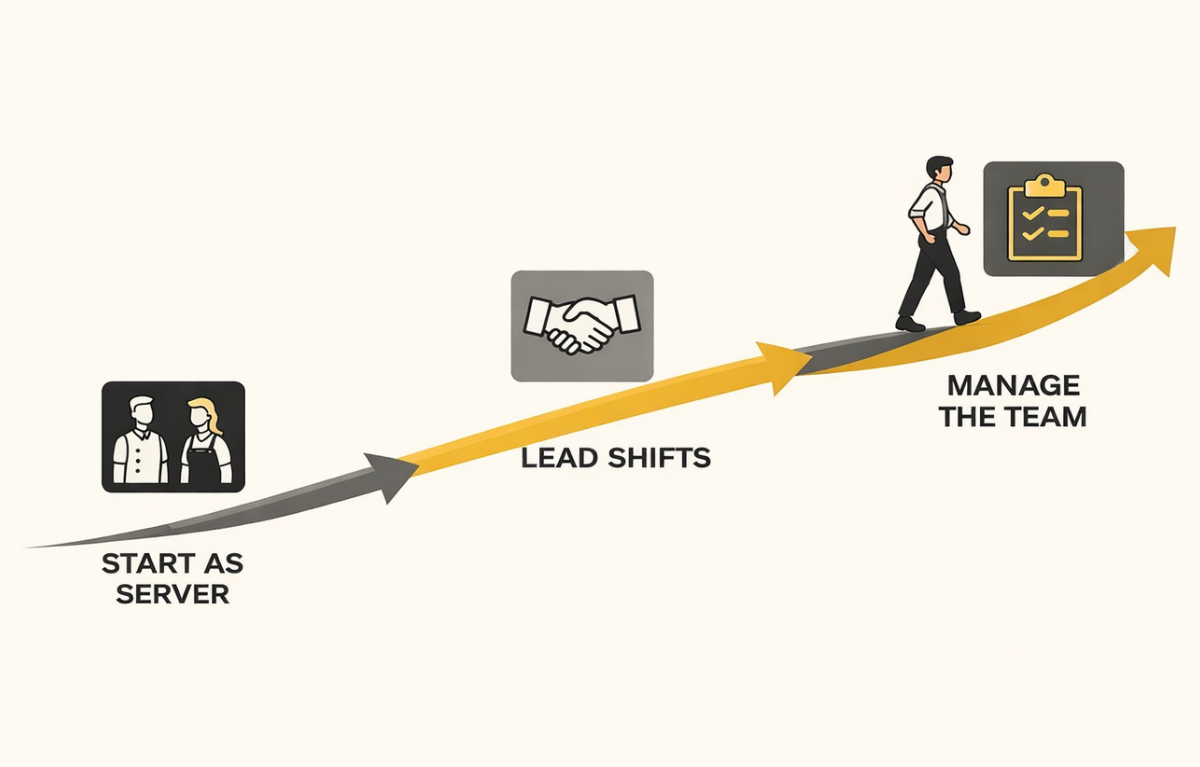
Starting the ‘What Is Next’ Conversation
The whole thing kicks off with a dedicated conversation. This is a real sit-down, a meeting focused completely on them and their aspirations. The goal is simple: line up what they want with what the business needs. That is the win-win.
Start by acknowledging what they are already bringing to the table and state clearly that you see a bigger future for them here. From there, you shift the conversation to what is next. Your job is to listen, ask the right questions, and help them paint a picture of their career within your restaurant group.
Get the ball rolling with questions that make them think beyond their current role:
- “If you look out one year from now, where do you want to be? How about in three years?”
- “What is a role in this restaurant that really excites you? What about it stands out?”
- “To get to that next level, what skills do you think you need to build?”
Building the Roadmap Together
Once you have a shared vision for their goal, it is time to build the roadmap. This plan has to be specific, actionable, and built for them, not a one-size-fits-all template. It should draw a clear line from their current role to where they want to go, whether that is server to shift lead or sous chef to chef de cuisine.
A solid roadmap should be a mix of different kinds of growth opportunities. Think about including these elements:
- Skill-Building Goals: Lock in on two or three specific skills they need to master. This could be anything from getting confident with inventory software to learning how to run a pre-shift meeting that actually fires people up.
- Mentorship: Pair them with a senior leader who is already crushing it in the areas they want to grow. This gives them a trusted guide for real-world advice and honest feedback.
- Targeted Assignments: Give them “stretch” projects that push them a little. If they want to be a manager, have them help with the weekly schedule or take the lead on training a new hire.
Investing in your high-potential people is not just nice to have; it is a strategic move. Developing talent from within strengthens your leadership pipeline and reduces the cost and disruption of external hiring.
According to LinkedIn, employees at companies with strong internal mobility stay an average of 60% longer. In hospitality, where turnover is constant, that kind of retention can make a real difference.
Building leaders from within is not just about growth. It is about stability.
Turning the Plan into Action
A roadmap is useless if it just collects dust in a folder. The final, and most important, step is putting it into motion and setting up a regular rhythm for check-ins. Schedule short, monthly follow-ups to talk about progress, celebrate the small wins, and tweak the plan if you need to.
These check-ins are what keep the momentum alive. They give you a chance to offer guidance, reinforce good habits, and make sure your rising star feels supported, not stranded. For instance, after they tackle a tough assignment, use that moment for specific praise and a few pointers for next time. Getting that feedback loop right is everything, and if you need some pointers, check out our guide on how to give constructive feedback.
By creating and actively managing these roadmaps, you are doing way more than just training an employee. You are building your next generation of leaders from within. You are creating a culture where ambition is not just noticed, it is actively developed and rewarded.
A Few Common Questions About Spotting High-Potential Staff
We’ve gathered the most common questions from hospitality leaders and answered them directly, based on what actually works in a busy restaurant. Think of this as your field guide to getting it right.
How do I avoid bias when picking high-potential employees?
The single best way to fight bias is to stop relying on “gut feelings” and start leaning on objective data. It is human nature to gravitate toward people we like or connect with, but that is how real talent gets overlooked. You need a system that values what people do, not just how they make you feel.
Focus on the concrete, observable signals we have talked about. Did they take initiative during a chaotic service? Did they successfully lead that small inventory project? Did they step up and solve a problem that was dragging the team down? These are facts, not feelings.
To take it a step further, use calibration sessions. Get two or three of your managers in a room to talk through potential candidates. This forces everyone to back up their picks with actual evidence. One manager might have seen something another missed, giving you a much fairer, more balanced picture of who truly has potential.
Build a process where multiple voices are heard. When you bring different perspectives to the table, you automatically water down individual biases. It makes it far more likely that your best people, not just the most visible ones, get the recognition they deserve.
What is the real difference between a high performer and a high-potential employee?
On the surface, they both look like your star employees. But the way they add value to your business is completely different.
Think of it as the difference between today and tomorrow.
A high performer is someone who absolutely crushes their current role. They consistently meet or blow past every goal you set. They are your best server, your fastest line cook, and your most organized host. They are the engine that powers your daily operations. You need them.
A high-potential employee, on the other hand, not only excels today but also shows you they are ready for what is next. They have the ambition, the hunger to learn, and the ability to think beyond their station. They do not just ask “what’s next,” they ask “why” and “what if.”
It is the gap between mastering today’s job and being ready for tomorrow’s challenges. While a high performer delivers outstanding results, a high-potential employee has the drive to elevate everyone around them and eventually lead.
How soon can I spot potential in a new hire?
You can start looking for signs on day one. While it definitely takes time to get a full read on someone, the seeds of high potential often sprout quickly, especially in the controlled chaos of a restaurant. You just have to know what you are looking for.
Pay close attention during their first few weeks of training and onboarding.
- Do they ask sharp questions that go beyond just learning the task in front of them?
- Are they genuinely curious about how different parts of the operation, the bar, the kitchen, and the floor, fit together?
- Do they jump in to help teammates without being asked, even when it is not their direct responsibility?
That kind of natural initiative is a huge tell. When a new hire gets the hang of their core duties and immediately starts looking for other ways to contribute, you are probably looking at someone special. They are not satisfied just doing the job; they are already trying to make an impact. These are the first clues that you have hired a future leader.
Ready to stop guessing and start building your next generation of leaders? MAJC✨ is the all-in-one platform for hospitality operators who want to hire smarter, retain longer, and develop their teams with confidence. From expert-led training, a powerful peer community, and practical tools for hiring and retention, we give you everything you need to build a thriving restaurant. Explore how MAJC can transform your talent strategy today.