


The best deals are won long before you ever sit down at the negotiating table. It is all about the prep work, and in today’s operating environment, that preparation matters more than ever.
With food and labor costs continuing to pressure margins across the industry, operators are under increasing pressure to manage costs more effectively. Food prices have risen roughly 40% since 2020, while median profit margins for full-service restaurants dropped to 2.8% in 2024, down from 4% in 2019, according to the National Restaurant Association report.
If you want to learn how to negotiate with suppliers from a position of strength, not desperation, you have to do your homework. That means getting crystal clear on three things: your purchasing data, your future needs, and your walk-away point.
Build Your Foundation for a Winning Negotiation
The single biggest mistake operators make is showing up to a supplier meeting unprepared. Walking in without a firm grip on your numbers is like trying to run a busy service without a prep list. You might survive, but you are guaranteed to leave money and opportunities on the table. The best negotiations are not won with aggressive tactics; they are secured with meticulous groundwork.
This preparation shifts the whole dynamic. It is no longer a battle of wills but a collaborative search for a solution that benefits both sides. And building a real partnership is not just a feel-good tactic; it is smart business.
Know Your Numbers Inside and Out
First thing is first: you need to become the world’s leading expert on your own operation. That means digging into your historical purchasing data to uncover the real story of your consumption, seasonality, and spending. When you operate from a place of certainty, you stop guessing and start leading the conversation.
Here’s what to focus on:
- Actual Consumption Volume: Do not just look at what you ordered. How much of that case of avocados did you actually use over the last six or 12 months? Your inventory system holds the key.
- Seasonality and Demand Spikes: When do you burn through fresh produce? When does your wine ordering peak? Identifying these trends helps you give suppliers a predictable schedule, which they love.
- Past Supplier Performance: Pull up those old invoices and delivery notes. Were they always on time? Was the quality consistent? This is not about pointing fingers; it is about having the facts ready for your next discussion.
This is a whole lot easier if you have the right systems in place. If you are still using spreadsheets and clipboards, it might be time for an upgrade. You can see what is involved by checking out our deep dive on how to implement a food inventory management system.
This simple process flow sums it up perfectly. Nail these three steps, and you are ready for any conversation.
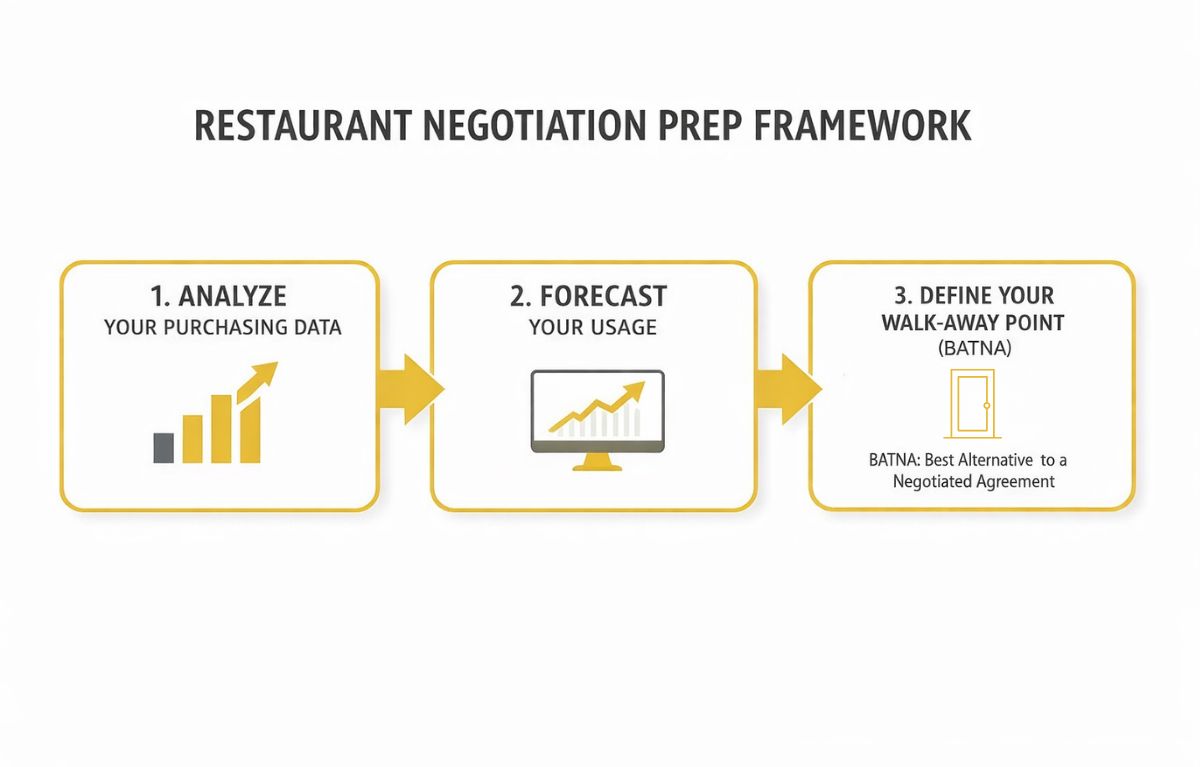
Mastering these pillars, analyzing your data, forecasting your needs, and defining your walkaway point, is what separates amateur haggling from professional negotiation.
To help you get organized, here is a simple checklist to run through before you pick up the phone.
Your Pre-Negotiation Checklist
| Preparation Area | Key Action | Why It Matters |
|---|---|---|
| Data Analysis | Pull six to 12 months of purchasing and consumption data for key items. | Provides a factual basis for your volume and spending claims. |
| Forecasting | Project future needs based on historical data, seasonality, and growth plans. | Shows the supplier the potential long-term value of your partnership. |
| Market Research | Get quotes from at least two other qualified suppliers. | Gives you pricing benchmarks and strengthens your BATNA. |
| Define BATNA | Identify your absolute best alternative if this negotiation fails. | This is your source of power and confidence to walk away from a bad deal. |
| Prioritize Terms | List your “must-haves” and “nice-to-haves” (e.g., price, payment terms, and delivery). | Keeps you focused on what truly matters and prevents you from giving up too much. |
Completing this checklist turns preparation from a vague idea into a concrete, actionable process. It ensures you walk into every meeting with clarity, confidence, and a clear path to a better deal.
Define Your Walk-Away Point
The last, and most powerful, piece of the puzzle is defining your BATNA. It stands for your Best Alternative To a Negotiated Agreement.
Put simply: what is your Plan B?
Your BATNA is your safety net. It is what keeps you from taking a bad deal out of fear or desperation. When you know you have other good options, you can negotiate calmly and rationally, focused on your goals without feeling cornered.
Your BATNA could be another supplier you have already vetted, a substitute product that will work just as well, or even bringing a function like bread-baking in-house. The stronger and more realistic your BATNA, the more power you have. It gives you the confidence to say, “Thanks, but no thanks,” and mean it. This one step ensures you always negotiate from a position of strength, not weakness.
Identifying Your Key Negotiation Terms Beyond Price
The price per case will always grab the headlines. But the best operators know that a truly great supplier deal is about so much more than the cost. If you only chase the lowest price, you will get blindsided by hidden costs that wreck your margins, unreliable delivery, inconsistent quality, or rigid payment terms that strangle your cash flow.
Think about it. A cheap ingredient that shows up late and forces you to 86 a popular dish is not a bargain. It is a liability. To negotiate like a pro, you have to look past the unit cost and focus on the total value of the partnership.
While price is a major piece of the puzzle, digging into these other terms is essential when you are mapping out everything from your initial startup costs for a coffee shop to your ongoing operational budget.
Unpacking Minimum Order Quantities
One of the first things to tackle is the supplier’s Minimum Order Quantity (MOQ). A killer per-unit price is useless if the MOQ forces you to tie up thousands of dollars in inventory you cannot store or afford. Your goal is to find a number that matches how your business actually operates.
This is where your prep work pays off. Use your consumption data to ground the conversation in reality. You could say, “I see your standard MOQ is 50 cases of chicken, but our sales and prep data show we consistently use about 20 cases a month. Could we start at that level to match our actual demand and avoid excess inventory?”
This shows you have done your homework. You are not just trying to haggle; you are looking for a practical, sustainable solution. For perishable or specialty items, a lower MOQ is even more critical to prevent the kind of waste that eats directly into your profit, a key factor we dig into in our guide on calculating your restaurant food cost percentage.
Securing Favorable Payment Terms
Cash flow is the lifeblood of any restaurant or bar. The payment terms you set with suppliers directly impact your financial stability and flexibility. The industry standard is often Net 30, meaning you have 30 days to pay an invoice.
But this is absolutely negotiable. Pushing for more time can give you critical breathing room.
- Net 45 or Net 60: Extending your payment window to 45 or even 60 days can be a game-changer for your working capital. It gives you time to actually sell the product and generate revenue before the bill comes due.
- Early Payment Discounts: You can also ask for a discount if you pay ahead of schedule. A common example is “2/10 Net 30,” which gives you a 2% discount for paying within 10 days, while the full payment is still due in 30 days.
When you bring this up, frame it as a win-win. Explain that better terms allow you to manage your cash flow more effectively, which in turn makes you a more stable and reliable customer for them in the long run.
Defining Lead Times and Delivery Schedules
Nothing creates chaos like an inconsistent supplier. A vague promise of “delivery in three to five days” just will not cut it when you are trying to run a service. You need to lock in a clear and predictable lead time, the exact window between placing an order and receiving it.
Get specific during your conversation. Do not be shy about asking direct questions:
- What is the guaranteed lead time for our core items?
- What is the cutoff time for placing an order for next-day delivery?
- Do you offer weekend or holiday deliveries if we get in a jam?
A reliable delivery schedule is a nonnegotiable part of any good partnership. If a supplier cannot commit to a schedule that works for your operation, their low prices do not mean a thing.
Mastering Your Negotiation Tactics and Scripts
This is the moment your prep work pays off. The conversation itself is your chance to shape the deal, and having a few proven tactics in your back pocket can make all the difference. Think of these as frameworks, not rigid rules. You can, and should, adapt them to your own style and the specific situation at hand.
Successful negotiation is not about strong-arming the other person. It is about confidently steering the conversation toward a deal that works for everyone. With the right techniques, you can build rapport, control the narrative, and counter effectively, no matter what comes your way.
Using Anchoring to Frame the Conversation
One of the most powerful moves you can make is anchoring. This is where you make the first offer to set the psychological starting point for the whole discussion. The first number that hits the table, whether it is a price or a delivery timeline, heavily influences how every other number is seen.
Let’s say you are negotiating the price of ground beef, and the supplier’s list price is $5.50 per pound. You can open with a data-backed anchor.
“Based on our volume and a look at the current market, we were looking to come in at $4.75 per pound.”
Even if $4.75 is ambitious, it immediately reframes the conversation around your number, not theirs. The final price is now far more likely to land closer to your anchor than it would have if you had let them start the bidding.
The Art of Bundling for Greater Value
Another smart tactic is bundling. This just means grouping several products together to negotiate a single package deal. Instead of haggling over the price of every single item, you can create leverage by offering to consolidate your spending with one supplier. It is a classic win-win.
You get a better overall price and simplified ordering. The supplier locks in a larger, more predictable order.
Here is how you might approach it:
- Identify related items: Look for products you are buying from different suppliers that one could easily provide. Think dry goods, paper products, and cleaning supplies.
- Present a consolidated offer: Go to your preferred supplier and lay it out. “We currently spend about $3,000 a month on dry goods and paper products combined. If you can provide all of these items and give us a 10% discount on the total order, we are ready to move all that business to you.”
This simple move shifts the focus from unit cost to total account value, which makes your business a lot more attractive.
Crafting Your Communication Scripts
Whether you are on the phone or firing off an email, the language you use sets the tone. Your goal is to be firm but fair, professional yet approachable. Here are a couple of simple scripts to get you started.
Sample Phone Script for a Counter-Offer:
“Hi, Samantha. Thanks for sending over the proposal. We have reviewed the pricing for the fresh produce, and while it is competitive, it is a bit higher than our budget allows. Based on our projected volume of 40 cases per week, we would need to be closer to $28 per case to make this work. Is there any flexibility on your end?”
This works because it is polite, direct, and gives them a clear, data-backed counteroffer. No ambiguity.
Sample Email Script for Following Up:
“Hi, David. Following up on our conversation, we are very interested in moving forward. As we discussed, our main requirement is locking in Net 60 payment terms to align with our cash flow cycle. If you can confirm that adjustment on the agreement, we are prepared to sign this week. Thanks again for your time.”
As hospitality pros juggle fluctuating costs and supply chain headaches, making negotiations more efficient is a must.
Implementing a Supplier Performance Scorecard
The handshake and the signed contract are just the starting line. It is a promise of partnership, but consistent performance is what actually hits your bottom line. To make sure the value you fought for in the negotiation actually shows up, week after week, you need a way to keep score.
This is where a Supplier Performance Scorecard comes in.
It is a simple tool that turns vague feelings into cold, hard facts. This is not about micromanaging your vendors. It is about building a shared, objective language for what success looks like. By tracking a few key numbers, you can have productive, data-driven conversations that celebrate great work and fix small issues before they blow up.
Choosing Your Key Performance Indicators
You do not need a spreadsheet with 50 columns. For most restaurants and hospitality businesses, a handful of core metrics will tell you almost everything you need to know about a supplier’s impact on your daily operations.
Focus on the numbers that directly affect your kitchen, your profitability, and your guest experience.
- On-Time Delivery Rate: What percentage of orders show up within the agreed-upon window? A late truck throws off prep, messes with labor, and can force you to 86 a popular dish.
- Order Accuracy: How often is the order 100% correct? Wrong items, short quantities, or damaged goods create chaos for your receiving team and torpedo your inventory counts.
- Quality Consistency: Does the product meet your spec every single time? Track the number of rejected items or quality complaints. This is your metric for reliability.
- Issue Resolution Time: When things go wrong, and they will, how fast does your supplier fix it? A great partner is one who acts with urgency when you have a problem.
These KPIs are the bedrock of a professional, data-driven relationship. They let you move from, “I feel like you guys have been late a lot,” to, “Our records show the on-time delivery rate dropped by 15% last month. Let’s talk about why.”
Data takes the emotion and blame out of the conversation. It creates a partnership where you and your supplier can look at the same facts, find the root cause of a problem, and solve it together. This is how you build a resilient, long-term supply chain.
Integrating the Scorecard Into Your Workflow
The goal here is to gather crucial data without burying your team in paperwork. The easiest way to do this is to build it right into your existing receiving process. Your team is already checking in orders; adding a few data points is a small tweak, not a new system.
When a delivery arrives, the receiver simply notes the arrival time, any missing or incorrect items, and any products that do not meet your quality standards. This can be logged in a basic spreadsheet or, even better, directly into your inventory management software.
The key is consistency, not complexity.
Reviewing these scorecards regularly is what makes them powerful. It allows you to hold structured, quarterly business reviews with your top suppliers. Those meetings stop being about putting out fires and start being about forward-looking strategy. Mastering these metrics is a nonnegotiable skill for any modern manager, and if you want to go deeper, check out our guide on the top restaurant KPIs every manager should track.
Putting Negotiation Strategies Into Practice: Real-World Playbooks
Negotiation is not a one-size-fits-all game. The tactics that work for a massive hotel group will fall flat for a single farm-to-table restaurant. Your leverage, your goals, and your playbook all depend on your business model.
Let’s break down how these principles work in the real world. We will look at three common scenarios to see how you can adapt your approach, whether you are running one location or a hundred.
The Independent Restaurant and the Local Farm
Imagine you run a single-unit, farm-to-table restaurant. Your brand is built on telling the story of local, high-quality ingredients. Your goal is not just about snagging the lowest price; it is about securing a consistent supply of unique products that your guests cannot get anywhere else.
Your power does not come from massive order volume. It comes from being a great, low-maintenance partner.
- Your Prep: Start by digging into your own data. Track how many specialty greens and heirloom tomatoes you went through last season. Forecast what you will need for the next quarter, remembering to account for menu changes or special events. Your backup plan, or BATNA, is that other local farm you have already vetted.
- The Conversation: This is about partnership. Instead of just demanding a discount, frame it as a win-win. You might say, “We want to feature your farm on our menu and socials. If we commit to buying all our heirloom tomatoes from you this season, that is about 100 pounds a week, can we lock in a price of $3.50 per pound?”
- The Tactic: This is a classic example of value-added bundling. You are bundling your marketing reach with a volume commitment to get a stable price and guaranteed supply. It is a collaborative move that makes the relationship stronger.
The Multi-Unit Hotel Group and Linen Standardization
Now picture a regional hotel group with eight properties. The mission is to standardize the linen program across all locations. This is not just about brand consistency; it is about unlocking major cost savings through bulk purchasing. The biggest hurdle? Getting all the general managers on board and managing a complex rollout.
Here, the negotiation scales up from a personal relationship to a large-scale contract.
For operators at this scale, centralizing procurement is a game-changer for savings and resilience. Research from hospitality experts highlights how programs like Group Purchasing Organizations (GPOs) amplify buying power. But even without a GPO, smart operators who build direct partnerships can negotiate better bulk pricing and combat market volatility, turning a cost-cutting chore into a powerful collaboration.
Your power comes from the combined volume of all eight properties. A supplier will offer much more aggressive pricing and favorable terms for an account of this size than they would for a single hotel.
The playbook here is all about presenting a unified front. Before you even talk to suppliers, your team needs to agree on the exact specs for every sheet, towel, and robe. You then create a single, massive request for proposal (RFP) and send it to three national linen suppliers, clearly stating your total annual volume.
This forces suppliers to compete hard for a major piece of business, giving you huge leverage on price, payment terms (Net 60 or even Net 90), and delivery schedules. Managing your stock becomes critical, so you will want to get sharp on your numbers by understanding how to use the inventory days on hand formula.
The Group Purchasing Organization and Master Agreements
Finally, let’s look at the Group Purchasing Organization (GPO). A GPO’s entire job is to negotiate on behalf of hundreds or thousands of independent restaurants and small hotel groups. They pool the purchasing volume of all their members to get pricing and terms that no single operator could ever dream of getting alone.
The GPO’s power is immense. They are not negotiating for a few cases of chicken; they are negotiating multi-million dollar master agreements for commodities like paper goods, cleaning chemicals, and broadline food products.
This level of negotiation is highly formal and driven entirely by data. The GPO team analyzes the collective spending of all its members, issues incredibly detailed RFPs to major national manufacturers, and uses sophisticated anchoring tactics backed by deep market intelligence. The talks go way beyond price, covering rebates, marketing funds for members, and ironclad performance guarantees. For a GPO, the relationship is less personal and more transactional, but the value it drives back to its members is undeniable.
The right strategy depends on where you sit. The table below breaks down how your goals and tactics shift based on your business type.
Negotiation Strategies by Business Type
| Business Type | Primary Goal | Key Tactic | Common Challenge |
|---|---|---|---|
| Single-Unit Restaurant | Quality and consistency. | Relationship building and value bundling. | Limited volume and leverage. |
| Multi-Unit Group | Cost savings and standardization. | Volume consolidation and competitive bids. | Internal alignment and logistics. |
| Group Purchasing Org (GPO) | Deepest discounts and rebates. | Aggregated volume and formal RFPs. | Member compliance and vendor management. |
Whether you are one restaurant or one hundred, the core lesson is the same: move beyond a simple price discussion. The best deals come from building a strategic partnership that delivers value for years to come.
Common Questions About Supplier Negotiations
Here are a few of the most common sticking points.
What is the biggest mistake operators make when negotiating?
Chasing the lowest unit price, period. It is the single most common trap, and it almost always costs you more in the long run.
A rock-bottom price looks great on an invoice, but it often comes with hidden costs. You might get inconsistent deliveries, lower-grade product that hurts your final dish, or inflexible payment terms that strangle your cash flow.
A smart negotiation looks at the whole picture. It balances price with other critical terms like payment windows (Net 30 vs. Net 60), minimum order quantities (MOQs), delivery frequency, and quality guarantees. You are not just making a transaction; you are building a partnership. That is the difference between a cheap deal and a strategic investment in your supply chain.
How can a small independent restaurant get any leverage?
For a small operator, leverage does not come from volume. It comes from being an outstanding partner. Think about it: suppliers deal with difficult, slow-paying, high-maintenance accounts all day. Being the opposite makes you incredibly valuable.
Here is how you can build that kind of leverage:
- Be Flawless with Payments: Suppliers love clients who pay on time, every time. It is a huge relief for them and immediately sets you apart.
- Offer Great Feedback: Be the operator who is willing to test a new product and give detailed notes. You become a source of free market intelligence for them.
- Stay Flexible: If you can take deliveries during their off-peak hours, you make their route more efficient. That simple move saves them time and money, which they will remember.
- Pool Your Purchasing Power: Talk to other local independent restaurants. By forming a small buying group and combining your orders, you can approach suppliers with much more attractive volume.
While you may not have the buying power of a national chain, being a low-maintenance, reliable, and collaborative account makes you an A-list client. That is a form of leverage that money cannot buy.
How often should I be renegotiating contracts?
There is no magic number here. The right frequency depends entirely on the product category and how volatile its market is. You need to tailor your approach to what you are buying.
For commodity items with prices that swing wildly, like fresh produce, meat, or seafood, you should be reviewing prices quarterly, or even monthly. Shorter-term agreements let you stay nimble and adapt to market shifts instead of getting locked into a bad price.
For more stable items like dry goods, paper products, or linens, an annual contract usually makes sense. The key is to build a formal check-in into that contract every six months. This is not necessarily a full-blown price renegotiation, but it is a chance to review performance against your KPIs and keep the lines of communication wide open. It ensures the partnership is still working for both of you.
At MAJC✨, we provide the tools, training, and community to help hospitality leaders run smarter operations. From our expert sessions to a robust library of operator-tested templates, we help you build a more profitable and sustainable business. Join our community to access the systems and peer support you need to master every aspect of your operation. Learn more at majc.ai.