


You know the feeling. You can run a station clean, move fast without getting sloppy, and keep your head during a slammed service. Then you send out your resume for a cook and get nothing back.
That disconnect is more common than it should be. Demand for kitchen roles remains strong, with employment for chefs and head cooks projected to grow 7% between 2024 and 2034, according to the U.S. Bureau of Labor Statistics. And yet, getting noticed still comes down to how you present your experience on paper.
Most of the time, the problem is not kitchen ability. It is translation. Hiring managers do not see your pace, your timing, or how you handle pressure. They see a page, often for a few seconds, and they decide whether you look like someone who will make service easier or harder.
A strong resume for a cook should read like mise en place. Organized, specific, and ready for service.
Why Your Great Skills Aren’t Getting You Hired
Managers are not hiring duties. They are hiring reliability, speed, judgment, and fit. If your resume sounds like every other resume in the stack, you disappear. That happens even faster when you are applying online, where generic applications pile up from every direction. If you are still searching broadly, these best hospitality job boards can help you focus on stronger listings instead of blasting the same resume everywhere.
What managers notice
They look for clues that answer practical questions:
- Can this person handle volume
- Will this person protect food quality
- Do they keep a clean station
- Will they train well and stay steady
- Can they work with the team, not against it
If your resume does not answer those questions, your real skill never gets a chance to matter.
What weak resumes do wrong
A weak cook resume usually has one or more of these problems:
- Generic job titles only like “Cook” or “Line Cook,” with no station, cuisine, or scope
- No proof of impact so the manager cannot tell whether you were strong, average, or a problem
- No customization which makes you look like you are applying everywhere without caring where you land
- No retention signal which matters in an industry where managers are tired of hiring people who leave fast.
The good news is this is fixable. Most resumes do not need fake polish. They need sharper wording, better structure, and a better understanding of how kitchens hire.
The Anatomy of a Powerful Cook Resume
A hiring manager opens your resume between lunch prep and the first dinner tickets. You have a few seconds to answer the only question that matters. Can this cook step in, stay steady, and make the kitchen better?
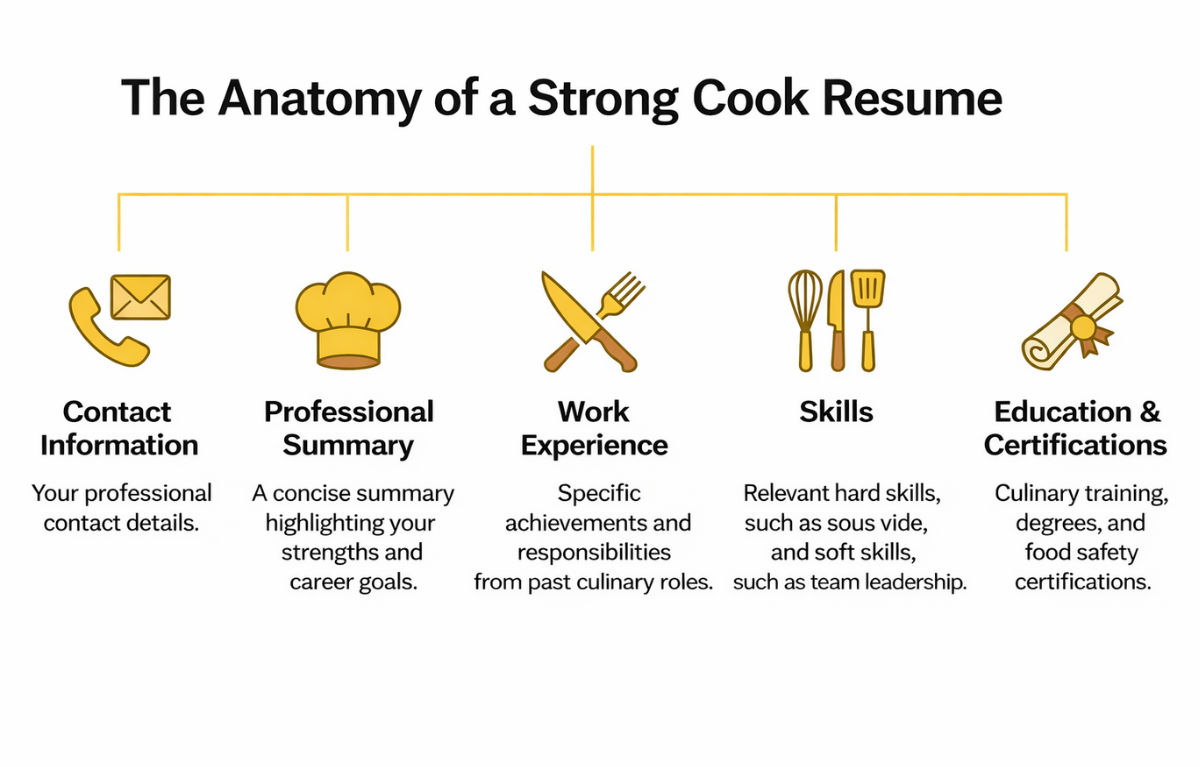 A strong resume for a cook needs clear structure, fast readability, and proof that you are worth training and keeping. In a business with constant turnover, that last part gets missed far too often. Skills get attention. Reliability gets hired.
Start with the essentials
Put your contact information at the top and keep it clean. Name, phone, email, city, and state are enough. Use an email address that looks professional, and make sure your voicemail works. Small details like that signal whether you handle the basics.
Then write a short professional summary. Two or three lines are enough. Good summaries tell three things fast. What kind of cook you are, what kind of kitchen you have handled, and what value you bring beyond filling a schedule gap.
A summary that works:
- Line cook with grill and sauté experience in high-volume casual dining
- Strong food safety habits, organized station setup, and calm execution during peak service
- Known for consistency, clean handoff, and dependable attendance. Seeking growth into lead line or sous chef responsibilities
That last line matters. Managers are not only hiring for tonight. They are watching for signs that you will last, train up, and reduce another hiring cycle in 60 days.
Build a skills section that reflects real kitchen hiring
The skills section should confirm that you can do the job the posting describes. It should not read like a keyword dump.
List hard skills that match the kitchen’s needs, then add a few soft skills that matter in service. Back-of-house teams still care about professionalism, communication, and composure because those traits affect ticket times, mistakes, and how well a shift holds together.
Hard skills to list if they apply
- Stations worked: grill, sauté, fry, pantry, expo, prep
- Food safety: food handling, sanitation, temp logs, allergen awareness
- Equipment and systems: slicers, combi ovens, flat tops, immersion circulators, POS tools (if relevant)
- Production strengths: batch prep, ticket flow, portioning, recipe consistency
- Service environment: high-volume dining, banquets, hotel breakfast, catering, brunch
- Cuisine familiarity: Italian, Mexican, steakhouse, seafood
Soft skills that matter in real kitchens
- Clear communication during service
- Composure under pressure
- Clean and organized station discipline
- Reliability and consistent attendance
- Training and mentoring new hires
If you have certifications, give them their own section so they are easy to spot. ServSafe should never be buried. Neither should allergen training, local food handler cards, or role-specific credentials. If you need to strengthen that section, review these hospitality industry certifications for food service roles and choose the ones that match the kitchens you want.
Show retention value, not just kitchen ability
This is one of the biggest misses I see.
A resume can show that you can cook. A better resume shows that you are worth investing in. Managers read between the lines for signs of stability because turnover burns time, payroll, and team morale. If you stayed in roles for solid stretches, trained new hires, opened or closed regularly, covered multiple stations, or earned more responsibility, make that visible.
Examples:
- Trusted to close grill station and complete end-of-night food safety logs
- Cross-trained on sauté and fry to support coverage during call-outs
- Helped onboard two new line cooks during menu rollout
- Promoted from prep cook to line cook within eight months
Those details show you did more than just punch in and out. They show the kitchen trusted you.
If you have little or no kitchen experience
Entry-level cooks often get stuck here and assume they have nothing to say. That is not true. I have hired plenty of strong beginners whose resumes showed work ethic, pace, and coachability before they ever worked a line.
Use any experience that proves transferable habits:
- Fast-paced retail or food service work
- Catering, concessions, cafeteria, or school dining
- Culinary school labs
- Meal prep for events, clubs, or community groups
- Cleaning, stocking, receiving, or shift opening duties
- Volunteer work involving food handling or team service
A good entry-level summary might say:
- Prep-focused cook seeking first restaurant kitchen role
- Comfortable with knife work, basic food safety, cleaning routines, and following recipes
- Known for punctuality, quick learning, and steady performance in fast-paced team settings
That works because it gives a manager a reason to take the interview instead of guessing.
Keep education brief unless it changes the conversation
Education belongs on the resume, but it rarely carries the application by itself. List culinary school, diploma, GED, or relevant coursework briefly unless the role specifically values formal training.
Put the strongest material in the top half of the page. If your best-selling point is volume experience, station range, promotion history, or certifications, make sure it appears before a manager has to hunt for it. In kitchen hiring, buried value usually gets missed.
Writing Experience That Shows Real Impact
A chef skims your resume between tickets, sees five bullets that read like a job description, and moves on. That is what happens to a lot of cook resumes. The problem usually is not a lack of ability. It is weak proof.
Good experience bullets show what changed because you were on that station, on that shift, or in that kitchen. I look for signs that a cook made service smoother, waste lower, standards tighter, or turnover less painful for the team. In a business where people leave fast, retention value matters. If you stayed, trained others, held standards, or became the person a chef could count on, put that on the page.
Resumes with quantified achievements tend to stand out more and make it easier for hiring managers to assess your impact. Vague descriptions, on the other hand, are often overlooked.
Build bullets the way chefs evaluate cooks
Start with responsibility, then add pressure, then add result.
A strong bullet usually answers four questions fast:
- What did you own?
- In what kind of service or production setting?
- What standard did you protect or improve?
- Why did that matter to the kitchen?
That structure works because kitchen hiring is practical. “Prepared food for service” is filler. “Ran fry station for lunch rush, held ticket accuracy, and kept pickup times steady during high-volume service” tells me a lot more.
What managers want to see
Use verbs that show ownership when you earned it.
Good options include:
- Managed
- Executed
- Maintained
- Trained
- Coordinated
- Reduced
- Improved
Then add context. Volume, station, covers, prep load, banquets, opening duties, inventory counts, cleaning standards, and team training all help picture your real level.
Proof matters, but it does not have to be dramatic. As noted earlier, strong cook resume examples often use specifics like waste reduction, faster prep, better consistency, menu contribution, or staff training. That style works because it sounds like kitchen reality.
Show retention value, not just output
A lot of cooks miss this.
Turnover is expensive. If your resume shows that you stayed long enough to earn harder stations, open or close independently, train new hires, or keep standards steady during staffing gaps, you become more valuable than someone with the same knife skills and no staying power.
These bullets carry weight:
- Trained three new line cooks on station setup, labeling, and closing procedures to keep service standards consistent
- Cross-trained on pantry, fry, and grill to cover callouts and keep service fully staffed
- Helped onboard two new line cooks during menu rollout
- Promoted from prep to line cook within eight months
Those points tell a chef you lower risk. That gets interviews.
Match the experience to the kitchen
Different kitchens hire for different pressure points. A hotel may care about banquet volume and consistency. A neighborhood bistro may care more about speed, station independence, and clean communication with expo. A healthcare kitchen may care most about safety, routine, and accurate production.
If you are not sure how to frame your background, review the range of back-of-the-house positions and choose bullets that fit the role you want, not just the tasks you handled.
If the employer uses software before a chef sees your application, clear wording helps there too. A plain resume with direct job language gives automated resume screeners more to work with than vague bullet points.
Before and after examples
| Weak bullet | Better bullet |
|---|---|
| Worked grill station | Managed grill station during dinner service handling 100+ covers with consistent quality |
| Helped with inventory | Supported inventory counts and restocking to prevent shortages during service |
| Trained new staff | Trained 3+ new line cooks on station setup and prep standards |
| Prepped food daily | Prepared ingredients with accurate portioning, labeling, and station readiness |
If a bullet could describe almost any cook, it is too generic.
Specific, grounded bullets do not make you sound arrogant. They make you sound reliable. That is the difference between a resume that gets a quick pass and one that gets an interview.
Optimizing for ATS and Standing Out to Managers
A lot of cooks still think resumes are mainly for chefs and hiring managers. That is no longer how much hiring works. Your resume often has to pass software before a person ever sees it.
What the system is looking for
ATS software scans for relevance. It wants to find overlap between the job posting and your resume.
If the posting says:
- grill station
- food safety
- prep lists
- inventory
- banquet production
Then those exact ideas should appear on your resume if they are true for your background.
This is why a plain, readable format wins. The machine cannot appreciate your design choices. It can only parse text cleanly.
Simple ATS rules that work
Keep formatting clean
Use standard headings like Experience, Skills, Certifications, and Education. Avoid text boxes, tables for your full layout, graphics in place of words, or overly styled templates.
Mirror the posting language
If the role is for a line cook, say line cook. If the posting emphasizes sauté, banquet, breakfast production, or prep volume, use those terms where honest and relevant.
Save the file the right way
Most employers can handle PDF, but some systems parse Word documents more reliably. Follow the application instructions exactly. When in doubt, use the requested format and keep the file name professional.
Need help understanding what a posting is really asking for? Start with a solid line cook job description and compare it line by line with your resume.
The same traits that help you beat ATS also help you impress a chef. Clarity, relevance, and clean execution.
Customizing Your Resume for Any Kitchen
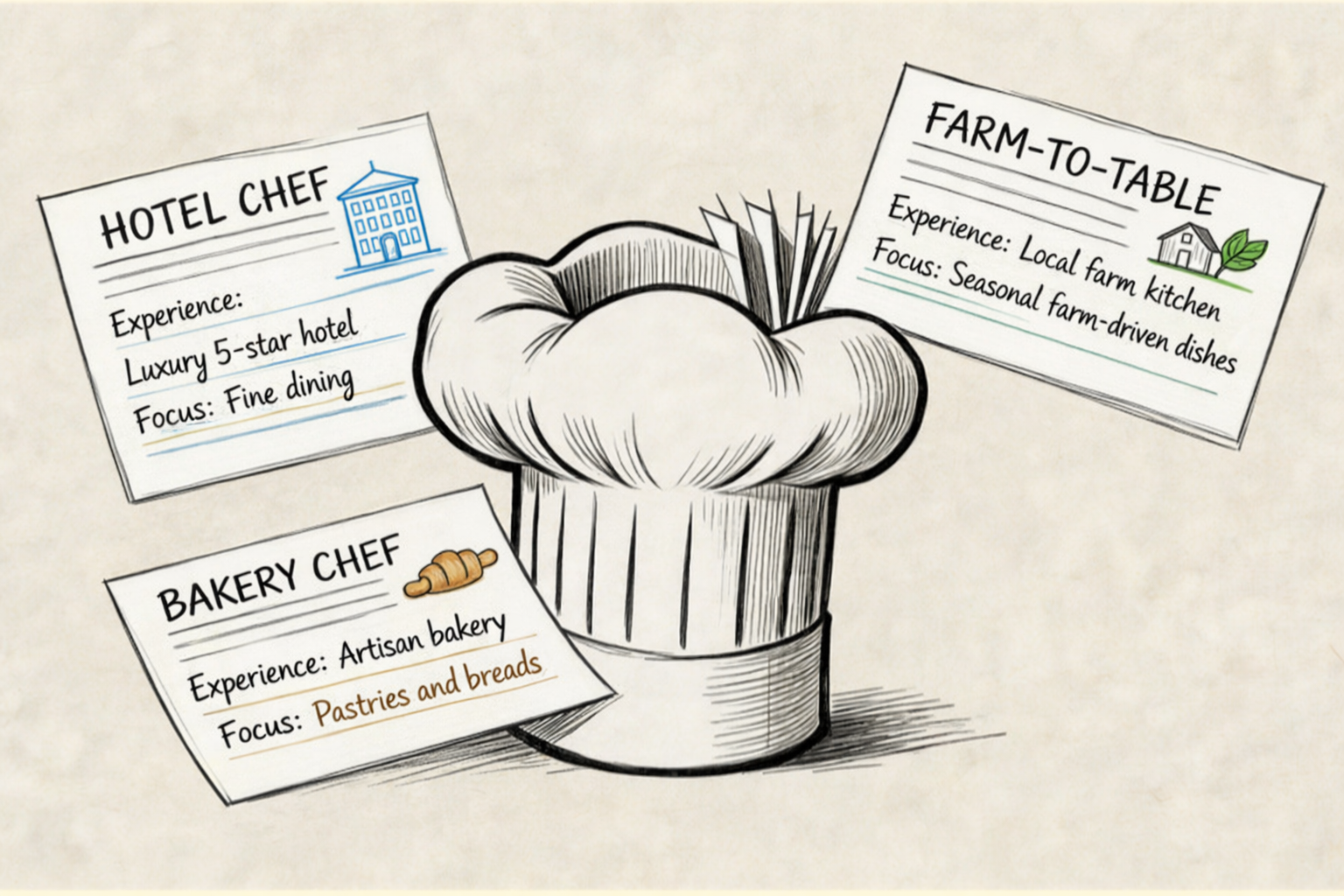
The best resume for a cook is not universal. A hotel chef, a farm-to-table owner, and a bakery production lead all read resumes differently because they run different operations.
Match the kitchen, not just the title
A prep cook applying to a high-volume hotel should highlight consistency, batch production, organization, and speed. A candidate applying to a scratch kitchen should emphasize knife work, recipe execution, seasonal ingredients, and care with detail.
That sounds obvious, but most applicants still send the same version everywhere.
Micro-credentials help, but only if they fit
Food safety courses, allergen awareness, and any basic hospitality certifications strengthen an entry-level resume because they show intent. They also give the employer one less reason to hesitate.
Frequently Asked Questions About Cook Resumes
A few questions come up constantly when cooks finalize an application. These are the ones worth checking before you hit submit.
Common Cook Resume Questions
| Question | Answer |
|---|---|
| Should a cook resume be one page? | Usually, yes. Most cook resumes read best at one page unless you have extensive leadership experience, multiple relevant roles, or significant certifications. |
| Do I need a summary at the top? | Yes, if it is short and specific. Skip generic objective statements and use a concise summary that matches the role. |
| What if I do not have kitchen experience? | Use transferable skills from fast-paced, service-oriented, or process-driven work. Add relevant food safety training if you have it. |
| Should I list every kitchen job I have had? | No. Keep the most relevant roles and focus on recent experience unless an older role strongly supports the job you want. |
| Is it worth adding mentoring experience? | Absolutely, especially for senior or growth-track roles. |
Quick final checks before sending
- Read job title alignment and make sure your target role appears clearly
- Check verb strength so your bullets sound active and credible
- Remove filler like “hardworking,” “team player,” or “fast learner” if you do not back it up
- Proofread once more because typos on a one-page document signal carelessness
A hiring manager should be able to scan your resume and understand three things fast: what kind of cook you are, what environment you have handled, and why you would make the kitchen stronger.
If you want a faster way to stand out without constantly rewriting your resume, MAJC✨ Jobs uses a smarter matching system built for hospitality. Learn more at MAJC.AI.