
Improving your restaurant is about creating smart, repeatable systems. It is not about one magic bullet. It is about getting three core areas right: empowering your people, engineering your menu for profit, and getting the right tech to do the heavy lifting. Nail these three pillars, and you’re not just surviving. You are building a business that is more consistent, efficient, and profitable.
Building Your Blueprint for Operational Excellence
Running a restaurant has never been tougher. Margins are tight, staffing is a constant headache, and every cost seems to be going up. The idea of a complete operational overhaul can feel like just one more thing on an already impossible to-do list.
But here’s the good news. Huge improvements don’t come from some massive, disruptive change. They come from a series of small, smart, and consistent adjustments. Think of it less like a demolition and more like reinforcing the foundation, one beam at a time. The goal is to stop putting out fires all day and start building a fire-proof structure. This guide is your roadmap to get there, focusing on the practical steps successful operators take to create smoother workflows and a healthier bottom line.
The Three Pillars of Success
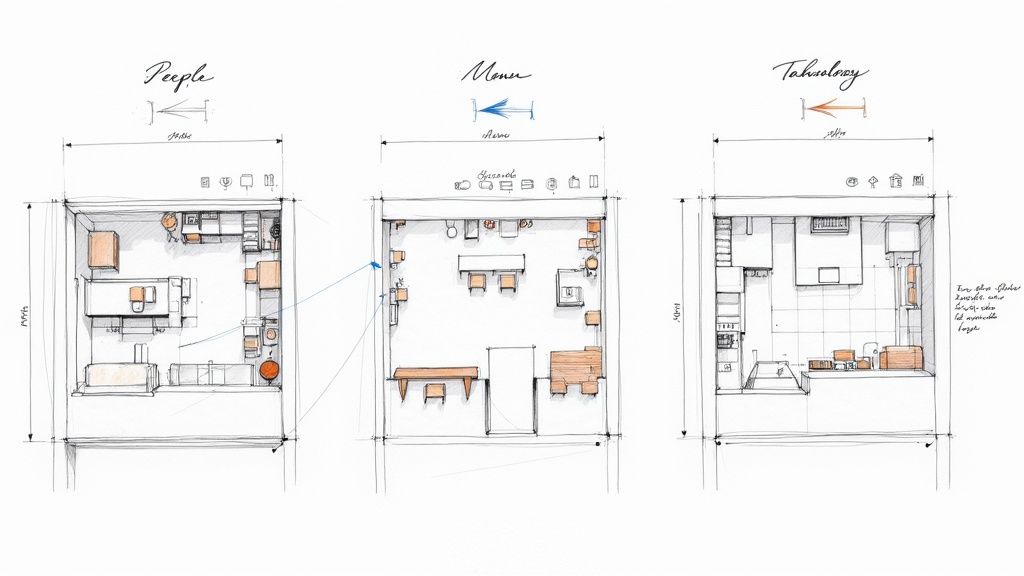
“Operations” can feel like a vague, corporate buzzword, but it really just comes down to how well three parts of your business work together. Each one leans on the others. A weakness in one area will absolutely undermine the strengths of the rest.
We are going to dig into each of these in detail, but it helps to see how they connect from the start. Thinking in these three pillars gives you a structured way to find your weak spots and figure out what to fix first. It’s the first step toward building a restaurant that does not just get by, but actually thrives.
The table below breaks down these core areas, their main goals, and the key actions we’ll cover. Think of it as your cheat sheet for the rest of this guide.
Core Pillars of Restaurant Operations
Here’s a high-level look at the framework we will use to diagnose and improve your operations, turning chaos into predictable success.
| Operational Pillar | Primary Goal | Key Actions |
|---|---|---|
| People and Culture | Empower your team to deliver consistent, high-quality service. | Implement structured training, foster a positive culture, and use effective scheduling. |
| Menu and Profitability | Engineer a menu that maximizes profit and kitchen efficiency. | Analyze item performance, control food costs, and streamline offerings. |
| Technology and Systems | Use tools to automate tasks, gather data, and boost efficiency. | Adopt a modern POS, inventory software, and workflow optimization tools. |
Understanding how these pillars support each other is crucial. A well-trained team cannot execute a poorly designed menu, and even the best tech is useless without a team that knows how to use it. Now, let’s dive into the specifics of each one.
Mastering Your Staffing and Training Strategy
Your team is the heart and soul of your restaurant. They are the ones bringing your vision to life, interacting with guests, and ultimately deciding whether a first-time visitor becomes a regular. But in an industry where staffing feels like a constant battle, just filling shifts is a losing game. The real win comes from building a strategy that attracts, develops, and keeps great people.
This is not about finding warm bodies to fill a schedule. It is about creating a culture where your team feels valued, supported, and fired up to do their best work. When your people are engaged, they deliver better service, which means happier guests and a healthier bottom line.
Build an Employer Brand That Pulls Talent In
In a hiring market this tight, you have to give top talent a real reason to choose you over the place down the street. It all starts with building a strong employer brand—your reputation as a place people want to work. It’s what your team, past and present, says about you when you’re not in the room.
To build a brand that attracts the right people, zero in on these areas:
- Showcase Your Real Culture: Use your social media and website to put your team in the spotlight. Share behind-the-scenes moments, celebrate employee milestones, and let the genuine personality of your restaurant shine through.
- Be Transparent with Pay: Put your pay ranges right in the job description. Honesty from the first click builds trust and shows you respect a candidate’s time. No games.
- Talk About the Path Forward: People want more than a paycheck; they want a career. Highlight your commitment to promoting from within and the training you provide to help them build real skills.
This proactive approach flips the script. Instead of desperately chasing applicants, you start attracting candidates who are genuinely excited to join your team. It’s the first real step in solving the staffing puzzle for good.
The Power of a Killer Onboarding Program
So you hired someone great. Now the real work begins. Those first few weeks are make-or-break. They determine whether your new hire feels set up for success or totally lost. A rushed, disorganized orientation is a fast track to turnover.
A structured onboarding program is more than just handing someone a uniform and pointing them toward the POS. It’s a deliberate process that covers the stuff that actually matters. A well-designed onboarding process is your single best weapon against early turnover. It transforms a nervous new hire into a confident, integrated team member who gets their role and feels connected to what you are building.
Make sure your onboarding checklist includes these fundamentals:
- Culture Immersion: Do not just lecture them about your mission and values; show them. Have new hires shadow your best people to see your standards in action.
- Crystal Clear Expectations: Give them a detailed handbook covering everything from service steps, and side work, to how you communicate as a team. Leave zero room for confusion.
- Consistent Check-ins: Schedule quick, formal check-ins at the end of their first day, first week, and first month. This creates a safe space for them to ask questions and gives you priceless feedback on your process.
A thoughtful onboarding experience sends a clear message: “We’re invested in you.” That makes them more invested in you. For a deeper dive, check out our guide on how to reduce staff turnover.
Keep Your Best People from Walking Out the Door
Hiring is expensive. Training takes time. Retention is where you see the real ROI. Keeping your best employees happy and engaged is one of the smartest operational moves you can make. The industry is still reeling from major labor challenges. According to the National Restaurant Association, more than 8 million U.S. restaurant workers were laid off or furloughed in 2020, about two-thirds of the workforce. These staffing-shortage pressures continue to force many independent restaurants to cut their hours.
To fight this, you need to tune into what really motivates your team. It is not always money. Things like flexible scheduling can be a powerful, low-cost perk that shows you respect their life outside of work.
Another game-changer is the “stay interview.” Do not wait for an exit interview to hear what went wrong. Sit down with your key players now and ask them what’s going right. Ask questions like, “What do you look forward to when you come to work?” or “If you had a magic wand, what’s one thing you would change about your job?” This kind of proactive feedback loop helps you fix small problems before they become big reasons to leave.
Ultimately, building a culture of appreciation, recognition, and open communication is the best strategy for creating a team that wants to stick around for the long haul.
Engineering Your Menu for Profit and Speed
Your menu is not just a list of what you sell; it’s the most powerful tool you have for sales and operations. When you get it right, a menu can supercharge your profits and bring a sense of calm to a chaotic kitchen. A smart menu does not just present options; it guides guests toward your most profitable dishes and makes your back-of-house faster and more consistent.
This whole process is called menu engineering. It’s about ditching the gut feelings and using hard sales data to see what is actually driving your business. Once you identify your star performers, your duds, and the items that are secretly crushing your kitchen, you can start making strategic cuts and tweaks. The result is a win-win: happier guests and a much healthier bottom line.
Uncovering Your Menu’s Winners and Losers
First things first: you need to categorize every single item on your menu using two simple metrics: popularity (how many you sell) and profitability (the margin on each one). This analysis will sort every dish into one of four buckets, and each one needs a different game plan.
Think of it like building a fantasy league for your food. Are your most popular dishes also your biggest money-makers? Or is that top-selling burger barely breaking even? Finding the real answers here is how you unlock hidden profit potential.
This infographic breaks down how a strong culture, built on attracting, training, and keeping the right people, is the foundation for any operational win.
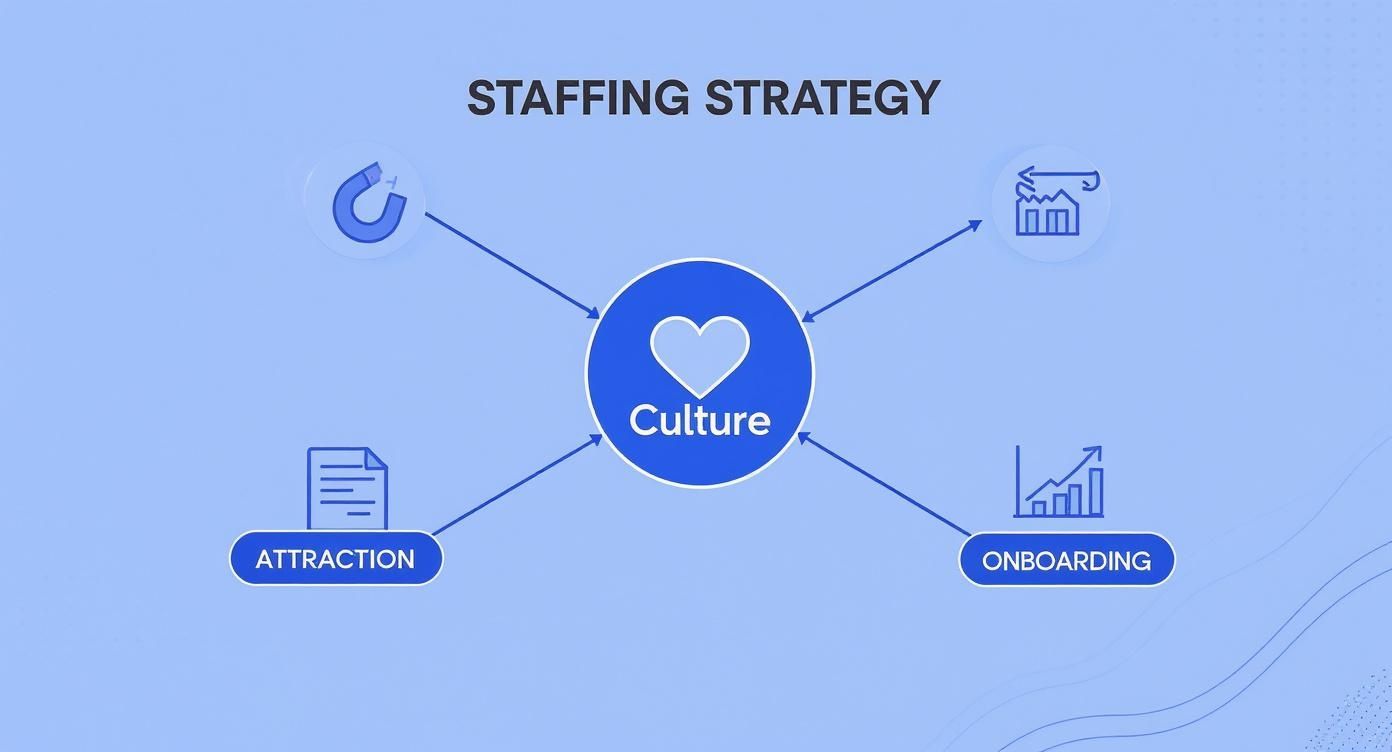
As you can see, a great culture is not a one-off initiative. It’s a connected system where finding the right talent, onboarding them effectively, and giving them real reasons to stay are all woven together.
The Case for a Leaner, Meaner Menu
It might feel backward, but shrinking your menu is often one of the quickest ways to improve your entire operation. A massive, sprawling menu creates decision fatigue for guests, invites inconsistency from the kitchen, and leads to a ton of food waste from all the inventory you have to carry.
A focused menu, on the other hand, lets your kitchen team become absolute masters of a smaller set of dishes. This pays off in a few huge ways:
- Faster Ticket Times: With fewer, more practiced dishes, cooks fly through orders with more speed and precision, especially when you are slammed.
- Reduced Food Waste: A tighter ingredient list means less perishable food sitting on your shelves, which directly slashes your food costs.
- Improved Consistency: When your team nails a core set of recipes, the quality and presentation of every plate become far more reliable. That is what builds trust with guests.
This is not just a theory; it is where the industry is heading. A 2021 Technomic study found that 36% of restaurant operators planned to adopt smaller menus focusing on core items, a trend that continues as restaurants seek greater efficiency and stability.
A well-curated menu is a sign of confidence. It tells your guests, “We do these few things exceptionally well,” instead of trying to be everything to everyone. That focus is what builds a loyal following.
Ultimately, simplifying your menu is about doing fewer things, but doing them better. It’s a strategic move that can turn your kitchen from a chaotic scramble into a smooth, efficient, and profitable engine for your business.
Taking Action on Your Menu Insights
Once you’ve run the numbers, it’s time to act. This is where a simple performance matrix comes in handy. It helps you visualize where each item stands and what you should do next.
Menu Item Performance Matrix
This matrix is a straightforward guide for categorizing your menu items based on how often they sell (popularity) and how much money they make you (profitability). Use it to make clear, data-driven decisions.
| Category | Description (Popularity and Profitability) | Recommended Action |
|---|---|---|
| Stars | High Profitability, High Popularity | Your bestsellers. Feature them prominently. Use great photos and descriptions. Never 86 them. |
| Puzzles | High Profitability, Low Popularity | These are hidden gems. Try promoting them as a special, train servers to suggest them, or slightly lower the price to encourage trial. |
| Plowhorses | Low Profitability, High Popularity | These are popular, but do not make you much money. Try to increase their profitability by slightly raising the price or reducing the cost of an ingredient. |
| Dogs | Low Profitability, Low Popularity | These items are dragging you down. They are not selling, and they are not making you money. Seriously consider removing them from the menu. |
This framework takes the emotion out of menu changes. Your “Stars” should be impossible to miss. Your “Puzzles” need a marketing push. The “Plowhorses” need a financial tune-up.
And the “Dogs”? Those are the toughest calls, but they are often the most important. Removing them frees up cash, inventory space, and your kitchen’s mental energy for the dishes that actually perform. Of course, adjusting prices is a huge part of this. If you need some help, check out our guide on how to raise prices without losing guests. The goal is a balanced, profitable menu that truly works for your restaurant.
Use Smart Technology to Get Your Time Back
Technology in a restaurant should solve problems, not create them. It is easy to get bogged down by all the options out there, but the right tech is not just another bill to pay, it’s an investment that pays you back in saved hours, lower costs, and smarter decisions. The goal here is simple: automate the repetitive tasks so you and your team can focus on what actually matters, taking care of your guests.
You don’t have to look far to see how this is playing out. As reported by Future Market Insights, the global food-service industry is projected to be worth approximately US $3.88 trillion in 2025, with estimates pointing toward US $6.46 trillion by 2035. A huge portion of that growth is driven by digital ordering and automation. We see chains like Papa John’s using AI for marketing and Wendy’s rolling out voice AI in their drive-thrus. They are not just chasing trends; they are building a more efficient foundation.
Your POS System Is Your Command Center
Your Point of Sale (POS) system should be the heartbeat of your restaurant, doing a lot more than just taking payments. A modern, cloud-based POS acts as a central hub, giving you a live look into the health of your business. It connects your front of house, back of house, and your office into one seamless loop.
Stop thinking of it as a cash register. It’s your single source of truth for:
- Sales Analytics: Instantly see which menu items are flying out the door and which ones are collecting dust. This is the data you need for smart menu engineering, not just guesswork.
- Labor Management: Track hours, manage overtime, and see your sales per labor hour in real-time. This is how you build smarter schedules and get a grip on your biggest variable cost.
- Guest Data: Keep track of your regulars, see their order history, and build loyalty programs that actually make them feel valued and keep them coming back.
The right POS turns raw data into clear, actionable insights, helping you make better decisions, faster.
Here is a look at what a modern POS dashboard offers: clean, visual data on sales performance.
This kind of at-a-glance reporting lets you spot trends and fix issues before they grow into real problems.
Automate Inventory to Stop Bleeding Money on Food Costs
Let’s be honest: inventory is one of the most soul-crushing tasks in a restaurant. Manual counts take forever, they are riddled with errors, and they lead to over-ordering, spoilage, and food costs that just seem to creep up month after month. This is where inventory management software becomes your best friend.
These systems plug right into your POS to track every single ingredient as it is used. A server rings in a burger? The software automatically deducts the bun, patty, and cheese from your stock levels.
Technology helps you move from putting out fires to preventing them in the first place. Instead of finding out your food cost was too high at the end of the month, you can see it daily and make changes on the fly.
This level of precision is just impossible to get with a clipboard and a spreadsheet. It helps you set pars, automate purchase orders when you’re running low, and pinpoint exactly where waste or theft is happening. By tightening up your inventory, you directly boost your bottom line every single day.
Reclaim Your Week with Smart Scheduling
How many hours a week do you or your managers burn building schedules, playing telephone tag for shift swaps, and scrambling to cover last-minute call-outs? For most operators, it is far too many. Scheduling apps are built to give you all that time back.
These tools are much more than a digital version of a paper schedule; they handle the entire process.
A solid scheduling platform lets you:
- Build Schedules in Minutes: Use templates and sales forecasts to create optimized schedules that do not take half your day to build.
- Empower Your Team: Let employees put in their availability, request time off, and swap shifts through an app (with your approval, of course). This kills the endless back-and-forth texts and calls.
- Communicate Instantly: Push out updates, announcements, and schedule changes to the entire team with a single click.
When you hand these admin headaches over to technology, you free up your managers to be on the floor, where they belong, coaching the team and talking to guests. That shift from back-office work to floor presence is one of the biggest wins you will get from a good tech stack.
Optimizing Front and Back of House Workflow
A great restaurant has a certain rhythm, a seamless flow where every move in the front of house syncs up perfectly with the back. This kind of harmony is no accident. It’s the result of carefully designed workflows that turn chaotic Saturday night rushes into controlled, efficient services.
The goal is to build systems so clear and repeatable that your team can execute them flawlessly, even when they are deep in the weeds.
When you nail your workflow, you are doing more than just moving faster. You are cutting down on stress, minimizing mistakes, and creating a predictable environment for your staff. That consistency translates directly into a better guest experience, turning first-time visitors into regulars. A calm, organized team is an effective team, and it all starts with the operational blueprint you give them.
Fine-Tuning the Back of House Engine
Think of your kitchen as the engine of the restaurant. Its physical layout is the foundation of its efficiency. A poorly designed kitchen forces cooks to take extra steps, cross paths, and waste precious seconds on every single ticket. Even small tweaks here can have a massive impact on ticket times and output.
Start by thinking like an efficiency expert. The concept of the kitchen work triangle, the path between the stove, sink, and refrigerator, is a classic for a reason. You want to shrink the distance your team travels between their most-used stations.
Consider these practical adjustments:
- Group Stations Logically: Does your grill cook constantly have to walk across the kitchen for plates? Move the plating station closer. Are prep cooks getting in the way of the dish pit? Create distinct zones for each function.
- Embrace Mise en Place: This French culinary term, meaning “everything in its place,” should be your kitchen’s mantra. Every station needs to be fully stocked with ingredients, utensils, and pans before service kicks off. No exceptions.
- Clear Communication Protocols: Yelling “corner!” is a start, but a modern kitchen needs a better system. A Kitchen Display System (KDS) is a game-changer, giving your cooks a clear, digital ticket queue that eliminates lost paper tickets and verbal mistakes.
These changes reduce the physical and mental clutter, letting your cooks focus on what they do best: making incredible food, fast.
Mapping the Ideal Front of House Journey
In the front of house, the workflow is all about the guest’s journey. From the moment they walk in to the final “thank you,” every interaction should feel smooth, intentional, and welcoming. Mapping this journey helps you spot friction points, those moments where guests might feel ignored, rushed, or confused.
It all starts at the host stand, which is both your first impression and mission control for the dining room. Your host should be armed with a digital reservation and table management system that gives them a bird’s-eye view of the floor, wait times, and server sections. This simple tool prevents those awkward pauses and double-seating mishaps, setting a professional tone from the get-go.
The best service feels effortless to the guest, but it is the result of a highly structured, almost choreographed, system behind the scenes. Every step, from seating to payment, should be designed to be as smooth and frictionless as possible.
Once seated, the server takes over. Define your steps of service clearly. How fast should a server greet a table? When are drinks delivered? How often do they check back? These are not restrictive rules; they are standards that guarantee every guest gets the same high level of attention.
Mastering the Art of the Table Turn
Turning tables efficiently during peak hours is a delicate art. The goal is to maximize revenue without ever making a guest feel like you are pushing them out the door. The key is to smooth out the final phase of the meal.
Train your servers to be proactive. They should recognize the cues that a table is winding down, plates pushed aside, conversation slowing. That’s the moment to present the check without being asked, saying something casual like, “No rush at all, but I’ll leave this here for you whenever you’re ready.”
Equipping your team with mobile, tableside payment devices can shave 5 to 10 minutes off each turn. It gets rid of the back-and-forth of taking a card, running it, and returning with a slip. This small change adds up to several extra covers over a busy night. By creating these smooth transitions, you can find ways to streamline restaurant operations without burning out your team, ensuring both profitability and a staff culture that lasts.
Still Have Questions? Let’s Get Practical.
Improving how your restaurant runs is not a one-and-done project. It’s a constant process of tweaking, learning, and getting better day by day. Even with the best game plan for your staff, menu, and tech, real-world questions always come up.
This is where the rubber meets the road. Think of this section as your go-to for those specific hurdles. We are cutting through the noise to give you direct, actionable answers to the sticking points we see operators face all the time.
Where in the World Do I Start?
Start with an honest look in the mirror. Before you change a single thing, you need a clear baseline of where your operation stands right now. This is not about what you think is happening; it is about digging into the data and observing the reality on the floor.
Run the numbers first. Pull your reports on key metrics like food costs, labor costs, average ticket times, and table turnover rates. Then, put the clipboard down and spend a full service just watching. Be a fly on the wall. See where the real bottlenecks are, listen to what your team is saying, and feel the flow of service. The combination of hard data and your own eyes will tell you exactly where to focus first for the biggest impact.
How Can I Make Real Improvements Without a Big Budget?
You do not need to throw a pile of cash at your problems to see significant change. Honestly, some of the most powerful improvements are about process, not purchases. It’s about being smarter with what you already have.
For instance, you can:
- Standardize Your Playbook: Get your recipes and plating guides written down, laminated, and posted. This is not micromanaging; it is creating consistency. It helps control portions, slashes food waste, and guarantees every guest gets the same great dish every time.
- Lean on Checklists: Simple, clear checklists for opening, closing, shift changes, and side work are your best friends. They eliminate the guesswork and make sure the crucial-but-boring stuff actually gets done.
- Cross-Train Your Crew: A host who can bus tables when you are in the weeds? A server who can jump on the expo line to get food out? That is not a “nice to have,” that is a flexible, resilient team that can handle whatever a crazy Friday night throws at them.
These tweaks cost you nothing but time and effort, yet they tighten up your systems and can radically boost efficiency.
The best operational gains almost always come from refining your human systems, not just buying the newest gadget. A well-trained, empowered team working with a clear set of rules will run circles around a disorganized team with fancy tech every single time.
These small, consistent adjustments add up. Over time, they compound to build a much stronger, more profitable restaurant.
How Do I Get My Staff on Board with All This?
This might be the most important question of all. Getting buy-in from your team is everything. If they do not understand why things are changing, you are going to face a wall of resistance. Communication and inclusion are not buzzwords here; they are your most critical tools.
Start by explaining the “why.” Do not just announce a new policy. Explain how it is going to make their lives better. Will this new system reduce their stress during a rush? Make their side work faster? Lead to happier guests and better tips? Connect the change directly to a benefit for them.
Even better, bring them into the conversation from the start. Your line cooks and servers live in the trenches; they know exactly where the friction points are. Ask them for their ideas. When you do roll out a new process, be there on the floor, providing hands-on training and answering questions. When your team feels like they are part of the solution, they will become champions for the change, not obstacles.
Ready to build a stronger, more profitable restaurant with systems that actually work? MAJC is a community-driven platform built by operators, for operators. We provide the training, tools, and expert support you need to hire better, retain longer, and run smarter. Start building your blueprint for operational excellence today.
