


Opening a restaurant is the ultimate dream for so many people. But turning that dream into a business that actually lasts takes more than just a great recipe; it demands a crystal-clear vision and a plan that’s built to withstand reality.
It all starts here. Before you scout locations or taste-test a single dish, you need to lay the groundwork. This is where you define your unique concept, dig into your market, and forge it all into a business plan that will be your roadmap for everything from raising money to surviving opening night. Get this part right, and you have built the foundation for everything that follows.
Defining Your Vision and Crafting a Business Plan
Every successful restaurant starts not just with great food, but with an idea that feels alive. Before you even think about menus or kitchen layouts, you have to answer the big question: What’s your story? This is not just fluffy marketing talk; it is about carving out an identity that makes you stand out in a sea of options.
Think about the operators you admire. Chef Dario Cecchini, the eighth-generation butcher from Panzano, did not just open a steakhouse. He built a destination around his life’s story, a deep, almost spiritual respect for the animal and the craft. That is a concept. That is a story. Yours needs to be just as sharp.
Carving Out Your Niche
First things first, you have got to get specific. A vague idea like “modern American food” is not a concept; it is a category. It will not attract investors, and it definitely will not attract die-hard regulars.
Drill down. Are you a true farm-to-table bistro where the menu is dictated by what your local farmer pulls from the ground that week? Or are you a lightning-fast, counter-service spot slinging authentic tacos al pastor for the lunch crowd?
Your concept is the DNA of your business. It dictates everything:
- Cuisine Type: What are you serving, really? Is it tied to a specific culture, a dietary focus like plant-based, or a wild fusion no one has seen before?
- Service Style: Will guests experience meticulous, fine-dining table service? A laid-back, order-at-the-counter vibe? Something in between?
- Ambiance: What does it feel like to be there? Picture the lighting, the music, and the materials on the walls. Is it a cozy, rustic hideaway or a sleek, high-energy room?
The journey from a spark of an idea to a fully-formed plan is a deliberate one.
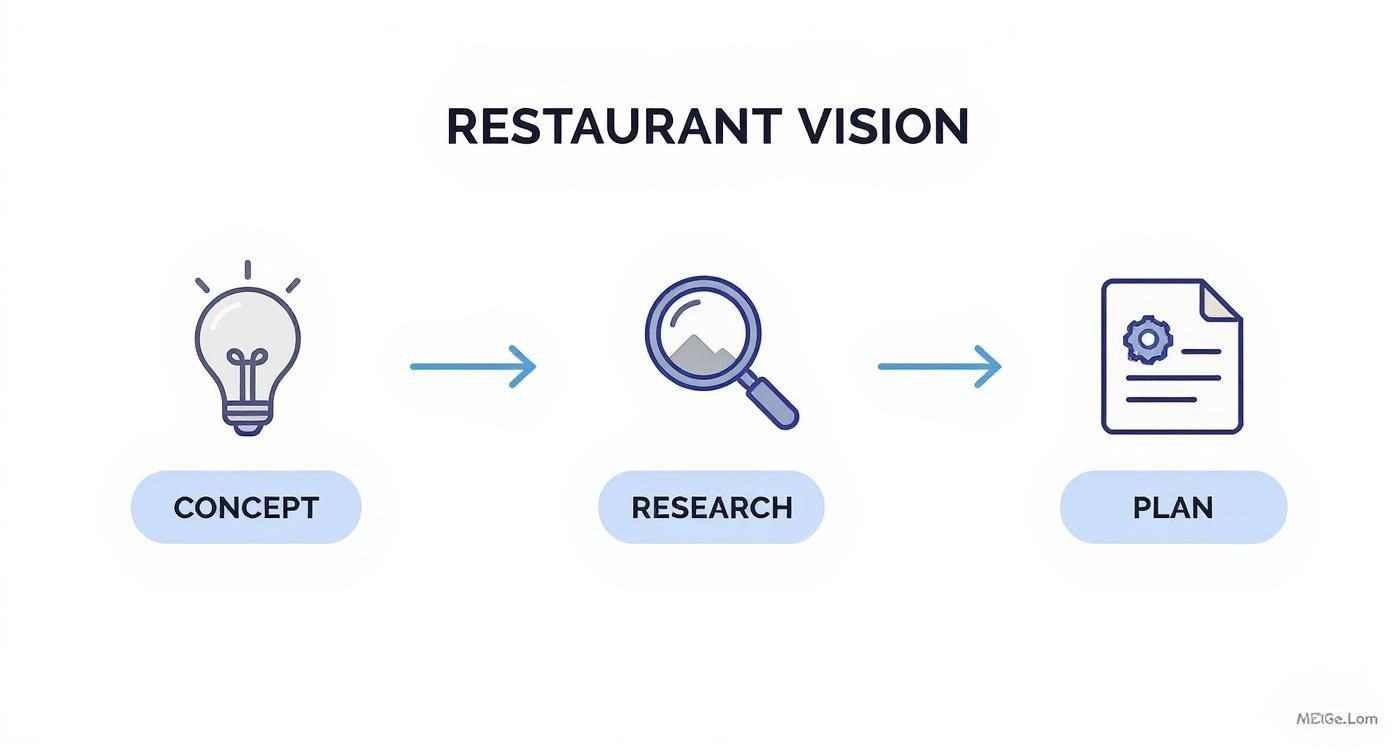
As you can see, a powerful concept does not just appear out of thin air. It is born from real research and solidified through smart, strategic planning.
Building Your Business Plan
Once your vision feels solid, it is time to put it on paper. Your business plan is not just a formality for getting a loan; it is your operational playbook. Yes, lenders and investors will demand to see it, but more importantly, it forces you to stress-test every single one of your assumptions. Research cited by LivePlan shows that businesses with a formal plan tend to grow about 30% faster than those without one.
A good business plan is part story and part spreadsheet. It needs to be detailed, brutally realistic, and compelling enough to convince someone to write you a very large check. A well-crafted plan forces you to validate your assumptions with data, anticipate challenges, and map out a clear path to profitability before you invest a single dollar.
Key Components of a Restaurant Business Plan
Your plan needs to be thorough. While you can find templates online, the best ones are deeply customized to your specific concept, city, and neighborhood. Do not cut corners here.
These are the absolute essentials:
- Executive Summary: This is your one-page pitch. It goes at the front, but you should write it last. It needs to grab the reader and quickly sell them on your mission, concept, and the financial potential.
- Company Description: Get into the details of your concept here. What is your legal structure (LLC, sole proprietorship)? What is your mission statement? What problem are you solving for diners in your area?
- Market Analysis: This is where your research pays off. Who is your target customer? Be specific about demographics and psychographics. Who are your direct competitors, and what are their biggest weaknesses you can exploit? What trends are happening in the industry and your local market?
- Menu and Pricing: Do not just list dishes; present a sample menu that reflects your brand. Explain the strategy behind your menu engineering and pricing and how it will drive profitability. For a deeper dive, check out our ultimate checklist for running a profitable restaurant.
- Marketing and Sales Strategy: How are you going to attract guests and keep them coming back? Lay out your plans for branding, the grand opening push, social media, and any local partnerships or advertising.
- Management Team: This is where you sell yourself and your key people. Highlight everyone’s relevant experience in hospitality and make the case for why this is the dream team to pull it off.
- Financial Projections: The numbers have to work. This section is non-negotiable and needs to include detailed startup cost estimates, a break-even analysis, and projected profit and loss (P&L) statements and cash flow projections for at least the first three to five years. Be conservative but confident.
Securing Funding for Your Restaurant Dream
You have got a killer concept and a business plan you believe in. That is the foundation. Now comes the part that can feel the most intimidating: getting the money to make it real.
Think of securing funding as the first real-world test of your business plan. It is where the dream meets the dollars, and with the right preparation, you can absolutely nail it. Turning your vision into a physical space with a humming kitchen and a full staff takes a serious upfront investment, so let’s get the numbers straight.
Breaking Down Your Startup Costs
Before you can ask anyone for a dime, you have to know exactly how many dimes you need. While every restaurant is unique, the startup costs tend to fall into the same core buckets. Getting these estimates right is crucial; it keeps you from running out of gas right as you are starting to pick up speed.
Here is what you need to budget for:
- Lease and Renovations: This covers your security deposit plus any construction or design work needed to transform the space.
- Kitchen Equipment: This is a big one. Ovens, walk-in coolers, prep tables, and dishwashers; you will need to decide whether to buy new, find quality used gear, or lease.
- Licenses and Permits: Do not underestimate this category. Health permits, business licenses, and especially a liquor license can add up fast.
- Initial Inventory: All the food, booze, and supplies you need to stock the shelves before you serve a single guest.
- Technology: A solid Point of Sale (POS) system is non-negotiable. You will also need to budget for reservation software and scheduling tools from day one.
- Working Capital: This is your safety net. It is the cash reserve you need to cover rent, payroll, and utilities for the first three to six months before you turn a profit. Whatever you think you need here, add more.
To give you a clearer picture, here is a sample breakdown of where your startup capital might go. These percentages can shift based on your concept and location, but it is a solid starting point for building your own budget.
Estimated Startup Cost Breakdown for a Small Restaurant
| Expense Category | Estimated Cost Range | Percentage of Total Budget |
|---|---|---|
| Commercial Lease & Security Deposit | $5,000 – $20,000 | 5-10% |
| Renovations & Build-Out | $50,000 – $250,000+ | 30-40% |
| Kitchen & Bar Equipment | $75,000 – $150,000 | 25-30% |
| Licenses, Permits & Legal Fees | $5,000 – $15,000 | 3-5% |
| Initial Food & Beverage Inventory | $10,000 – $25,000 | 5-7% |
| Technology (POS, Security) | $5,000 – $15,000 | 2-4% |
| Pre-Opening Marketing & Signage | $5,000 – $20,000 | 3-5% |
| Working Capital (3-6 months) | $50,000 – $100,000 | 15-20% |
Remember, these are just estimates. Your real costs will depend heavily on your specific needs, but this table should help you start putting tangible numbers to your dream.
Projecting Your Financial Future
Your financial projections are the heart and soul of your pitch to investors. This is where you prove your restaurant is not just a passion project; it is a viable business that will make money. You will need a realistic sales forecast, a detailed cash flow statement, and a break-even analysis.
Knowing what is happening in the broader industry makes your projections far more credible. For example, while the foodservice industry is growing, reports show that concepts centered on chicken and Mexican food are poised for strong growth, while categories like burgers and pizza might be slowing down. You can dig into the restaurant industry’s sales forecast for 2025 on NRN.com to see how these trends might impact your numbers.
A well-researched financial projection shows you have done your homework. It is not about predicting the future with perfect accuracy; it is about demonstrating a clear, data-backed understanding of how your business will make money.
To build these projections, you have to get granular. Calculate your potential revenue alongside every single ongoing cost, from rent and labor to the price of every onion and lemon. Tools like our restaurant profit margin calculator can be a huge help in getting a grip on these make-or-break numbers.
Common Funding Sources for New Restaurants
Once your numbers are locked in, it is time to find the right funding partner. Each option has its pros and cons, so think about which one fits your goals and personal situation best.
- Traditional Bank Loans: Banks offer term loans and lines of credit, but they are tough to get. They will expect a stellar personal credit score, significant collateral, and an airtight business plan. For a first-time operator, this is often the highest hurdle.
- SBA Loans: These loans are backed by the U.S. Small Business Administration, which lowers the risk for lenders and makes them more willing to say “yes.” The application process is a beast, but the favorable terms make them one of the most popular routes for new restaurants.
- Private Investors or Angels: These are individuals or groups who provide cash in exchange for equity, a piece of your company. The big upside is that they often bring industry connections and mentorship to the table. The downside? You are giving up some ownership. Your pitch has to be laser-focused on their return on investment.
- Friends and Family: This can feel like the easiest path because these “investors” already believe in you. But you have to treat it like a serious business transaction. Get everything in writing with a formal contract to protect your relationships if things get rocky.
No matter which path you take, your success hinges on your preparation. A polished business plan, defensible financials, and a passionate, well-rehearsed pitch will give you the best possible shot at turning that restaurant dream into a fully-funded reality.
Finding Your Spot and Making It Official
Alright, you have got a solid business plan and a clear idea of your funding. Now comes the part where your restaurant dream starts to feel real. We are talking paperwork, permits, and pounding the pavement to find the perfect location. It is easy to get bogged down in the details here, but getting this stage right is the foundation for everything that follows.
First things first, you need to decide how your business will be legally structured. This decision has big implications for your taxes and, more importantly, your personal liability. It is not a choice to make lightly, and I always recommend talking to a lawyer, but most small restaurants land on one of two paths.
Choosing Your Business Structure
A Sole Proprietorship is the simplest to set up. It is basically just you, doing business as yourself. The downside? There is zero legal separation between you and the restaurant. If the business racks up debt or gets sued, your personal assets, your house, your car, are on the line.
That is why most operators go with a Limited Liability Company (LLC). It creates a legal wall between your personal and business finances. Sure, it involves a bit more paperwork and a filing fee, but that protection is worth its weight in gold. It is the smart play for nearly every restaurant owner.
The Permit and License Gauntlet
Once you are legally a business, you need permission from what feels like everyone to actually operate. The world of restaurant permits is a bureaucratic maze, and the rules change from city to city. Mess this up, and you are looking at hefty fines or a delayed opening. You have to be organized.
Here is the checklist of permits and licenses you absolutely cannot skip:
- Business License: The baseline requirement to operate any business in your town.
- Employer Identification Number (EIN): Think of it as a Social Security number for your business. You need it to hire anyone.
- Food Service License: This comes from your local health department and proves you know how to handle food safely.
- Health and Building Permits: These ensure your space is safe for the public and your staff, think fire codes, plumbing, and sanitation. Getting familiar with commercial building permit requirements is a nonnegotiable step before you even think about swinging a hammer.
- Liquor License: If you are serving alcohol, this is a big one. The application can be a long, expensive headache, so get this process started the moment you have a location in mind.
Start the application process for all necessary licenses and permits far in advance. Bureaucratic delays are common, and waiting until the last minute is one of the easiest ways to blow past your planned opening date.
Finding the Perfect Location
You have heard it a million times: location, location, location. For restaurants, it is not a cliché; it is the gospel. The right address can fill your seats before you even unlock the doors. A great spot is not just about a pretty storefront; it is a calculated move based on who you want to serve.
When you are out scouting, look past the curb appeal and think strategically.
- Visibility and Foot Traffic: Can people see you from the street? More importantly, are the right people walking by when you plan to be open?
- Neighborhood Demographics: Does the area’s vibe match your concept? A high-end tasting menu is going to die a slow death in a college town, just like a rowdy sports bar probably will not fly in a quiet residential neighborhood.
- Accessibility and Parking: This is huge. If customers cannot easily get to you or find a place to park, they will just go somewhere else. Do not forget to check public transit routes and bike access, too.
- Zoning and Local Rules: Make absolutely sure the property is zoned for a restaurant. Check for weird local rules, like noise ordinances or patio restrictions, that could hamstring your operations.
Negotiating a Lease That Won’t Sink You
Found a spot? Great. Now comes the negotiation. This is not the time to be shy. A bad lease will bleed you dry for years, but a good one gives you the stability to grow.
Get a lawyer who specializes in commercial real estate to look at any agreement before you sign a thing. They will help you fight for key terms like base rent, lease length, and renewal options. Do not be afraid to push for a tenant improvement (TI) allowance, where the landlord chips in cash for your renovations. Nailing your lease terms is one of the most important financial moves you will make.
Developing a Profitable Menu and Assembling Your Team
You have got a solid business plan, the funding is secured, and the keys to your new location are in hand. Now for the fun part: the two things that will actually define your restaurant, what you serve and who serves it.
Think of your menu as your single most important marketing tool. And your team? They are the soul of the entire operation.
Getting both right is a constant balancing act between artistry and cold, hard numbers. A stunning dish is useless if its food cost torpedoes your profit margin. By the same token, the most gifted chef cannot carry a front-of-house team that just does not care about the guest. This is where your vision truly comes to life.

Engineering a Menu for Profit
A great menu is so much more than a list of delicious food. It is a carefully engineered document, designed to guide guests toward your most profitable items. This process starts with knowing your numbers inside and out, specifically, the food cost percentage for every single thing you sell.
This means you have to cost out every recipe down to the last pinch of salt. It is tedious work, but it is nonnegotiable. Get detailed price lists from your suppliers and build a spreadsheet that tracks the exact cost of each component in a dish. Your target food cost should land somewhere between 28% and 35%.
Once the numbers are dialed in, you can start designing the menu layout strategically:
- Put your stars in the spotlight. Place high-profit, high-popularity dishes in prime real estate, like the top right corner of the menu where eyes naturally go first.
- Sell the sizzle. Use descriptive language that makes the food sound irresistible. “Flame-grilled ribeye” is always going to sell better than just “steak.”
- Ditch the price column. Never list your prices in a neat, single-file line. That just encourages guests to shop by price. Instead, tuck the price discreetly at the end of the dish description.
Sourcing Suppliers and Managing Inventory
Your suppliers are your partners. Do not just chase the lowest price. Find the local farmers, butchers, and purveyors who are just as obsessed with quality as you are. Building real relationships with them can unlock better pricing, first dibs on special ingredients, and a supply chain you can actually count on.
Behind the scenes, consistent inventory management is what keeps your costs steady. A simple ‘first-in, first-out’ (FIFO) approach can go a long way in minimizing spoilage and waste while keeping your kitchen running efficiently. Get in the habit of doing regular inventory checks to spot problems like over-ordering or potential theft before they become financial catastrophes.
Building Your Dream Team
Your people bring your restaurant to life. Hiring the right ones is arguably the most important job you have as an owner. You are not just filling slots on a schedule; you are building a culture.
Start with clear, compelling job descriptions that sell your mission and explain why your restaurant is a great place to work.
During interviews, look past the resume. You can teach someone how to carry three plates, but you cannot teach a warm personality or a genuine desire to make people happy. Ask behavioral questions that reveal how a candidate handles pressure, works with others, and solves problems on the fly.
A positive, supportive work environment is your best defense against the industry’s brutal turnover rate. Invest in real training, offer competitive wages, and build a culture where your team feels valued from day one.
Let’s be honest: labor challenges are nothing new in this industry. Data from Paytronix shows just how intense turnover can be; full-service restaurants see annual rates between 75% and 100%, while quick-service restaurants often exceed 130%. This kind of churn leads to higher training costs and kills operational consistency, making your hiring and retention strategy absolutely critical.
Creating a stable and motivated team is a continuous effort. For more specific strategies, you can learn how to reduce staff turnover in our guide. That foundation starts now, with your very first hire.
Establishing Operations and Marketing Your Grand Opening
With your menu dialed in and your core team hired, the energy starts to shift. The dream is no longer a blueprint; it is taking physical form, and the big day is getting closer. This is where you build the systems for daily success and ignite the marketing buzz that will carry you through your grand opening and beyond.
Smooth operations do not just happen. They are the result of careful planning and creating repeatable processes for every single part of the guest experience. It is time to move from big-picture strategy to the nitty-gritty details of running a restaurant day in and day out.
Setting Up Your Core Operational Systems
Your operational toolkit begins with your Point of Sale (POS) system. A modern POS is the central nervous system of a restaurant, doing way more than just processing payments. It tracks sales data, manages inventory, handles online orders, and can even help with staff scheduling. Choosing the right one is a huge decision that impacts efficiency everywhere.
But beyond the big tech purchase, your success hinges on the small, consistent actions your team takes every single shift. This is where checklists become your best friend.
- Kitchen Opening and Closing Checklists: These are nonnegotiable for food safety. They ensure equipment is properly cleaned and maintained, and that prep stations are stocked for a smooth service.
- Front-of-House Checklists: These cover everything from wiping down menus and setting tables to restocking service stations and running end-of-day sales reports.
These simple tools create accountability and consistency. They are the secret to making sure every guest gets the same high standard of service, whether it is a slow Tuesday or a slammed Saturday night.
Leveraging Technology for a Smoother Launch
Adopting the right tech is no longer optional if you want to open a small restaurant successfully. Today’s diners expect convenience and speed, and that means digital tools like mobile ordering and efficient delivery. Globally, restaurants that embrace these tools just run better and build stronger customer connections.
In fact, service speed is a major priority for diners. A survey by Tastewise found that around 40% of consumers say speed and convenience influence their choice of where to order from, which underscores the importance of efficient systems. You can dig deeper into how consumer preferences are shaping the restaurant industry on Tastewise.io.
A soft opening is your dress rehearsal. It is a low-stakes opportunity to let your team practice under real-world pressure, identify bottlenecks in the kitchen, and smooth out service kinks before you officially open to the public.
Inviting friends, family, and local business owners for a limited-menu, private event is one of the smartest moves you can make. It builds goodwill and gives you priceless feedback when the stakes are low. Use this event to test everything, from your POS system and your kitchen’s timing to your staff’s ability to work together under fire.
Crafting a Buzzworthy Grand Opening Marketing Plan
Your grand opening is not just one day; it is a full-on campaign. You want to build a wave of excitement that crests on opening night and creates momentum that lasts for weeks. A great launch strategy combines digital buzz with real-world community engagement.
Start by creating a social media countdown. Post behind-the-scenes photos of the build-out, sneak peeks of menu items, and introduce your key team members, like your chef. This builds a story and makes your followers feel like they are part of the journey.
Next, identify and connect with local food bloggers and influencers. Do not just blast out a generic press release. Personalize your outreach, invite them to your soft opening, and give them an experience they will want to talk about. A single, authentic post from a trusted local voice can be more powerful than a month’s worth of traditional advertising. So many new owners stumble with their initial outreach, a topic we explore in our guide to common restaurant marketing fails.
Getting your marketing timeline right is key. You do not want to start too early and lose steam, or start too late and miss the opportunity to build real anticipation. Here is a simple checklist to guide your efforts in the final weeks leading up to your launch.
Grand Opening Marketing Checklist
| Timeline | Marketing Action | Key Objective |
|---|---|---|
| 4-6 Weeks Out | Claim social media handles; start posting “coming soon” content. | Build initial brand awareness and start gathering followers. |
| 2-3 Weeks Out | Announce official opening date; host a press/influencer event. | Create a sense of urgency and generate early positive reviews. |
| 1 Week Out | Run a social media contest or giveaway (e.g., win a free dinner). | Boost engagement and expand reach through shares and tags. |
| Opening Day | Go live on social media; actively engage with all comments. | Capture the excitement of the launch and thank early supporters. |
| Post-Opening | Share positive customer photos (with permission); run opening specials. | Maintain momentum and encourage repeat visits. |
By blending disciplined operational planning with a creative and energetic marketing push, you set the stage for a successful launch. This is how you establish your new restaurant not just as a business, but as a vibrant and essential part of your community.
Common Questions About Opening a Restaurant
Starting a restaurant stirs up a million questions. You can have the perfect vision, a rock-solid business plan, and an incredible team lined up, but there are always those nagging little queries that keep you up at night. Getting straight answers is what gives you the confidence to push through the final hurdles before you finally open the doors.
Let’s tackle a few of the most common questions from aspiring restaurateurs. Think of this as a dose of clarity to help you turn that culinary dream into a real, thriving business.
How much profit does a small restaurant typically make?
This is the big one, and the honest answer is: it depends. Profit margins in this business are all over the map, swinging based on your concept, your location, and how obsessively you manage your costs.
That said, the general industry average for a restaurant’s profit margin hovers somewhere between three to five percent. A high-end fine-dining spot might push that a little higher with premium pricing, while a busy fast-casual joint often works with thinner margins but makes up for it in sheer volume. At the end of the day, your profitability is a direct result of how well you control your big three: food costs, labor, and rent.
What is the most common reason new restaurants fail?
Nobody wants to talk about failure when they are just starting out, but knowing the pitfalls is the absolute best way to sidestep them. While no single issue is to blame, most restaurant failures are a cocktail of a few predictable problems.
Running out of cash is the number one killer. So many owners underestimate their startup costs and burn through their capital before they can build a loyal customer base. Other classic culprits include a bad location with zero visibility or foot traffic, marketing that just does not connect with diners, and operating costs that balloon out of control and eat every last dollar of potential profit. Your business plan is your best shield against all of these.
Direct industry experience is a massive advantage, but it is not a deal-breaker. If you are coming in fresh, you absolutely must surround yourself with veterans. Hire a seasoned general manager or an experienced head chef who knows the ropes. Their expertise is nonnnegotiable.
How long does it take to open a small restaurant?
Patience is not just a virtue in the restaurant world; it is a survival tool, especially in the beginning. The timeline for getting a new restaurant open can be anywhere from six months to well over a year. Seriously.
A few key things will dictate your timeline:
- Securing Funding: Just this piece of the puzzle, from pitching investors to signing loan documents, can easily take several months.
- Finding a Location: Scouting the perfect spot and then negotiating a lease that does not sink you is rarely a quick win.
- The Permit Process: Let’s be honest, navigating city hall for all your licenses and permits can be painfully slow.
- Renovations and Build-Out: Construction timelines are notorious for stretching out due to contractor schedules, supply chain issues, or uncovering unexpected problems behind a wall.
Plan for a longer runway than you think you need. It gives you a buffer to handle the inevitable delays without panicking. For more specific answers, it is always smart to dig into a good resource of frequently asked questions from people who have been there. This journey is a marathon, not a sprint, and being ready for the long haul is a key ingredient for success.
At MAJC, we get it; opening a restaurant is one of the most challenging and rewarding things you will ever do. We provide the tools, community, and expert guidance to help you hire smarter, train better, and build a profitable business that lasts. Join our community to access the resources you need to succeed at majc.ai.