


Let’s be honest: the constant churn of employees is draining. It’s more than a financial headache; when a great team member walks out the door, they take knowledge, customer relationships, and a piece of your team’s morale with them.
To stop this revolving door, you have to shift from reacting to resignations to proactively building a workplace people don’t want to leave. This isn’t about a single magic fix. It’s a deliberate strategy: figuring out why people really quit, redesigning your hiring for longevity, fostering a supportive daily environment, and building a culture that actually means something.
Why Your Best People Are Quietly Quitting
The conversation has moved beyond the “Great Resignation.” Now, we’re facing a period of rising disengagement, a quiet but corrosive wave of employee disconnection.
This isn’t just a feeling; it’s a core business problem. Retention remains the top challenge for 66% of HR executives and more than half of operations leaders, as reported by Gallagher and C-Suite Analytics. It’s not just an HR issue, but a critical operational one that hits the bottom line hard.
This guide is a practical playbook for leaders ready to get serious about retention. Forget generic advice. We’re focusing on actionable strategies to build a team that is genuinely invested in their work and your success.
Your Roadmap to Better Retention
Our approach is built on four core pillars. To give you a clear roadmap for what we’re about to cover, we’ve broken down the key strategies into a simple table.
The Four Pillars of Employee Retention
| Pillar | Key Action | Why It Matters |
|---|---|---|
| Diagnose | Uncover the root causes of turnover through data, exit interviews, and stay interviews. | You can’t fix a problem you don’t truly understand. Guessing wastes time and resources. |
| Hire & Onboard | Redesign your hiring process to attract the right fit and create a structured, welcoming onboarding experience. | Great retention starts on day one. A strong start prevents early exits and sets the tone for the entire employee journey. |
| Foster | Implement systems for training, scheduling, and compensation that show you value your team’s time and growth. | Daily frustrations are a primary driver of turnover. Fair and predictable systems build trust and reduce friction. |
| Culture | Intentionally build a culture of recognition, respect, and open communication where people feel seen and valued. | A positive culture is your best defense against burnout and disengagement. It’s the “why” that makes people stay. |
This framework shows that retention isn’t a single action but a continuous cycle. It’s about being intentional at every stage of an employee’s time with you. This infographic gives you a visual of that process flow.
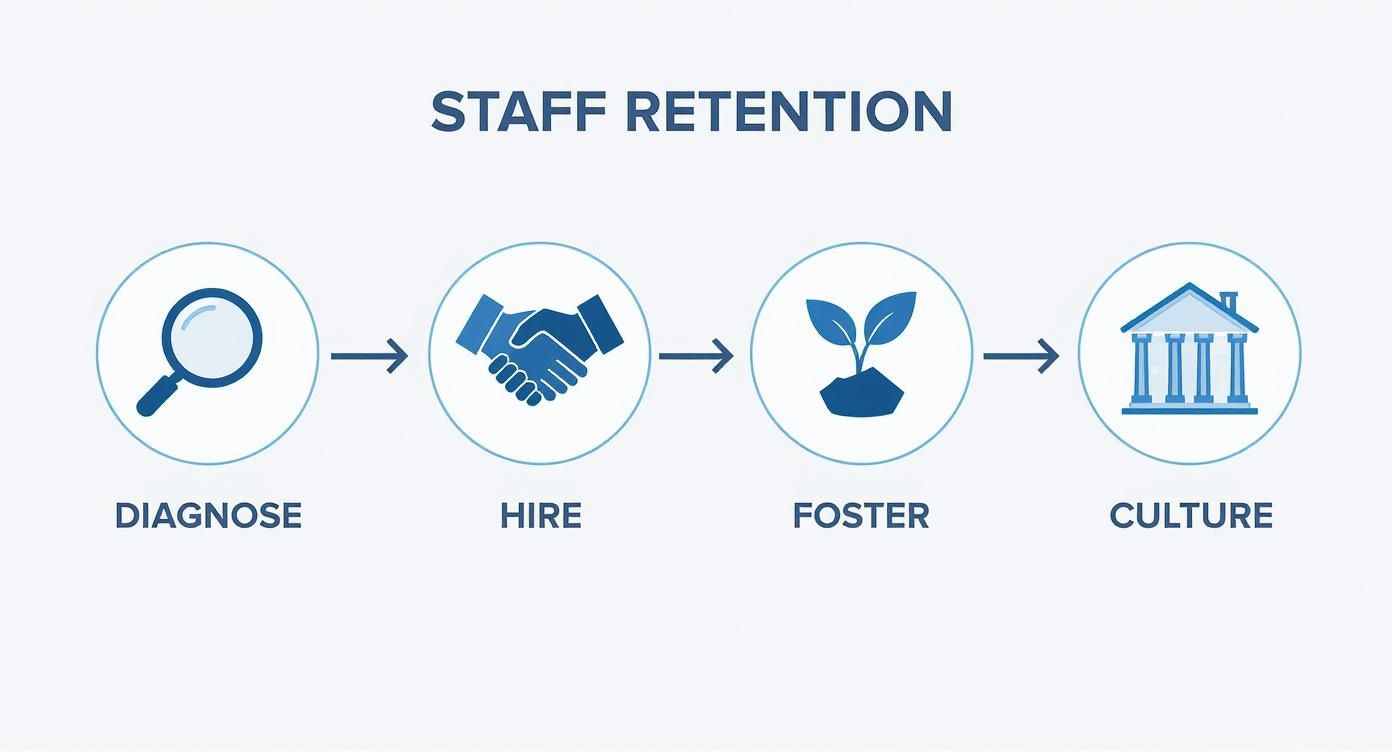
The real cost of turnover isn’t just the money spent on hiring. It’s the lost momentum, the fractured teams, and the constant feeling of starting over. A proactive retention strategy is an investment in stability and sustainable growth.
Building this kind of environment is especially critical in demanding fields like hospitality, where burnout is a constant threat. Leaders who master these pillars don’t just keep their best people; they create more resilient, profitable businesses. For a deeper look at managing these pressures, check out our guide on how to run a restaurant without burning out.
Now, let’s start by digging into why your employees are leaving.
Uncovering Why Your Employees Are Really Leaving
If you want to fix your turnover problem, you have to stop guessing and start diagnosing. Most leaders think it’s about pay, but the real reasons people walk are usually hiding just beneath the surface.
Your new job is to become a turnover detective. That means gathering real data and learning to listen to what your team is telling you, both directly and indirectly.
Exit Interviews That Actually Tell You Something
Let’s start with the exit interview. For most businesses, it’s a polite formality, a box to check. That needs to change. It should become your most powerful tool for understanding past mistakes.
Too often, departing employees give vague answers because they don’t want to burn bridges. To get the truth, you have to create a space that feels safe and neutral. Ideally, their direct manager shouldn’t conduct the interview. Have HR or a trusted senior leader from another department handle it. This simple change encourages honesty. Then, ask better questions, ones that go beyond “So, why are you leaving?”
Try weaving these into your process:
- “Was there a specific moment that made you start looking for another job?”
- “Think about your time here. Describe a day you went home feeling energized. Now, what about a day you felt completely drained?”
- “If you could change one thing about your role for the next person, what would it be?”
- “Looking back, were there any promises made during hiring that didn’t quite match the day-to-day reality of the job?”
Questions like these shift the conversation from blame to constructive feedback, giving you concrete examples of what’s broken.
The Proactive Power of Stay Interviews
Exit interviews tell you why people left. Stay interviews tell you why your best people stay, and what might make them leave.
These are structured, one-on-one conversations with your current, high-performing employees. The goal is to understand what keeps them engaged before they think about looking elsewhere. A stay interview is not a performance review; it’s a proactive check-in focused on their satisfaction.
The goal of a stay interview is simple: find out what’s working and what’s not for your most valued team members before they become a flight risk. It’s one of the most effective, low-cost retention strategies you can deploy.
Just like with exit interviews, the questions are everything. Schedule these in a casual setting and frame it as a genuine opportunity for open dialogue.
A Few Stay Interview Questions to Get You Started:
- “What do you look forward to when you come to work?” This helps you pinpoint the positive parts of the job you must protect.
- “What daily frustrations or roadblocks make your job harder than it needs to be?” The little things: clunky software and poor communication that slowly kill morale.
- “What skills do you want to learn or what projects are you interested in?” This opens a real conversation about career growth, a massive driver of loyalty.
- “Honestly, what might tempt you to leave for another opportunity?” This bold question gives your best people permission to tell you what they truly value.
Using Anonymous Surveys to Get the Unfiltered Truth
One-on-one conversations are gold, but some employees will never be 100% honest face-to-face. Anonymous surveys provide the psychological safety needed to get a true pulse on how the team is feeling.
You can use simple, free tools for short, frequent “pulse” surveys. Ask about manager effectiveness, scheduling fairness, and job satisfaction. Always include an open-ended question like: “If you had a magic wand, what’s the one thing you would change about working here?”
Once you’ve gathered feedback, your real work begins: connecting the dots. Look for patterns. Is the same manager’s name popping up? Is scheduling a constant theme? This data-driven approach lets you systematically solve the root problems, creating a place people are excited to join and reluctant to leave.
Hiring and Onboarding for Long-Term Success

Great retention doesn’t start on an employee’s first day. It starts the moment a candidate reads your job description. If you want to stop the revolving door, you have to build a hiring and onboarding process that’s about clarity and connection from the jump.
When expectations don’t match the job, people walk. In fact, the average restaurant employee stays for about 110 days before leaving, according to 7shifts. This high turnover often stems from unclear expectations and weak onboarding. A clear job preview helps the right people opt in and stay.
- Get real in your job description. Talk about the challenges right alongside the perks.
- Highlight the actual daily tasks. This is the fastest way to weed out mismatches.
- Show, don’t just tell. Use photos or team testimonials to give a real feel for your culture.
Writing Job Descriptions That Filter for Fit
To write a job description that works, interview your best people. Ask a server who’s been with you for years what it really takes to handle a busy Friday night. Their insights are gold.
Next, add a short “Day in the Life” section. A simple line like, “Be ready to juggle a six-top’s drink order while greeting new guests at the door, all with a smile”, speaks volumes.
Finally, throw in a candid photo of your team in action. When you make your culture tangible, you attract people who can see themselves as part of it.
Designing a 90-Day Onboarding Roadmap
A structured 90-day plan is the difference between a new hire who feels lost and one who feels confident. Break it down into phases to build momentum.
- Phase One (Week 1): Focus on welcome and connection. Pair them with a mentor, schedule a team lunch, and give them a clear checklist for their first week.
- Phase Two (Weeks 2-8): Shift to building skills. This means guided shifts, one-on-one training, and check-ins on core competencies.
- Phase Three (Weeks 9-12): Empower your new hire. Move the focus to ownership with feedback sessions and their first real performance goals.
“A consistent 90-day framework turns nervous new hires into engaged team members who feel supported every step of the way.”
The secret sauce? Frequent, informal check-ins. A quick “how’s it going?” chat during the first few weeks can uncover small issues before they become reasons to quit.
Integrating Early Wins and Feedback Loops
Momentum is everything for a new hire. Celebrate small victories. When a trainee masters the POS system, give them a shout-out in the pre-shift huddle. These wins build pride and give you something positive to discuss in your check-ins.
Use simple pulse surveys around day 30 and 60 to see how they’re feeling. Ask direct questions like, “What part of training helped the most?” and “Where do you still need more support?” The key is to act on that feedback quickly to show you’re listening.
- Pulse surveys should be short, under five questions, taking less than three minutes.
- Share general themes from the surveys in team meetings to show transparency.
- Track trends in a simple spreadsheet to spot patterns and refine your process.
Strengthening Onboarding with Targeted Training
A solid onboarding plan goes hand in hand with practical training. To dial in this part of the process, check out our guide on how to train restaurant staff quickly and effectively.
Don’t underestimate the power of mentorship. Research shows that mentorship programs help employees build stronger connections at work, and nearly half of job seekers (49%) believe mentoring cultivates greater collaboration, based on a 2023 survey published on PR Newswire.
Give your mentors a clear mission. For example: shadow the new hire for two shifts, let them run a solo shift, then co-manage a busy service. Document these milestones so you can celebrate progress.
Sustaining Momentum Beyond Day 90
The work isn’t done after three months. Keep the conversation going. Schedule check-ins at the six-month and one-year marks to revisit goals, celebrate accomplishments, and talk about what’s next.
- Mark anniversaries. A handwritten note or a small team celebration goes a long way.
- Rotate mentors. Exposing new hires to different leaders helps them grow.
- Keep listening. Use quick surveys to track satisfaction and catch any issues that pop up later.
Fostering a Culture People Don’t Want to Leave
A strong culture is the invisible force that holds a team together. It’s more than a holiday party or free shift meals; it’s the sum of everyday interactions and genuine mutual respect. In a demanding industry like hospitality, it’s your single greatest defense against turnover.
“Culture” can feel abstract, but it’s built on concrete, daily actions, and it always starts at the top. The way a leader communicates and handles pressure sets the tone for the entire operation.
The truth is, a dip in culture often predicts that people are about to walk. The Employee Retention Index recently showed its biggest drop in two years, driven heavily by a 3.1-point decline in culture ratings, according to Eagle Hill Consulting’s January 2025 report. The numbers don’t lie: a weakening culture and an employee’s decision to leave are directly linked.
Leadership Behavior Sets the Tone
Your team is always watching. They see how you react when an order is wrong and whether you follow through on promises. This is where culture is forged.
To build a culture that sticks, leaders must be intentional. This means shifting from reactive “firefighting” to proactive support. It’s about creating an environment of psychological safety, where people feel comfortable speaking up without fear.
For example, instead of asking “Who messed this up?” when a problem arises, a culture-focused leader asks, “How can we fix this and prevent it from happening again?” That simple switch changes the dynamic from blame to collaborative problem-solving.
Culture isn’t a poster on the wall; it’s what happens in the difficult moments. It’s the difference between a team that points fingers and a team that pulls together.
This shift demands that leaders be transparent. Admitting you don’t have all the answers builds trust more effectively than pretending everything is perfect.
Recognition That Genuinely Motivates
Meaningful recognition is one of the most powerful, and underused, tools for keeping your people. A generic “good job” is fine, but it doesn’t leave a lasting impact. The goal is to make recognition personal, specific, and timely.
Real recognition connects what a person did to a bigger team goal. It shows them that their contribution was noticed and mattered.
Ideas for Meaningful Recognition:
- Peer-to-Peer Shout-Outs: Set up a simple system, a whiteboard in the breakroom or a dedicated Slack channel, where team members can publicly praise each other.
- “Caught You Doing Good” Notes: A simple, handwritten note from a manager detailing a specific positive action is incredibly powerful. “Sarah, I saw how you calmly handled that tough customer. Your professionalism set a great example. Thank you.”
- Skill-Based Praise: Acknowledge the skill someone used. For example, “John, your attention to detail on the inventory count saved us a headache this weekend. That’s a huge help.”
When recognition is a genuine part of your daily rhythm, you create a place where people feel seen, a powerful reason to stay. For more, check out our guide on how to build a high-performing restaurant team culture that lasts.
Building Clear Pathways for Growth
Nobody wants a dead-end job. Even if an employee loves their role, they need to see a future. A lack of growth opportunities is a massive driver of turnover, especially for your most ambitious team members.
Creating career pathways doesn’t have to mean a rigid corporate ladder. It’s about providing chances to learn new skills and take on more responsibility.
Here’s what that could look like:
- Cross-Training: Teach a server the basics of bartending or a line cook some prep skills for another station. This makes your team more versatile and keeps the work interesting.
- Leadership “Sprouts” Program: Identify team members with potential and give them small responsibilities, like leading a pre-shift meeting or training a new hire on one task.
- Transparent Skill Tiers: Create clear levels for roles. For instance, a “Line Cook 1” has mastered their station, while a “Line Cook 2” can work multiple stations. This gives employees a clear roadmap to advance and earn more.
When you invest in your team’s growth, you’re sending a powerful message: we see a future for you here. That’s how you turn a job into a career.
Modernizing Pay and Scheduling to Keep Your Team Happy
In the hospitality world, how you handle pay and scheduling sends a clear message. These aren’t just back-office tasks; they tell your team exactly how much you value their time and their life outside of work.
Getting these two fundamentals right is one of the most powerful moves you can make to stop staff turnover. Competitive wages are just the start. The real magic happens with transparent pay, fair schedules, and benefits that your team actually wants.
The financial hit from turnover is no joke. According to the Society for Human Resource Management (SHRM), replacing an employee can cost between 50% and 200% of their annual salary, depending on their level. In an industry like food service, where turnover in quick-service restaurants can exceed 130% as reported by Paytronix, the math is simple: investing in your people pays for itself.
Rethinking Compensation Beyond the Hourly Rate
A competitive wage is table stakes, but your compensation strategy can’t stop there. Today’s best employees want transparency and a clear path forward. When pay feels like a mystery, it breeds resentment.
A transparent pay structure means you clearly outline what it takes to earn more. For example, a “Server I” is a new hire, while a “Server II” has passed skill tests and can train new team members. This gives your crew a ladder to climb, directly connecting their growth to their paycheck.
And don’t forget about performance incentives. Think small, achievable team goals. A small kicker for hitting a weekly sales target or a reward for the shift with the best guest feedback can create a sense of shared purpose.
The Power of Predictable and Flexible Scheduling
Nothing burns out a good employee faster than a chaotic, last-minute schedule. When a schedule drops with barely any notice, it makes planning a life impossible. This is where a modern approach can change the game.
First, predictability is king. Post schedules at least two weeks in advance. That’s it. This simple act of consistency shows you respect your team’s time.
Second, embrace flexibility. Give your team the power to easily swap shifts with approved coworkers through a simple app. This provides a feeling of control, reduces no-shows, and takes a huge administrative burden off your managers. It acknowledges that life happens.
When you build a scheduling system that respects your team’s life outside of work, you’re not just filling shifts. You’re building a culture of mutual respect that makes people want to commit long-term.
It’s time to ditch the clunky spreadsheets. Embracing technology creates a system that’s more equitable and efficient. For a deeper look, check out the differences between manual vs. automated scheduling and what operators should know.
Benefits That Actually Move the Needle
Modern benefits are about more than a basic health plan. The key is to think about what your team actually values. For many, the right nonmonetary perks can be as compelling as a raise.
Here are a few ideas that show you’re invested in their well-being:
- Mental Health Support: Access to counseling or a subscription to a mindfulness app shows you care about your people, not just their performance.
- Professional Development: A small annual stipend for industry courses, certifications, or a wine-tasting class shows you believe in their career.
- Commuter Benefits: Helping to offset the cost of getting to and from work can make a real difference in their take-home pay.
Here’s a quick comparison of old-school thinking versus a modern, retention-focused approach.
Modern Compensation and Benefits Comparison
| Element | Traditional Approach | Modern Retention-Focused Approach |
|---|---|---|
| Pay Structure | Opaque, often inconsistent. “Black box” where raises are arbitrary. | Transparent pay bands with clear criteria for advancement. |
| Scheduling | Last-minute, unpredictable schedules posted with little notice. | Schedules posted 2+ weeks in advance with easy, app-based shift swapping. |
| Incentives | Focused on individual top-line sales, if any. | Team-based bonuses tied to shared goals like sales targets or positive reviews. |
| Benefits | Basic health insurance, if offered at all. | Holistic benefits including mental health support, professional development stipends, and commuter assistance. |
| Time Off | Standard PTO, often difficult to use due to scheduling conflicts. | Flexible time-off policies, plus potential for benefits like paid parental leave or wellness days. |
By upgrading your approach to pay, scheduling, and benefits, you’re building a foundation of trust and respect—the secret ingredient for keeping your best people.
Common Questions About Reducing Staff Turnover

Even the best playbook runs into real-world roadblocks. When you start making changes to fight turnover, questions always pop up. Here are the most common hurdles, with clear answers to keep you moving forward.
What Is the Single Most Effective Quick Win?
While building a great culture is the long game, the quickest win is almost always improving manager-employee communication. Start this week by training your managers to hold regular, informal one-on-one check-ins.
These aren’t performance reviews; they’re genuine conversations about workload, challenges, and what your employee wants to learn next. This simple act shows your team they’re valued, builds trust, and helps you solve small problems before they grow. It costs nothing to start and can boost morale immediately.
The fastest way to make an employee feel valued is to listen to them. Consistent, informal check-ins are a low-cost, high-impact tool for building trust and catching issues early.
How Do I Convince Leadership to Invest in Retention?
To get buy-in from owners or upper management, you have to speak their language: data and return on investment (ROI). Lead with data and ROI alongside lived experience.
First, calculate your actual cost of turnover. Multiply the number of employees who left last year by their estimated replacement cost. Frame this number as “money walking out the door.”
Then, propose a small pilot program in one department. Give it a clear budget and a measurable goal, like a 10% turnover reduction in six months. Position your new initiatives as direct investments that will slash that massive turnover cost.
What Are Some Low-Cost Ways to Improve Retention?
You don’t need a huge budget to make people want to stay. Many of the most powerful retention strategies are low-cost or free.
Focus on what matters to your team day-to-day:
- Meaningful Recognition: A public shout-out in a team meeting or a specific, handwritten thank-you note often means more than a small bonus.
- Scheduling Flexibility: Allowing easy shift-swapping or giving your team more input on their hours costs nothing but builds immense goodwill.
- A Positive Environment: Enforce a zero-tolerance policy for negativity and gossip. A respectful workplace is nonnegotiable for keeping good people.
- Growth Opportunities: Cross-train employees in different roles. It makes them more valuable, keeps them engaged, and shows them a path forward.
These actions prove you respect your team’s contributions and their life outside of work, which is often more powerful than any expensive perk.
At MAJC, we provide the tools, training, and community support hospitality leaders need to build teams that last. From operator-tested templates for onboarding to expert-led workshops on culture, we help you implement the systems that reduce turnover for good. Discover how to run a smarter, more stable business at majc.ai.