

In the hotel world, “online marketing” simply means using the internet to put heads in beds. It’s a mix of SEO, paid ads, and social media, all working together to get your property seen and, most importantly, to drive direct, commission-free bookings. A winning strategy connects with travelers at every point in their journey, from dreaming to booking.
Your Blueprint for Hotel Marketing Success
With more than 60% of the world’s population now online, a strong digital presence isn’t just nice to have; it’s the foundation of a modern booking strategy. The days of relying on walk-ins and print ads are over.
Today’s travel journey starts with a search. Guests are looking up destinations, comparing rates, and reading reviews long before they ever click “book.”
This guide is your blueprint for building a marketing engine that consistently fills your rooms. We will break down how all the different channels, from your website to your online reviews, should work together to create a smooth path for your guests, from their first Google search to their next return visit.
The Pillars of a Modern Strategy
A great hotel marketing strategy isn’t about doing one thing well. It’s about making sure every channel supports the others. The essentials include:
- A High-Performing Website: This is your digital front door. It has one primary job: convert lookers into bookers.
- Search Engine Optimization (SEO): This is how you make sure guests find you when they search on Google, not your competitor down the street.
- Paid Advertising: Paid ads give you a direct line to potential guests, driving immediate traffic when and where it matters most.
- Social Media Engagement: This is where you tell your story, build a community, and give people a reason to choose your property.
- Reputation Management: Your guest reviews are one of your most powerful marketing assets. Turning feedback into a positive story is crucial.
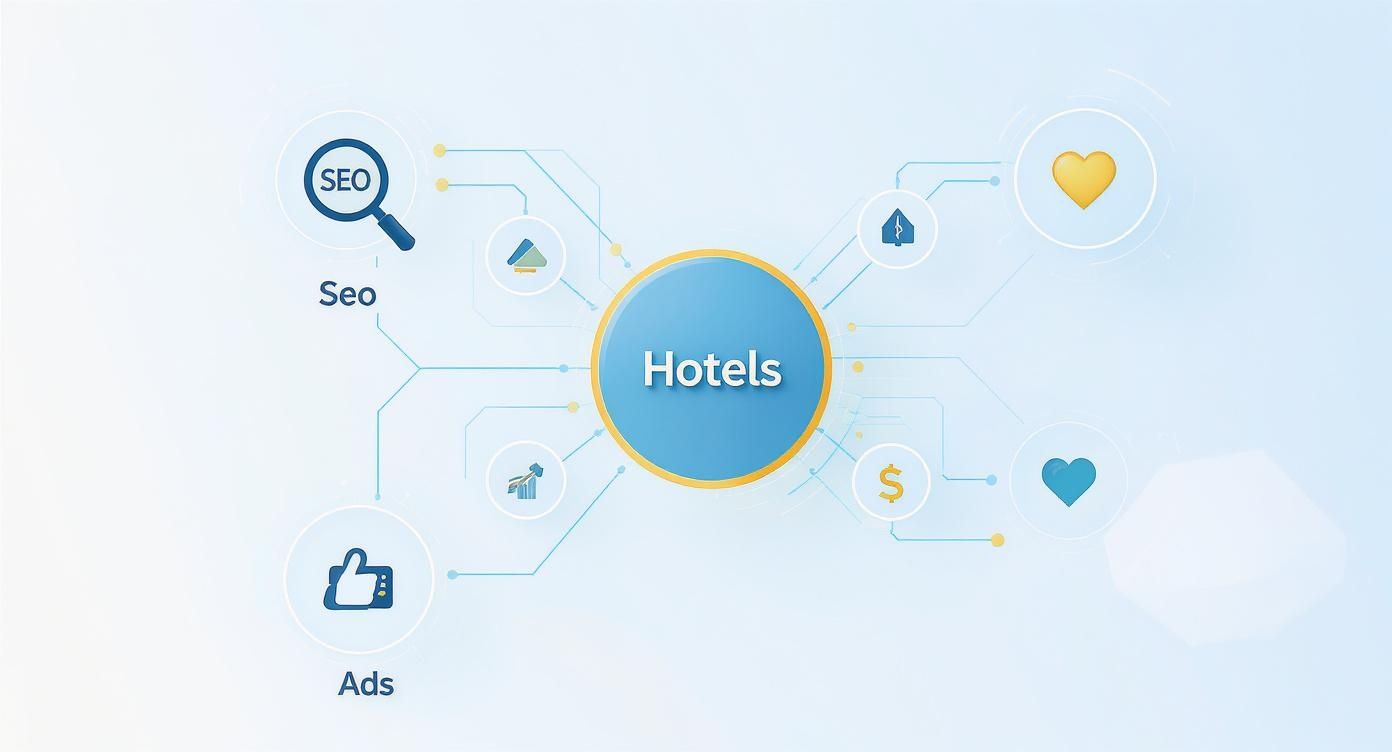
A successful approach integrates these different tactics to attract, engage, and convert potential guests. To get started building a plan that works, a solid digital marketing strategy template can provide a framework.
A clear plan helps you sidestep the common mistakes that can sink even the best hotels. While every industry is different, the core principles of good marketing hold true. You can learn more about what not to do from our guide on common restaurant marketing fails.
Key Online Marketing Channels for Hotels
Here’s a quick look at the most important channels for any hotel, what they do, and what you should measure.
| Channel | Primary Goal | Key Metric to Watch |
|---|---|---|
| Website & SEO | Drive direct, commission-free bookings. | Direct Booking Rate. |
| Paid Search (PPC) | Capture high-intent travelers and fill the need periods. | Return on Ad Spend (ROAS). |
| Social Media | Build brand awareness and community engagement. | Engagement Rate. |
| Email Marketing | Nurture past guests and drive repeat business. | Open Rate & Click-Through Rate. |
| OTAs & Metasearch | Increase visibility and capture new audiences. | Booking Volume & Cost Per Acquisition. |
| Reputation Management | Build trust and social proof. | Average Review Score. |
Each of these channels plays a specific role. Your website is your booking engine, while OTAs are more like billboards. The goal is to make them all work together to build a healthy, profitable business.
Building Your Digital Foundation with a Great Website and SEO
Think of your hotel’s website as its digital front door. It’s the single most important tool you have for locking in commission-free direct bookings. In the wide world of online marketing, this is your home base, the one piece of digital real estate you completely own and control. It’s where your brand story comes to life and where guests make that final click to book.
A high-performing website does more than just look pretty; it acts as your best salesperson, working around the clock. The fundamentals are non-negotiable: an intuitive user experience (UX), stunning visuals that make someone feel like they’re already there, and a booking engine that’s fast, simple, and utterly frictionless. Every click should pull a guest closer to a reservation, not push them away in frustration.
Prioritizing a Mobile-First Experience
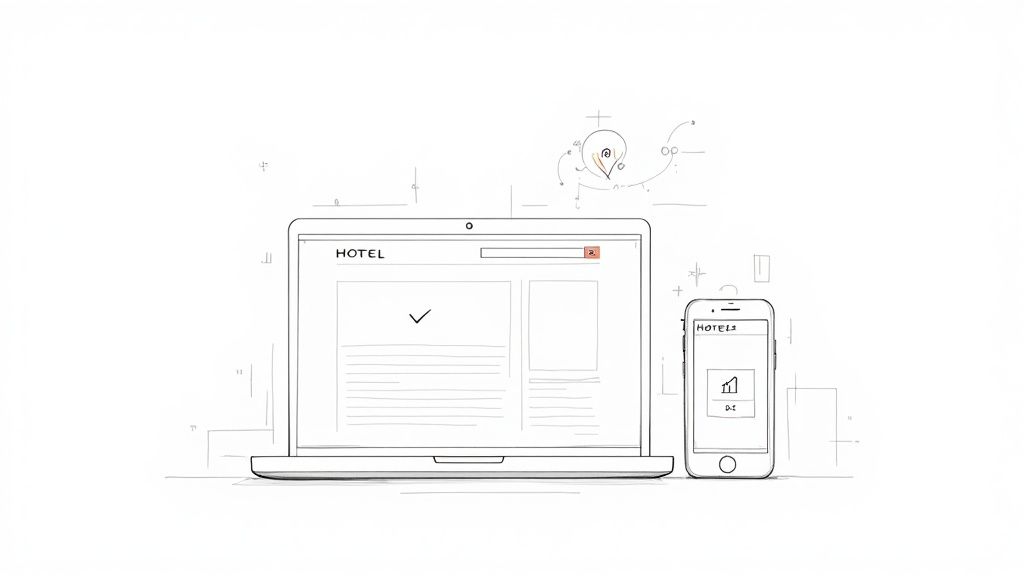
Travelers plan and book their trips on the go. This isn’t a trend; it’s the norm. A mobile-first design isn’t optional anymore. With over five billion mobile internet users worldwide, having a clunky mobile site is like locking your front door during peak check-in hours. A slow, hard-to-navigate experience will send potential guests straight to an OTA or your competitor down the street.
On top of that, Google’s algorithm heavily favors sites that work beautifully on a phone. If your site isn’t mobile-friendly, you’re getting pushed down in the search rankings, making it that much harder for new guests to find you in the first place.
But a great website is just the start. If potential guests can’t find it, it doesn’t matter how beautiful it is. That’s where Search Engine Optimization (SEO) comes in. SEO is the craft of making your hotel more visible the moment a traveler searches for a place to stay on Google. It’s about showing up when someone is actively looking for exactly what you offer.
Understanding Hotel SEO Fundamentals
Think of SEO as the digital equivalent of picking a great location for your physical hotel. You want to be on a busy, well-lit street where people are actively looking for a place to stay, not tucked away on a side alley nobody knows about. Good SEO puts your website right on that digital main street.
It all starts with keyword research. This just means figuring out the exact phrases potential guests are typing into search engines. These aren’t just generic terms; they’re highly specific to what travelers actually want.
- Location-based Keywords: “Boutique hotel near Times Square,” “Pet-friendly hotel downtown Austin”
- Amenity-based Keywords: “Hotel with indoor pool in Chicago,” “Miami hotel with free breakfast”
- Event-based Keywords: “Hotels near McCormick Place for conference,” “Places to stay for Mardi Gras”
Once you know what people are searching for, you can start weaving those terms into your website’s content. This is called on-page optimization. It’s about naturally placing keywords in your page titles, headings, photo captions, and blog posts. This signals to Google what your pages are all about, helping it match your site to the right searches. The goal isn’t to cram keywords everywhere, but to create genuinely helpful content that answers a traveler’s questions. Telling a compelling story is just as crucial for your website as it is for building your overall brand, which you can learn more about in our guide on turning your restaurant’s story into brand loyalty.
Leveraging Local SEO and Google Business Profile
For any hotel, local SEO is a goldmine. When someone searches for “hotel near me,” Google serves up a map with a list of local options. Your goal is to be at the top of that list. The absolute key to this is your Google Business Profile (GBP). It’s a free listing that acts like a mini-website right in the search results, showing off your photos, reviews, address, and a direct link to book.
A complete and optimized Google Business Profile is one of the most impactful “quick wins” in online marketing for hotels. It directly influences your visibility in local search and on Google Maps, which is where a huge number of booking decisions are made.
Claiming and optimizing your GBP is nonnegotiable. Make sure every piece of information is accurate, upload plenty of high-quality photos, respond to every review (good and bad), and use the Q&A feature to proactively answer common guest questions. This doesn’t just boost your local ranking; it builds trust with potential bookers before they even land on your website.
Driving Immediate Traffic with Paid Advertising
While a strong website and smart SEO build your long-term digital authority, sometimes you just need to fill rooms now. That’s where paid advertising comes in. It’s the fastest, most direct way to get your hotel in front of travelers right when they’re searching and ready to book.
Think of SEO as building a beautiful, permanent storefront on a busy street. It takes time, but it’s an asset. Paid advertising is like buying a primetime commercial slot; it gets you noticed instantly. The real magic happens when you blend both, creating a strategy that delivers immediate returns and lasting growth.
Let’s break down the paid channels that actually move the needle for hotels, focusing on Google Ads and social media advertising.
Capturing Travelers with Google Ads
For most travelers, planning starts on Google. This makes it nonnegotiable territory. While SEO can take months to rank, Google Ads can put your property at the top of the search results almost overnight. It’s a direct investment in capturing travelers who are actively looking for a place to stay.
A few types of Google Ads are especially powerful for hoteliers:
- Google Hotel Ads: These are the game-changers. They show up right in search results and on Google Maps, displaying your live rates and availability next to the OTAs. You’re catching people at the final stage of their decision-making process, comparing prices, and ready to click “book.”
- Paid Search Ads: These are the classic text ads you see at the top of search results. You can bid on specific keywords like “boutique hotel near Union Square” or “pet-friendly hotel Asheville NC” to connect with guests who have very specific needs.
- Display Ads: These are the visual, banner-style ads that follow you around the internet. While less direct for immediate bookings, they are brilliant for building brand awareness and retargeting people who’ve already visited your website, keeping your hotel top-of-mind as they continue their research.
Reaching Guests on Social Media
If Google Ads are about capturing existing demand, social media ads are about creating it. Platforms like Facebook and Instagram have incredibly powerful targeting tools that let you reach your ideal guest based on their interests, demographics, and even past travel behavior.
Social media advertising is your chance to stop waiting for travelers to find you. Instead, you can proactively reach specific audiences like couples planning a romantic getaway or families looking for a spring break spot with beautiful visuals that make them want to plan a trip.
For instance, you could run a campaign with stunning video of your rooftop pool and bar, targeting it specifically to users who have shown an interest in “luxury travel” or follow high-end resort brands. Even better, you can retarget people who visited your website but didn’t book, reminding them what they’re missing with a compelling offer. The key here is fantastic creative. Your photos and videos have to be good enough to stop the scroll.
Measuring What Matters Most
The single greatest advantage of paid advertising is that it’s completely measurable. You are not just throwing money at a billboard and hoping for the best; you can track every dollar and see exactly what’s driving revenue. The one metric you need to obsess over is your Return on Ad Spend (ROAS).
This simple formula tells you how much money you’re making for every dollar you spend. If you spend $100 on a Facebook ad and it generates $1,000 in direct bookings, your ROAS is 10x. That’s an investment, not an expense.
To make sure your campaigns are profitable, you have to set a clear budget and define your bidding strategy. My advice? Start small. Test different ad creatives, audiences, and offers, and watch your ROAS like a hawk. The data will tell you what’s working. Double down on the winners, cut the losers, and turn your advertising budget into a powerful engine for growth.
Engaging Guests Through Social Media and Email Marketing
If your website is what attracts guests, social media and email are what keep them. These are your direct lines to building real relationships, driving loyalty, and earning that all-important repeat business. Great online marketing for hotels isn’t about broadcasting promotions; it’s about building a community around your brand.
This isn’t just about posting pretty pictures. It’s about crafting a strategy that tells your hotel’s story, forges genuine connections, and turns one-time visitors into people who rave about you.

Crafting a Compelling Social Media Story
Think of platforms like Instagram and Facebook as visual storytelling tools. Your job is to make potential guests feel what it’s like to stay with you before they even click “book.” That means your content has to be authentic, engaging, and a true reflection of your brand’s personality.
To get this right, you need clear content pillars. These are the core themes you’ll hit again and again, ensuring your feed stays focused and gives your audience what they actually want to see.
- Behind-the-Scenes: Introduce your team. Show the care that goes into turning over a room or a glimpse of your chef plating a new special. This is what humanizes your hotel.
- Local Experiences: You’re not just selling a room; you’re selling a destination. Feature nearby gems, team up with local businesses, and create mini-guides to the best spots in town.
- Guest Spotlights: Share user-generated content (always with permission, of course). When a guest posts about their amazing stay, it’s powerful, authentic social proof that money can’t buy.
This approach is about more than just aesthetics. For hotel ads, a visual-first story on Facebook and Instagram can pull in a click-through rate (CTR) of two to four percent, often beating Google. It just goes to show how much compelling imagery and real content can spark interest and drive someone to book.
Turning Email into Your Most Profitable Channel
While social media builds awareness, email marketing is your engine for conversions and retention. It’s one of the most cost-effective tools in your arsenal, letting you talk directly to people who’ve already raised their hand and shown interest. First things first: you need a quality list.
You can start by digging into strategies for building a robust email list. Simple moves, like offering a small discount for signing up on your website or collecting emails at check-in, make a massive difference.
Once you have a list, personalization is everything. Segmenting your audience lets you send the right message to the right person at the right time.
Do not send the same generic newsletter to everyone. A past guest who stayed for a romantic weekend has very different interests from a family that booked your largest suite for a week. Personalization is what makes email marketing feel helpful, not spammy.
Designing Email Campaigns That Drive Action
A smart email strategy nurtures the guest relationship from booking to check-out and beyond. Think about setting up automated campaigns for key moments. They save you a ton of time while delivering timely, relevant info.
Here are a few essential campaigns to build:
- Pre-Arrival Excitement: A few days before check-in, send an email with helpful tips, parking details, the local weather forecast, or a list of your favorite nearby restaurants. This builds anticipation and shows you’re thinking about them.
- Post-Stay Feedback: An email sent the day after checkout asking for a review is incredibly effective. Make it dead simple by linking directly to your Google or TripAdvisor page.
- Exclusive Offers: Target past guests with special promotions to get them to come back. A simple “We Miss You” offer with a small discount can be a powerful way to drive repeat business.
By focusing on personalized communication, you can turn your email list into a reliable source of direct bookings. For a deeper dive into keeping guests coming back, check out our guide on strategies to increase repeat business.
Getting Smart About OTAs and Your Online Reputation
Let’s be honest: Online Travel Agencies (OTAs) and review sites are giants in the hotel world. Platforms like Booking.com and TripAdvisor are often the first stop for travelers, which makes them partners you can’t ignore. But the trick is to treat them as a piece of your strategy, not the whole game.
Think of it this way: you want to strike a smart balance. Use these platforms for their incredible reach, but never lose sight of your main goal: getting more profitable direct bookings. It’s like buying a billboard in Times Square. It gets millions of eyes on you, but the real win is getting those people to walk through your front door, not someone else’s.
How to Use OTAs and the “Billboard Effect”
OTAs have dominated distribution for years, but the ground is shifting. While they still hold a huge chunk of the market, direct bookings on hotel websites are catching up. Industry research from Skift shows that direct bookings are growing quickly, driven by loyalty programs and improved booking engines. This is a big deal. When a guest books directly, you avoid those hefty 15-30% OTA commissions, which means higher profit margins and a chance to build a real relationship with your guest. You can dig deeper into these trends with the latest hotel booking statistics and market insights.
This is where the famous “billboard effect” kicks in. A traveler discovers your hotel on an OTA, gets intrigued, and then opens a new tab to find your website, hoping to learn more or snag a better deal. Your OTA listing acts as a massive, free advertisement that can drive commission-free traffic right to you.
For this to work, your OTA profile can’t be an afterthought. It needs to be perfect.
- Show-Stopping Photos: This is your first impression, so make it count. Use high-resolution, professional images that make your property look its absolute best.
- Descriptions That Sell: Don’t just list features; sell the experience. What makes your hotel special? Is it the rooftop bar with a view, the locally-sourced breakfast, or the insider tips from your concierge? Tell that story.
- Always-Accurate Info: Nothing frustrates a potential guest faster than wrong information. Keep your rates, availability, and policies updated across the board to prevent booking headaches.
Your Reputation is Everything
Beyond just listings, your online reputation is your most valuable asset. In hospitality, trust is the currency, and it’s built one review at a time. Before booking, people want to know what past guests thought. Managing your reputation isn’t just a customer service task, it’s a core marketing function.
This means you need to be constantly listening and responding to reviews, whether they’re on Google, TripAdvisor, or the OTAs themselves. How you handle feedback, especially the negative stuff, is on public display. A thoughtful response shows everyone watching that you care about your guests, and it can turn a complaint into proof of your professionalism.
Just look at this TripAdvisor screenshot. The reviews, ratings, and rankings are front and center, shaping a traveler’s decision in a split second.
That star rating is a quick visual summary of your hotel’s quality. You have to be proactive in shaping that perception.
A Game Plan for Getting and Handling Reviews
A proactive approach to reputation can completely change the game. Do not just sit back and wait for reviews to trickle in; go out and get them. A simple, automated email sent after a guest checks out is incredibly powerful. Make it easy for happy guests to sing your praises by giving them direct links to the review sites you care about most.
When a negative review does come in, you need a plan:
- Act Fast and Stay Professional: Acknowledge their comment quickly. Keep your tone calm and respectful, even if the review feels unfair.
- Thank and Apologize: Start by thanking them for the feedback and apologizing that their stay wasn’t perfect. This one move can instantly de-escalate things.
- Take It Offline: Offer to connect with them directly via phone or email. This shows you’re serious and moves a potentially messy conversation out of the public spotlight.
- Explain Your Fix: Briefly mention what you’re doing to address their concerns. This tells future guests that you listen and are always working to get better.
A thoughtful response to a bad review can be more powerful than a dozen five-star ones. It shows potential guests that if something goes wrong, you’re a team that listens, cares, and takes action to make it right.
When you manage your OTA presence and your reputation with real intention, you build trust, get seen by more people, and create a powerful system that consistently feeds your most profitable channel: direct bookings.
Creating Your Hotel Marketing Action Plan
A great strategy is worthless if it just sits in a binder. Now that we’ve walked through the essential online marketing channels for hotels, it’s time to pull it all together into a practical, step-by-step roadmap. This is where your vision turns into direct bookings and real, sustainable growth.
Building a powerful marketing program doesn’t happen overnight. It’s more like a snowball rolling downhill; it starts small and builds momentum. The key is to begin with high-impact, low-effort tasks that deliver immediate results, then build from there.
Launching with Foundational Quick Wins
Start with the basics that give you the biggest bang for your buck. These are foundational tasks you can tackle this week to see an immediate lift.
- Optimize Your Google Business Profile: This is your digital front door. Make sure every detail is complete, accurate, and packed with high-quality photos. Just as importantly, respond to all existing reviews to show potential guests you’re listening.
- Add an Email Capture Form: Place a simple signup form on your website’s homepage. A small incentive, like 10% off their first direct booking, is usually all it takes to get people on your list.
- Conduct a Website Audit: Spend an hour navigating your own website on your phone. Seriously. Is it fast? Is the booking process simple? Identify and fix any obvious friction points.
Once these foundational pieces are solid, you can graduate to more advanced, ongoing strategies. This is where you shift from setup to active marketing, like developing a simple social media content calendar or launching your first targeted ad campaign on Facebook or Google.
Measuring Success with the Right KPIs
You can’t improve what you don’t measure. To make sure your marketing efforts are actually driving revenue, and not just costing you money, you have to track the right Key Performance Indicators (KPIs). Data-driven decisions are what separate successful campaigns from expensive guesses.
Tracking a few core metrics is far more effective than getting lost in dozens of vanity numbers. Focus on the data that directly connects marketing activities to your hotel’s bottom line.
Here are the essential metrics to keep your eye on:
- Direct Booking Ratio: The percentage of total bookings coming straight from your website. This is your north star.
- Cost Per Acquisition (CPA): How much you’re spending in marketing to land one booking. This number tells you if your ad campaigns are actually profitable.
- Guest Lifetime Value (LTV): The total revenue a single guest generates over their entire relationship with your hotel. This helps justify what you spend on loyalty programs and email marketing.
While the hotel world has its unique metrics, many performance principles are universal. To get a deeper feel for monitoring business health, check out our guide on the top KPIs every restaurant manager should track.
By focusing on these core numbers, you’ll have a clear view of what’s working. That clarity allows you to double down on your most profitable channels and build a marketing engine that consistently delivers.
Got Questions? We’ve Got Answers.
When you’re trying to wrap your head around online marketing, a few questions always seem to pop up. Let’s tackle some of the big ones.
How much should a hotel actually budget for online marketing?
How much should a hotel actually budget for online marketing? There’s no single magic number. According to Hospitality Net, U.S. hoteliers spend less than 3% of room revenue on average, including payroll for sales and marketing. However, if you’re a new hotel or operating in a highly competitive market, aiming for around 5% of room revenue is a sensible starting point; some properties may invest up to 10% or more when focused extensively on brand-building and direct-booking acquisition.
Your budget should be a direct reflection of your goals. Need to fill rooms next month? You will likely push more money into things like Google Ads for a quick hit. Focused on building a brand that guests remember for years? You will want to invest in the long game, things like great SEO and creating valuable content. The real key is to track what’s working, see where you’re getting the best return, and be ready to shift your spend to what’s driving the most business.
Should my hotel just ditch OTAs altogether?
Look, driving direct bookings is always going to be more profitable. We all know that. But cutting ties with Online Travel Agencies (OTAs) completely is a bad move for most hotels.
Think of OTAs as a massive, worldwide billboard. They give you visibility to an audience you could never hope to reach on your own. This is the famous “billboard effect.” As we mentioned before, many travelers discover a hotel on an OTA, then pop over to the hotel’s own website to book directly.
The smart play is a balanced one. Use OTAs to get in front of fresh eyes, but give those potential guests a compelling reason to book directly with you. It could be something as simple as a complimentary drink, a slightly better rate, or a room upgrade. Your goal is always to own that guest relationship right from the very start.
What Are the Most Important Metrics to Track?
If you’re not tracking the right data, you’re just guessing. Focusing on a handful of key metrics will tell you if your marketing is actually making you money, without getting bogged down in numbers that just look good on paper.
The only Key Performance Indicators (KPIs) that really matter are the ones that tie your marketing spend directly to revenue. These numbers tell the real story of what’s driving your business forward and what isn’t.
Keep a close eye on these essentials:
- Direct Booking Ratio: This is the big one. What percentage of your total bookings are coming straight through your website?
- Website Conversion Rate: Of all the people who visit your site, how many actually make a reservation?
- Cost Per Acquisition (CPA): On average, how much are you spending in marketing to get a single booking?
- Return on Ad Spend (ROAS): For every dollar you put into advertising, how much revenue are you getting back?
Ready to build a team that can execute a winning marketing strategy? MAJC provides the training, tools, and community your hospitality leaders need to run smarter and retain longer. Explore our platform today.