


Running a busy cafe feels like a success story, but high foot traffic doesn’t always translate to healthy profits. In the U.S. alone, consumers spend nearly $301 million every day on coffee and related products, according to the National Coffee Association’s 2023 Coffee Impact Report.
And yet, strong demand doesn’t automatically mean strong profitability.
Average cafe profit margins typically range from 5% to 15%, which means for every dollar in sales, you might only keep a few cents after all the bills are paid. This number, your profit margin, is the true measure of your business’s financial health.
The Truth About Your Cafe Profit Margins
It’s a scene every cafe owner knows: the espresso machine is humming, the line is out the door, and every table is full. You’re busy, so you must be profitable, right?
Not necessarily. Being busy and being profitable are two very different things.
Understanding your cafe’s profit margins is the first step toward building a business that actually lasts. It shows you how much of your revenue becomes real profit after costs like ingredients, labor, and overhead. Without this clarity, you’re flying blind.

The Anatomy of a Single Cup
Let’s break down a single $5 latte. It’s tempting to think of that as $5 in your pocket, but the reality is a lot more complicated. A big chunk of that price is immediately eaten up by the direct costs of making it.
That $5 sale is quickly divided. The coffee beans, milk, cup, and lid might cost you $1.25. This is your Cost of Goods Sold (COGS). Suddenly, you only have $3.75 left.
But the deductions don’t stop there. That remaining amount now has to cover all your operational expenses, often called overhead. These are the fixed costs of keeping your doors open, whether you sell one latte or one hundred.
- Labor Costs: This includes the wages for the barista who made the coffee and the cashier who took the order.
- Rent and Utilities: A slice of your monthly rent, electricity, and water bills gets assigned to that one cup.
- Other Expenses: This bucket covers everything else, from marketing and insurance to the fees for your point-of-sale system.
After you subtract all those costs, the small sliver that remains is your actual profit. Out of that initial $5, you might only be left with $0.50. That’s a 10% profit margin. This simple breakdown shows why a bustling cafe can still struggle to get ahead.
Focusing only on driving sales without managing the costs that eat into them is a recipe for burnout, not business growth. This guide will shift your focus from simply being busy to becoming strategically profitable. By understanding and actively managing your margins, you can make sure your hard work builds a thriving, long-lasting business.
How to Calculate Your Gross and Net Profit
To get a real handle on your cafe’s financial health, you have to look past total sales and get familiar with two crucial numbers: gross profit and net profit. They tell two very different, but equally important, stories.
Gross profit shows you how profitable your menu is on its own. Net profit reveals what you actually pocket after every single bill is paid. Think of it this way: gross profit is the money you make just from selling stuff, while net profit is what’s left in your bank account at the end of the month. You need both to get the full picture.
Understanding Gross Profit Margin
Your Gross Profit Margin is a direct measure of how efficiently you turn raw ingredients into revenue. It pits your sales directly against your Cost of Goods Sold (COGS)—the direct costs of the items you sell. We’re talking coffee beans, milk, flour, sugar, and even the cups and lids.
A healthy gross margin is the first sign that you’re pricing your menu correctly. It tells you there’s a solid gap between what an item costs you and what you sell it for.
The formula is straightforward:
Gross Profit Margin = (Total Revenue – COGS) / Total Revenue
Let’s put this into practice with a fictional cafe, The Daily Grind. Last month, they brought in $25,000 in total sales. The direct cost for all the coffee, milk, pastries, and cups they sold (their COGS) came to $7,500.
- First, we find the gross profit: $25,000 (Revenue) – $7,500 (COGS) = $17,500
- Next, we divide that by the total revenue: $17,500 / $25,000 = 0.70
- To get the percentage, multiply by 100: 0.70 x 100 = 70%
The Daily Grind has a gross profit margin of 70%. This is a great number. It means that for every dollar in sales, $0.70 is left over to cover all other operating expenses and, with any luck, become profit.
Calculating Your Net Profit Margin
A strong gross margin is fantastic, but it doesn’t pay the rent. That’s where your Net Profit Margin comes in. This is your true “bottom line,” showing what’s left after all your expenses are subtracted from revenue. This includes COGS, labor, rent, utilities, marketing, insurance, literally everything it costs to run the business.
Net profit is the most honest measure of your cafe’s overall profitability.
Of course, to calculate this, you need to know what you’re spending. A critical first step is to diligently track business expenses. Once you have a firm grip on every dollar going out, you can see what’s really left. You’ll find all this laid out on your Profit and Loss (P&L) statement.
Here’s the formula:
Net Profit Margin = Net Profit / Total Revenue
Let’s go back to The Daily Grind. We already know their revenue was $25,000 and COGS was $7,500. Now let’s pile on their other monthly operating expenses:
- Labor Costs: $8,000
- Rent & Utilities: $4,000
- Marketing & Admin: $1,000
So, total expenses are $7,500 (COGS) + $8,000 (Labor) + $4,000 (Rent) + $1,000 (Admin) = $20,500. If you want to get into the weeds on this, our guide on how to calculate overhead rates is a great resource.
Now for the net profit calculation:
- First, find the net profit: $25,000 (Revenue) – $20,500 (Total Expenses) = $4,500
- Then, divide that by revenue: $4,500 / $25,000 = 0.18
- Finally, multiply by 100 to get the percentage: 0.18 x 100 = 18%
The Daily Grind’s net profit margin is 18%. That’s an exceptionally strong result for a cafe. It tells the owner that after every single bill was paid, they kept $0.18 of every dollar the cafe earned. That’s the money you can take home, reinvest, or save for a rainy day.
A Look at the Numbers: The Daily Grind’s P&L
To see how these numbers fit together, let’s look at a simplified monthly Profit & Loss (P&L) statement for our example cafe. This is exactly the kind of report you or your bookkeeper would use to find your margins.
| Line Item | Amount | Calculation Notes |
|---|---|---|
| Total Revenue | $25,000 | All sales from coffee, food, and merch. |
| Cost of Goods Sold (COGS) | ($7,500) | Direct cost of ingredients and packaging. |
| Gross Profit | $17,500 | ($25,000 – $7,500) |
| Gross Profit Margin | 70% | ($17,500 / $25,000) |
| Operating Expenses | ||
| Labor Costs | ($8,000) | Wages, salaries, and payroll taxes. |
| Rent & Utilities | ($4,000) | Lease, electricity, water, and internet. |
| Marketing & Admin | ($1,000) | Ads, software, POS fees, bank fees, and insurance. |
| Total Operating Expenses | ($13,000) | Sum of all non-COGS expenses. |
| Net Profit | $4,500 | ($17,500 – $13,000) |
| Net Profit Margin | 18% | ($4,500 / $25,000) |
Seeing it all laid out like this makes it clear. The 70% gross margin shows the menu is priced well, and the 18% net margin confirms the business as a whole is healthy and profitable. This is the clarity every cafe owner should be aiming for.
Benchmarking Your Cafe’s Profitability
You’ve calculated your gross and net profit margins. Now what? The immediate, burning question for every operator is, “Are these numbers any good?”
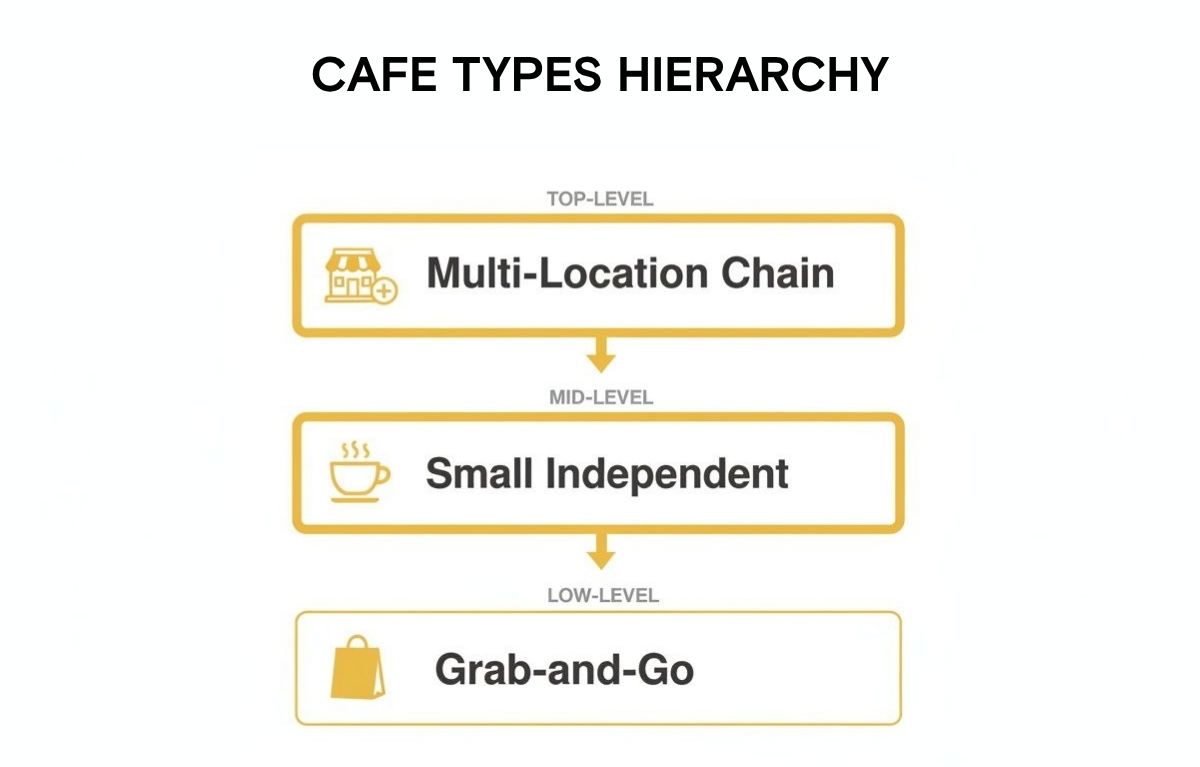
There’s no single, universal answer. A small independent spot in the suburbs plays a completely different game than a high-volume, grab-and-go kiosk in a dense city center. Likewise, a multi-location chain has access to economies of scale that a single-unit owner just can’t match. To get a real sense of your performance, you have to compare your cafe to others like it. Knowing your category is the first step to a fair fight.
What Is a Good Cafe Profit Margin?
While every business is unique, industry benchmarks give you a helpful yardstick. For years, many operators have considered a 10% to 15% net profit margin a strong benchmark. But the world has changed. Post-pandemic pressures, from rising ingredient costs to higher wages, have squeezed those numbers significantly.
Today, a more realistic target for a well-run independent cafe is a net profit margin between 6% and 12%. If you’re consistently hitting 12%, you’re in a strong position. Reaching 15% or higher puts you in the top tier of operators, running an exceptionally efficient business.
Of course, these are just averages. A few key factors will always move the needle:
- Business Model: A cafe with a full kitchen and table service has much higher labor and food costs than one that just serves amazing coffee and pre-made pastries.
- Location: Prime urban real estate demands a ton of sales volume just to cover the rent, while a spot in a lower-cost suburb or rural town gives you more breathing room.
- Product Mix: If you’re selling a lot of high-margin drip coffee, tea, and simple baked goods, your margins will naturally be healthier than a shop focused on complex, labor-intensive espresso drinks.
Benchmarking by Cafe Type
To get an even clearer picture, it’s crucial to compare apples to apples. Different cafe models have fundamentally different cost structures and profit potential.
| Cafe Type | Average Net Profit Margin | Key Characteristics |
|---|---|---|
| Small Independent Cafe | 6% – 12% | Highly flexible menu and pricing but lacks buying power. Thrives on community connection. |
| Multi-Location Chain | 8% – 15%+ | Benefits from bulk purchasing, standard operating procedures, and brand recognition. Higher overhead. |
| Grab-and-Go/Kiosk | 10% – 15% | Lower labor and rent. Built for high volume and low-touch service with a limited menu. |
| Full-Service Cafe/Bistro | 5% – 10% | Broader menu with extensive food, requiring more kitchen and service staff. Margins look more like a full-service restaurant. |
When you know these benchmarks, you can assess your performance with real context. If your grab-and-go kiosk is only hitting a 7% margin, you know there’s a major opportunity for improvement. On the flip side, if your little independent shop is consistently pulling 14%, you can be confident you’re running a truly efficient and profitable business.
Turning Insight Into Action
Understanding your cafe’s profit margins is only the first step. The real impact comes from actively managing the key drivers behind them.
A few core levers have the biggest influence on your bottom line.
Manage Your Cost of Goods Sold (COGS)
Small improvements in ingredient and packaging costs can significantly increase your margins. Regularly review your suppliers, compare pricing, and negotiate when possible, especially for high-volume items like coffee, milk, and cups. Even a small percentage reduction here can have an outsized impact on your profitability.
Control Labor Costs with Smarter Scheduling
Labor is one of the largest expenses in any cafe. Use your POS data to align staffing with actual demand, avoiding overstaffing during slow periods and understaffing during peak hours. Cross-training employees can also improve flexibility and help you operate more efficiently without sacrificing service quality.
Minimize Waste Through Better Tracking
Every item you throw away is lost profit. Implement simple systems like first-in, first-out (FIFO) and start tracking what gets wasted. Identifying patterns, like over-ordering or preparation errors, can help you reduce unnecessary costs and improve consistency.
Price and Design Your Menu Strategically
Your pricing should reflect both your costs and the value you deliver. If an item falls outside your target cost range, consider adjusting the price, portion, or sourcing. You can also guide customers toward higher-margin items through simple menu design and staff recommendations.
Improving your cafe’s profitability doesn’t require drastic changes. Small, consistent improvements across these areas can compound into meaningful gains over time.
Your Top Questions About Cafe Profits, Answered
Here are straight answers to the most common questions from cafe owners on the ground.
What’s a realistic profit margin for a new cafe?
Let’s be real: the first year is about survival. It’s about getting your name out there, dialing in your systems, and building a core group of regulars. While a well-oiled independent cafe might hit a net profit margin of 6% to 12%, that’s not the target for year one.
If you can break even or hit a modest 2% to 5% net profit in your first 12 months, you’re doing something right. Your initial costs for marketing, training, and just getting people in the door are naturally going to be high. Focus on driving sales and making your operations smooth and repeatable. Once you’ve built that foundation, you can start pushing your margin toward the industry benchmark.
How do I cut food costs without cheapening my product?
This is the big one. Slashing your Cost of Goods Sold (COGS) is one of the fastest ways to see more money on the bottom line, but doing it by buying cheaper ingredients is a race to the bottom. It’s a short-term fix that can wreck your reputation for good.
The smarter move is to focus on your operations. Here are three things you can do right now:
- Talk to Your Suppliers. Don’t just accept the price on the invoice. If you’re a loyal customer who pays on time, you have leverage. Ask for better pricing on high-volume items like coffee and milk. A strong relationship is a two-way street.
- Get Serious About Waste. Every burnt croissant or wrong-temp latte is pure profit poured down the drain. Start a simple waste log today. Have your team write down everything that gets tossed. You’ll quickly see patterns that point to training gaps, recipe flaws, or ordering mistakes.
- Make Your Menu Work Smarter. Design a menu where ingredients pull double or triple duty. Using the same high-quality tomato in a sandwich, a salad, and a soup reduces the number of SKUs you have to manage, minimizes spoilage, and makes inventory a whole lot simpler.
Should I focus on high volume or high margin?
Ah, the classic cafe dilemma. The honest answer? It completely depends on your model. There’s no magic formula here; it’s about finding the right balance for your specific concept, location, and customer base.
A high-volume model is all about speed and efficiency. Think of a grab-and-go spot in a busy financial district. They crank out hundreds of drip coffees and simple pastries, making a small profit on each but winning through sheer numbers. Success is measured in seconds and customer count.
On the other hand, a high-margin model is about creating a destination. This is your specialty shop known for its meticulous single-origin pour-overs and exclusive artisanal scones. They sell fewer items, but each sale contributes significantly more to the bottom line. This strategy leans on brand, experience, and perceived value that justifies a premium price.
The most durable cafes usually find a way to do both. They use popular, accessible items to drive traffic while strategically pushing their unique, high-margin “Star” products to lift the overall profitability of every transaction.
Ready to turn these insights into action? MAJC✨ is a community-driven platform designed to help hospitality operators run smarter, more profitable businesses. Access operator-tested tools, expert coaching, and a network of peers to help you master your cafe profit margins and build a team that thrives. Find out how MAJC can support your growth.