

A solid business plan is more than a formality for lenders; it is your strategic roadmap. It turns a creative concept into a viable operation by forcing you to analyze every detail, from your brand story to daily financial forecasts. Without it, you are flying blind in a crowded market.
Why a Business Plan Is Nonnegotiable
Beyond securing funding, a comprehensive plan acts as your “stress test.” It helps you identify operational challenges long before you brew your first cup and provides a benchmark to measure your progress once the doors open.
The opportunity is massive: the global foodservice coffee market is projected to reach USD 946.08 billion by 2034, with the U.S. market alone estimated at USD 154.01 billion by 2032, according to Fortune Business Insights. This growth is fueled by a rising demand for specialty coffee and experience-driven cafes, creating a clear path for new operators who approach the business with a strategic, data-driven plan.
Our coffee shop business plan guide is designed specifically for hospitality professionals, providing the essential structure you need to move from vision to grand opening with confidence.
Key Sections of Your Coffee Shop Business Plan
To make sure your plan is rock-solid, you need to cover all the essential bases. This table breaks down the core components every lender or investor will be looking for.
| Section | Purpose | Key Questions to Answer |
|---|---|---|
| Executive Summary | A powerful, concise overview of your entire plan. | What is your mission? What are your key financial highlights? Why will you succeed? |
| Company Description | Details the “what” and “why” behind your coffee shop. | What is your legal structure? What problem are you solving for customers? |
| Concept & Menu | Defines your brand identity and what you will be serving. | What is your unique selling proposition (USP)? What are your signature items? |
| Market Analysis | Shows you understand your industry, customers, and competitors. | Who is your target audience? Who are your direct and indirect competitors? |
| Operations Plan | Outlines the day-to-day nuts and bolts of the business. | What are your daily procedures? Who are your suppliers? What tech will you use? |
| Management Team | Highlights the experience and expertise behind the business. | Who are the key players? What relevant experience do they bring to the table? |
| Marketing & Sales | Explains how you will attract and retain customers. | How will you build brand awareness? What is your strategy for launch and beyond? |
| Financial Projections | Provides the numbers to back up your strategy and prove viability. | What are your startup costs? When will you break even? What are your sales forecasts? |
Think of these sections as chapters in your business’s story. Each one builds on the last to create a compelling and convincing narrative.
Crafting Your Unforgettable Brand and Concept
Long before you pull your first perfect shot of espresso, your coffee shop needs a soul. In a market flooded with options, just serving great coffee is the bare minimum. It is the price of entry, not what makes you special.
Your brand and concept are the story you tell. It is the reason a customer walks past three other cafes to get to yours. This is where you go beyond the beans and brew an identity people connect with.
This section of your coffee shop business plan is where you nail down your “why.” It is the heart of your operation, influencing everything from the music you play to the design of your loyalty cards.
So, what kind of experience are you creating?
Are you a cozy, community hub with worn-in armchairs and a book exchange? A sleek, minimalist space for professionals needing a high-quality espresso on the go? Or maybe a vibrant, eclectic spot that hosts local artists and open mic nights? Defining this niche is your first real step toward building a brand that actually resonates.
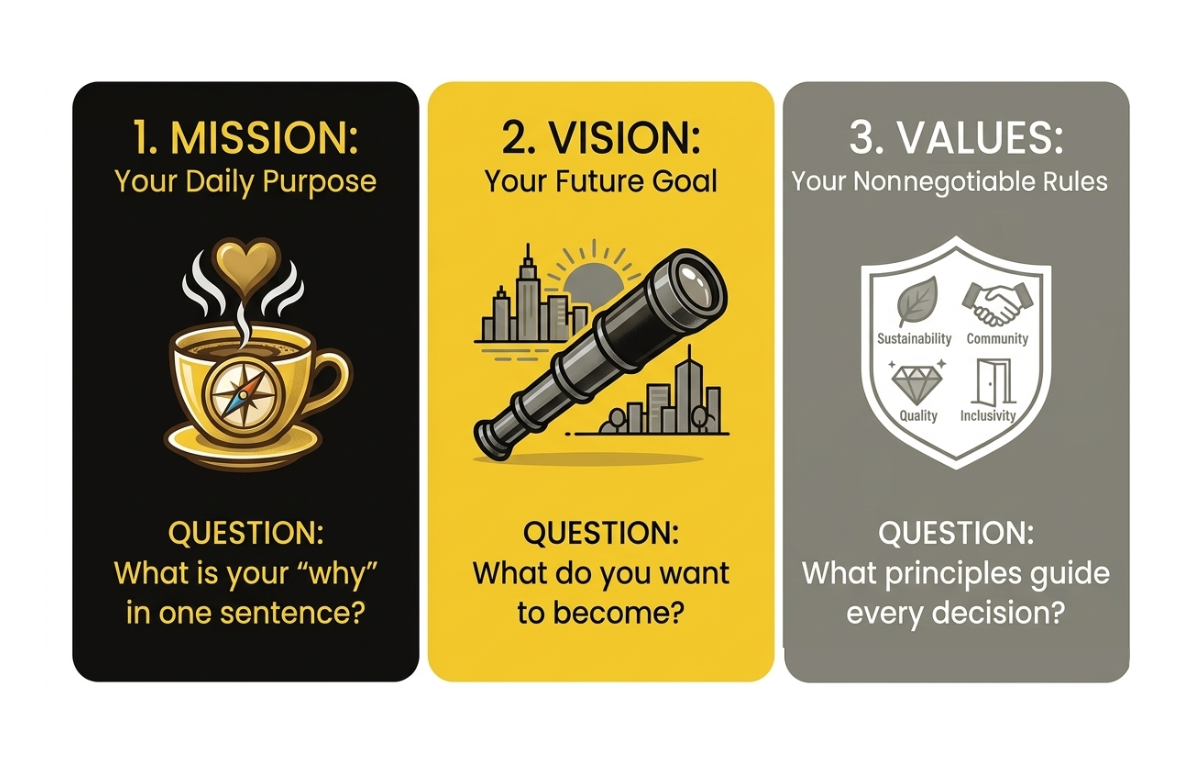
Defining Your Mission, Vision, and Values
Mission, vision, and values are not just corporate fluff; they are the guardrails for your business. They give your team clarity and build an authentic connection with your customers. They are the foundation of a brand people can get behind.
-
Mission Statement: This is your purpose: what you do, who you do it for, and how. It is your “why” in one powerful sentence. For example: “To be the neighborhood’s living room, fostering connection and creativity through ethically sourced coffee and genuine hospitality.”
-
Vision Statement: This is your big-picture goal. It answers the question, “Where do we want to go?” A vision might be: “To become the most beloved community hub in our city, known for exceptional coffee and inspiring local culture.”
-
Core Values: These are the nonnegotiables that guide your actions. Maybe it is sustainability, community, quality, or inclusivity. Nailing down three to five of these will help you make decisions that always feel true to your brand.
These statements give your brand real depth. If you need more inspiration on this, our guide to building a restaurant marketing plan digs into how to turn these values into actions your customers can see and feel.
From Concept to Customer Experience
Once you have established your identity, it is time to build the tangible things that bring your brand to life. This is where your concept becomes a real experience for every single person who walks through your door. Every detail should feel cohesive and intentional.
A strong brand is more than a logo; it is a consistent, emotional experience. It is the feeling a customer gets when they see your sign, hold your cup, and interact with your team.
Think about how your concept translates into real-world decisions.
-
Name and Logo: Is your name modern and witty or classic and comforting? Does your logo’s font and color palette reflect the vibe you’re creating? Your visual identity is your brand’s first handshake.
-
Shop Ambiance: The layout, furniture, lighting, and even the music playlist all have to align with your concept. A fast-paced commuter spot will have a totally different flow and feel than a relaxed lounge built for long conversations.
-
Service Style: How will your baristas talk to customers? Is the service quick and efficient, or is it more personal and educational? The tone your team sets is a massive part of your brand experience.
Ultimately, your brand is the promise you make to your customers. By defining it clearly in your business plan, you create a blueprint for delivering on that promise, cup after cup. This is what turns a simple coffee shop into a cherished local spot.
Sizing Up Your Local Market and Competition
This part of your business plan is where you show that your coffee shop is not just a great idea, but a viable one. Think of it as your reconnaissance mission.
This is not about guesswork; it is about building a data-backed case that gives you, and your potential investors, confidence that you know the neighborhood you are about to serve.
Who Are You Serving?
Before you can win over customers, you have to know exactly who they are. Do not just guess. Building a detailed customer profile, or buyer persona, is the secret to making everything from your menu to your marketing feel like it was made just for them. Go deeper than basic demographics.
- Demographics: What is their age, income, and job? Are you in a neighborhood full of students, young professionals with kids, or established retirees?
- Behaviors: What does their day look like? Are they grabbing a quick espresso at 7:00 a.m. on the way to the train, or are they looking for a quiet corner with a laptop for a few hours in the afternoon?
- Spending Habits: How much is a cup of coffee worth to them? Are they hunting for a bargain, or will they happily pay a premium for a single-origin pour-over and an experience to match?
Nailing these answers helps you design a space that speaks directly to the people you want to attract. A shop targeting remote workers is a failure without plenty of outlets and comfortable seats. One built for commuters dies if the service line is not ruthlessly efficient.
Scoping Out the Competition
A serious competitive analysis is how you understand the local landscape and carve out a space that is uniquely yours. This means looking at both your direct and indirect competitors.
A competitor is not just another coffee shop. It is any place your target customer might go to solve the problem you’re trying to solve, whether that is a quick caffeine fix, a place to meet a friend, or a great pastry.
Direct competitors are the obvious ones: other coffee shops, cafes, and local bakeries. For each, you need to become a student of their business:
- What is on their menu? What is the quality and price point?
- What is their vibe? How does it feel to be a customer there?
- When are they busy? When are they dead?
- What are people saying about them in online reviews and on social media?
Indirect competitors are the places people go that are not coffee shops: fast-food chains with a decent brew, convenience stores, or that new juice bar. They might not specialize in coffee, but they offer an alternative. Understanding what they do well (like speed or rock-bottom prices) helps you sharpen your own unique advantages.
Running a SWOT Analysis
A SWOT analysis is a brutally simple but incredibly powerful way to organize your research. It forces you to look at your future business from four critical angles.
| Analysis Point | Description | Example for a Coffee Shop |
|---|---|---|
| Strengths | What you have going for you, internally. | Specialty single-origin beans, a head barista with a local following, a prime corner location. |
| Weaknesses | The internal realities you have to overcome. | A tiny seating area, limited startup capital, zero brand recognition. |
| Opportunities | External trends or events you can jump on. | A new office building opening nearby, the growing local demand for vegan pastries. |
| Threats | External forces that could hurt you. | Skyrocketing dairy prices, a new Starbucks opening two blocks away. |
This exercise is not just academic; it is the foundation of a strategy that plays to your strengths and actively protects you from your risks.
Designing Your Daily Operations for Success
While your brand gives the business its soul, your operations plan provides the muscle. A rock-solid operational strategy shows investors you have moved beyond the dream and have a real plan for delivering a consistent, high-quality experience every single day.
A detailed operations section proves you get the day-to-day reality of running a hospitality business. It is all about creating systems that work, hiring people who care, and choosing tools that make everything run smoother. Let’s break down the three areas that matter most.
Menu Development and Sourcing
Your menu is the most direct expression of your brand, but it also has to make money. Every single item, from a simple drip coffee to that fancy seasonal latte, must be costed out. This means calculating the cost of goods sold (COGS) for every recipe, right down to the espresso beans, milk, cup, and lid.
A smart menu offers a mix of high-profit staples and more unique, enticing items that draw people in. Just as important are your suppliers. Who is providing your beans, dairy, alternative milks, syrups, and pastries? You need to find partners who align with your brand values, whether that is a focus on local sourcing, organic ingredients, or fair-trade practices.
Building Your Dream Team
Your baristas are the face of your business. They are the brand ambassadors who can turn a first-time visitor into a regular for life. That is why your hiring and training strategy is so critical to your operational success. Start by writing clear, detailed job descriptions that attract passionate, service-oriented people.
Once they are on board, a structured training program is nonnegotiable. This goes way beyond just showing them how to pull a shot. Your training has to cover:
- Technical Skills: Perfecting espresso extraction, milk steaming, and latte art.
- Product Knowledge: Knowing the flavor profiles of your coffees and the ingredients in your food.
- Customer Service: Role-playing common scenarios to make sure every interaction reflects your brand.
- Operational Workflow: Knowing opening and closing procedures, health and safety standards, and how to use the POS system.
For a deeper dive into creating consistent processes, check out our guide on how to create standard operating procedures for your team.
Daily Workflow and Technology
Efficiency is everything in a coffee shop. A well-designed workflow minimizes chaos and maximizes speed, especially during that morning crush. Map out your floor plan to create a logical path for both customers and staff. The journey from the door to the ordering counter, pickup area, and seating should feel easy and natural.
Behind the counter, an ergonomic layout is nonnegotiable. Place your espresso machine, grinders, milk fridges, and POS system to reduce unnecessary steps. This “barista cockpit” approach keeps everything within arm’s reach, speeding up service and cutting down on employee fatigue.
Finally, choosing the right tech is a huge operational decision. Your Point of Sale (POS) system is the heart of your tech stack. A modern POS needs to do more than just take money. Look for features like:
- Inventory Management: To track stock levels in real-time and automate reordering.
- Sales Reporting: To give you detailed data on your best-sellers and peak hours.
- Integrated Loyalty (CRM): Tools to manage loyalty programs, collect customer feedback, and drive repeat visits through personalized offers.
- Employee Management: To handle scheduling and track staff performance.
Investing in the right tools and designing an intelligent workflow from day one will pay off big time, letting your team focus on what really matters: delivering an exceptional experience.
Building Your Financial Projections
Let’s be honest: the numbers tell the real story of your coffee shop’s potential. This is the one section of your business plan that investors and lenders will tear apart. It is where your passion for incredible coffee meets the cold, hard reality of dollars and cents, proving your concept is not just a cool idea, but a business that can actually make money.
A solid set of financial projections shows you have done the homework. It tells a potential backer that you have thought through every single cost, from the big-ticket espresso machine down to the price of a paper cup. Without this financial roadmap, securing a loan or investment is a nonstarter.
Identifying Your Startup Costs
Before you can even think about future profits, you have to get painfully specific about what it will cost to open your doors. Startup costs have a nasty habit of being higher than you expect, so a detailed, line-by-line list is your best defense against surprises.
I find it helpful to think of these expenses in two main buckets: what you buy once, and what you have to pay for before you make your first dollar.
- One-Time Capital Expenditures: This is the big stuff. Think espresso machines, grinders, refrigeration, ovens, furniture, and your POS system. It also covers the physical build-out, renovation costs, architectural fees, and initial security deposits for your lease.
- Initial Operating Expenses: These are all the costs you rack up before you sell your first latte. This includes your starting inventory (coffee beans, milk, syrups, pastries), all those business licenses and permits, insurance premiums, legal fees for setting up your LLC, and your pre-opening marketing budget to build some buzz.
One piece of advice: whatever you think your startup costs will be, add a contingency fund of at least 15-20%. Unexpected plumbing issues, construction delays, or equipment price hikes happen. That buffer will save you.
This diagram shows how all the moving parts of your operation, your menu, your team and your tech, all feed directly into these numbers.
From inventory and payroll to software subscriptions, every decision you make in your operations plan has a direct financial consequence.
Creating Pro Forma Financial Statements
With your startup costs nailed down, it is time to project your financial performance for the first three to five years. These forward-looking documents are called pro forma statements, and they are the heart of your financial section. You will need three of them.
- Income Statement (Profit & Loss): This is where you prove your business model can be profitable. It subtracts all your costs and expenses from your revenues to show your net profit or loss over time, usually monthly for the first year, then quarterly or annually after that.
- Cash Flow Statement: Honestly, this might be the single most important document for a new business. It tracks the actual cash moving in and out of your bank account. Profit on paper does not pay the bills; cash does. This statement helps you see cash shortages coming so you can pay suppliers, staff, and rent on time.
- Balance Sheet: This is a snapshot of your business’s financial health on a given day. It lists your assets (what you own), liabilities (what you owe), and owner’s equity. It gives you, and investors, the complete picture of your company’s net worth.
Forecasting Sales and Calculating Your Break-Even Point
Forecasting sales for a business that does not exist yet can feel like pulling numbers out of thin air, but it needs to be an educated guess rooted in your market analysis. Do not just make it up. Build a realistic forecast by looking at a few key factors:
- Seating Capacity: How many customers can you physically serve at once? What is a reasonable estimate for how quickly tables will turn during your morning rush versus your afternoon lull?
- Average Ticket Size: Based on your menu and pricing, what do you realistically expect the average person to spend? A simple latte? Or a latte and a pastry? Get specific.
- Foot Traffic and Hours: Go back to your location analysis. Use what you learned about the neighborhood to estimate customer flow during your peak and off-peak hours.
Once you have a sales forecast and a firm grip on your costs, you can calculate your break-even point. This is the magic number, the exact moment your total revenue equals your total costs. You are no longer losing money.
Knowing this number is powerful. It is not just an accounting exercise; it gives you a clear, tangible sales target to hit every single month. It is also a critical benchmark for measuring your performance in those crucial early days. For a deeper dive into the cost side of this equation, you can learn more about how to calculate your overhead rate and work it into your analysis.
This level of detail gives a potential investor confidence that you are not just a dreamer with a great coffee recipe. You are a serious entrepreneur who is ready to run a successful, profitable business.
Common Questions About Coffee Shop Business Plans
Working through these common questions is the last step in polishing your plan and getting the confidence you need to walk into a lender’s office.
How do I secure funding with limited history?
This is the big one for most first-time entrepreneurs. When you do not have a proven track record, your business plan has to do the heavy lifting to build trust. Remember, investors are not just funding an idea; they are betting on you.
Investors look for passion backed by a deep understanding of the business. Your plan must show you have thought through every operational challenge and have a realistic, data-driven strategy for profitability.
Lean into your unique strengths. Maybe you have years of experience as a barista or manager. Perhaps your head barista already has a loyal following in town, or you have secured a killer location with guaranteed foot traffic. You can also showcase a strong advisory board or key partnerships to prove you have a solid support system ready to tackle the inevitable challenges.
What is a realistic estimate for startup costs?
This is where so many new owners get into trouble. It is easy to underestimate all the little expenses that bleed a budget dry. A solid estimate goes way beyond the big-ticket items like an espresso machine or your rent deposit.
A truly realistic budget has to include:
- Contingency Fund: Always, always add a buffer of 15-20% to your total estimate. Construction delays happen. Equipment prices go up. This fund is what will keep a small hiccup from derailing your entire launch.
- Working Capital: You need enough cash in the bank to cover all your operating expenses for the first three to six months, before you are actually profitable. This means having payroll, inventory, utilities, and marketing costs covered.
- Professional Fees: Do not forget to budget for the boring stuff. You will have legal fees for setting up your LLC, accounting services, and maybe even consultant fees.
Being overly optimistic here is one of the most critical mistakes you can make. A detailed, well-researched budget shows potential backers that you are a serious, pragmatic operator who has done your homework.
What do investors look for besides the numbers?
Your financial projections are absolutely critical, but investors read between the lines. They are looking for a story that makes sense and a founder they can believe in. They want to see a genuine connection to your brand and a crystal-clear vision for the customer experience you are trying to create.
They are really evaluating your:
- Team: Who is on your management team? Do they have the right blend of creative vision and nuts-and-bolts operational experience?
- Brand Strength: How compelling is your concept? Does it actually fill a gap in the local market, or are you just another coffee shop?
- Scalability: What is the long-term vision? Do you have a plan for future growth, like opening a second location, expanding into catering, or launching a retail line of coffee beans?
Ultimately, a winning coffee shop business plan helps you tell a complete story. It combines a passionate vision with a grounded, realistic plan for making it happen, giving investors every reason to bet on your success.
Ready to build a smarter, more profitable hospitality business? Join the community at MAJC✨ to access expert-led training, operator-tested tools, and a network of peers dedicated to helping you succeed. Explore all we have to offer at majc.ai.