


Knowing how to handle employee conflicts in a restaurant comes down to speed, neutrality, and structure. Conflict that’s ignored never disappears. It spreads, escalates, and quietly undermines your team. Effective managers step in early, act as calm first responders, and treat friction as a signal that something in the operation needs attention.
The Real Cost of Unresolved Conflict in Your Restaurant
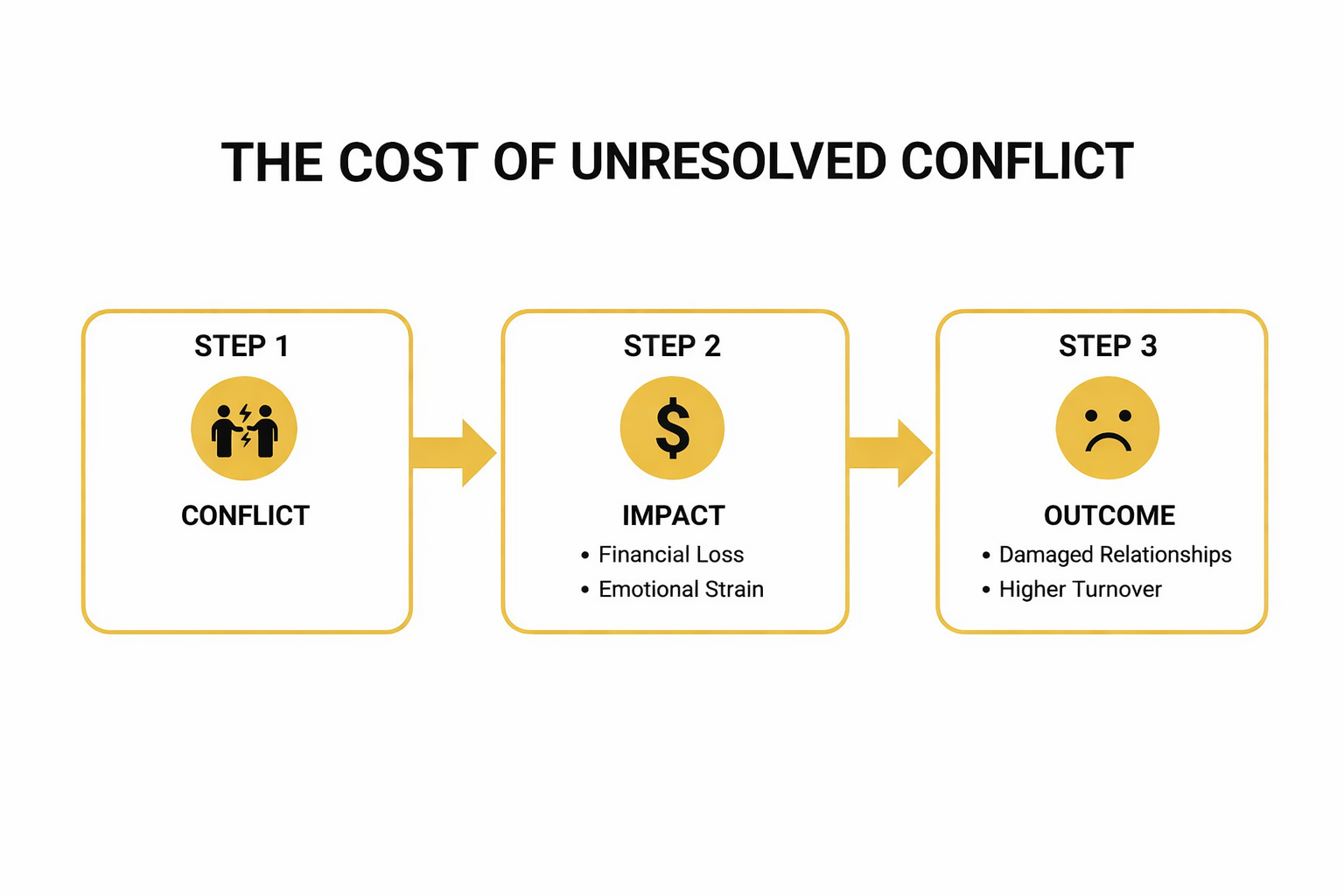
In hospitality, tension is inevitable. Tight spaces, fast-paced service, and high-pressure shifts create constant stress points. But dismissing conflict as “just part of the job” is a costly mistake. A disagreement between a server and a cook is rarely isolated. It disrupts workflow, slows service, and creates a ripple effect that guests can feel.
The impact goes far beyond one bad moment on the floor.
Unresolved conflict drains productivity and morale. Research from CPP Global found that employees spend an average of 2.8 hours per week dealing with workplace conflict, contributing to hundreds of billions in lost productivity across U.S. businesses. In restaurants, those lost hours translate directly into slower service, unfinished prep, and missed standards.
The hidden damage adds up quickly:
-
Higher Turnover: Talented staff won’t stay in environments where tension goes unchecked.
-
Lower Morale: Ignored conflict signals weak leadership and erodes trust.
-
Worse Guest Experience: Teams under stress struggle to deliver consistent hospitality.
Conflict itself isn’t the real problem. Poorly handled conflict is. When addressed early and correctly, it becomes a diagnostic tool that reveals gaps in communication, processes, or leadership.
Understanding the stakes is the first step. What matters next is how you respond when conflict appears, especially in the critical first hour.
Your First Response in the Critical First Hour
The dinner rush is peaking, the printer is firing off tickets, and two of your best servers are in a heated, whispered argument by the POS station. This is the moment where your leadership is truly tested.
How you handle these first few seconds determines whether the issue fizzles out or explodes, taking team morale and guest satisfaction down with it.
Your first move is not to solve the problem; it is to control the environment. Forget about assigning blame or even understanding the root cause right now. The immediate goal is to de-escalate, contain, and stabilize.
Separate and Neutralize the Situation
Your very first action is to physically separate the employees. Do it calmly and discreetly to avoid drawing the attention of guests or other team members.
A simple, quiet, “Can I speak with you both separately for a moment?” works wonders.
Find a neutral, private space. This could be the manager’s office, a dry storage area, or even the back alley, anywhere away from the eyes and ears of the floor. Just changing the scenery helps break the emotional intensity of the moment.
Use Disarming Language
The words you choose in this critical first hour are everything. Asking an accusatory question like, “What’s your problem?” will only put people on the defensive. Instead, you need to lead with empathy and a calm tone.
Your objective is not to be a judge, but a facilitator. Acknowledge the emotion without validating the conflict itself. This approach signals that you see their frustration and are taking it seriously, which is often enough to lower the temperature.
Try using specific, disarming phrases that focus on observation and action, not blame. Here are a few that work in real-world restaurant settings:
- “I can see you’re both frustrated. Let’s step into the office for five minutes to talk separately.”
- “Hey, let’s pause this conversation. Alex, can you help me with table 12? Maria, I’ll circle back with you in two minutes.”
- “It looks like things are getting tense. Let’s take a quick breather and regroup in the back.”
This approach achieves two critical goals. First, it ensures service continues uninterrupted. Second, it shows your entire team that conflicts are handled respectfully and professionally, not ignored or allowed to fester.
Set the Expectation for Resolution
Once you have each employee in a private space, keep the interaction brief. This is not the time for a full investigation. Your script should be simple and focused on the next steps.
For example, you might say, “I know you’re upset, and I want to hear your side of what happened. I’m going to talk with [the other employee] as well. We will find a time to sit down and sort this out properly after the shift. For now, I need us to focus on getting through service.”
This reassures them they will be heard while firmly re-establishing the immediate priority: the guests. You have now successfully contained the conflict, de-escalated the raw emotion, and set a clear path for a proper resolution later, all without disrupting the dining experience. That is how you lead in the heat of the moment.
Building a Fair and Neutral Investigation Framework
Once the immediate fire is out and everyone has taken a breath, your job shifts from de-escalation to discovery. Rushing to a solution without knowing the full story is like trying to fix a broken dish without finding all the pieces. You will just end up with a mess.
It is time to build a fair and neutral investigation framework. This is not about playing detective; it is about being an objective leader. This process takes you past gut feelings and assumptions, making sure whatever resolution you land on is based on solid facts about what happened and why.
Conduct Private One-on-One Conversations
Your investigation starts with individual conversations. It is absolutely critical to speak with each person involved separately, along with any direct witnesses. This gives you an unfiltered account from each perspective, free from the pressure of having the other person in the room.
The goal here is simple: listen more than you talk. Your role is to create a safe space where your team members feel comfortable sharing their side of the story. Kick things off by reassuring them that your purpose is to understand, not to blame, and that their honesty is crucial for finding a way forward.
Ask the Right Questions
The quality of your investigation really comes down to the questions you ask. You have to avoid leading questions that corner someone into an answer or subtly place blame. Instead, stick to open-ended questions that encourage them to tell you the story in their own words.
This technique is how you gather the facts while also understanding the emotional side of the conflict.
Getting this right is crucial. Bad questions lead to biased answers and a flawed investigation. Here is a quick guide to asking questions that actually get you the information you need.
Effective vs. Ineffective Investigation Questions
| Question Type | Ineffective Question (Leading/Biased) | Effective Question (Neutral/Open-Ended) |
|---|---|---|
| Opening | “So, I heard you were angry. What did you say to them?” | “Can you walk me through the situation from your perspective?” |
| Fact-Finding | “Did they take your prep station without asking again?” | “Describe what happened right before the disagreement started.” |
| Impact | “You must have been really frustrated, right?” | “What was the impact on your ability to do your job?” |
| Context | “This seems like the same issue as last week, wasn’t it?” | “Has anything similar to this happened before?” |
Using neutral language empowers your team to give you an honest account, which is the only way you will get to the root of the problem. This is not just about being nice; it is fundamental to a fair process.
The Importance of Meticulous Documentation
As you have these conversations, write everything down. And I mean everything. Your notes need to be factual, objective, and consistent for every single person you talk to. Vague notes are useless later on. Details are your best friend here.
Make sure your documentation includes:
- Who You Spoke With: Full name and their role.
- When and Where: The date, time, and location of the conversation.
- What Was Said: Capture key points, direct quotes where it makes sense, and specific details of their account.
- Your Observations: Note the employee’s demeanor (e.g., “visibly upset,” “calm”) but avoid making assumptions about why they feel that way.
This record is not just for your memory. It becomes the official account of the incident and is an invaluable reference for mediation, any necessary follow-up, and potential escalation. Good documentation also proves you have been consistent and fair, which is how you build trust.
Facilitating a Productive Mediation Meeting
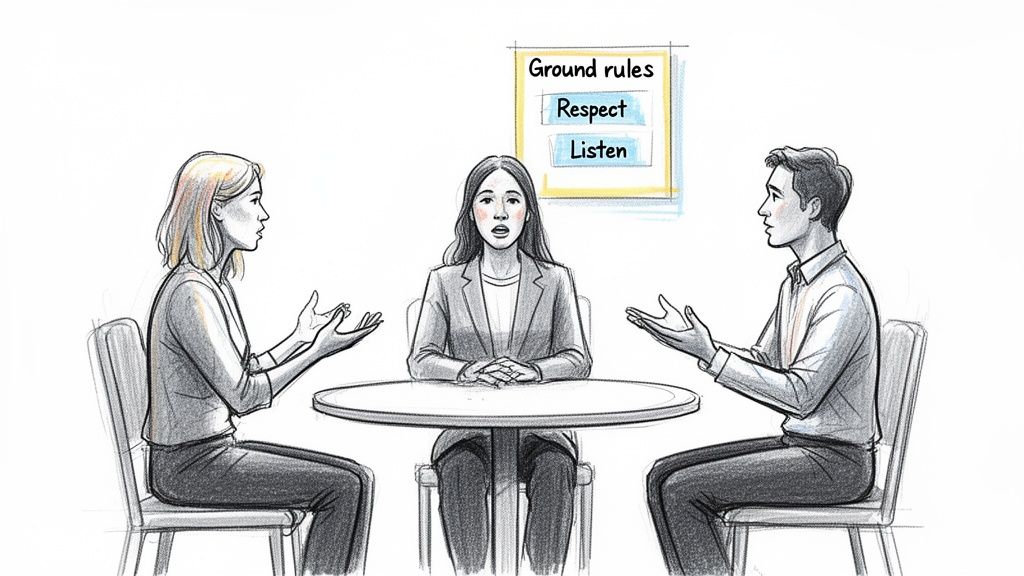
You have done the quiet work and gathered the facts. Now it is time to bring everyone together for a mediation meeting. Your job here is not to investigate anymore; you are a neutral facilitator. That is a critical shift. You are not a judge declaring a winner and a loser. You are guiding a tough conversation toward a solution everyone can live with.
When you get this right, you are not just putting out one fire. You are helping your team members find common ground and agree on a path forward. It builds the kind of trust that can stop future conflicts before they even start.
Setting the Ground Rules for Respect
Before anyone says a word about the issue, you have to set the rules of engagement. This is nonnegotiable. It sets the tone for everything that follows.
These rules create a safe space. They ensure both employees feel they can speak honestly without getting attacked. It is the only way you are going to make any real progress.
Keep your ground rules simple and direct:
- One person speaks at a time. No interruptions. Period.
- Use “I” statements. Encourage them to own their feelings (“I felt frustrated when…”) instead of pointing fingers (“You always…”).
- No personal attacks. The focus is on specific actions and situations, not someone’s character.
- The goal is a solution, not blame. Remind them you are all there to figure out how to work together better.
By setting these boundaries up front, you build a container for a difficult conversation, keeping it from spiraling out of control.
Guiding the Conversation Toward Common Ground
Once the rules are clear, it is time to start. Ask one employee to share their perspective, without interruption. After they finish, your next move is what really makes this work.
Do not just turn to the other person for their side of the story. Instead, use a technique called active listening reflection.
For example, you might say, “John, thank you. Maria, before you share your side, can you tell me what you heard John say?”
This is a simple but incredibly powerful step. It forces one person to actually hear the other, slowing the conversation down and stopping knee-jerk defensive reactions. It also gives you a chance to clear up misunderstandings right away. After Maria summarizes what she heard, you can invite her to share her perspective, and you will do the same for John.
The real art of mediation is shifting the focus from the problem to the solution. Once both people feel heard, you can start asking future-focused questions like, “What would a better outcome look like for both of you?” or “What’s one thing you could each do differently next time?”
This approach gradually moves the conversation away from replaying the past and toward building a better way of working together. It all comes down to clear, respectful dialogue.
Documenting the Resolution
As they start brainstorming solutions, your job is to capture the commitments they are making. The meeting needs to end with a clear, written agreement outlining the specific actions each person agrees to take. This is not some complicated legal contract; it is a simple summary to create accountability.
A simple Resolution Agreement might include:
- The Issue: A brief, neutral, one-sentence summary of the conflict.
- Agreed-Upon Actions: Bullet points detailing what each employee will do. (e.g., “Maria will confirm ticket modifications with the on-duty chef before sending them to the line.”)
- Commitment to Follow-Up: A note that you will check in with both of them in one week to see how things are going.
Have both employees review it and sign it. This simple act turns a verbal promise into a concrete commitment. It gives everyone a clear reference point and sets the stage for your follow-up, making sure the resolution actually sticks.
Using Documentation and Follow-Up to Prevent Recurrence
Solving a conflict is a short-term win. Preventing it from happening again is how you build a resilient, high-performing team for the long haul.
The final steps in handling employee disputes, documentation, and follow-up are where you turn a quick fix into a lasting improvement. This is not just about managing the immediate problem; it is about strengthening your entire operation.
After a productive mediation, it is tempting to just shake hands and move on. But without a formal record, agreements get fuzzy and old habits creep back in fast. Writing down the resolution is not about building a case against anyone. It is about creating a shared, objective roadmap for moving forward.
Creating a Formal Record of the Resolution
Your documentation needs to be simple, factual, and stripped of emotional language or blame. Think of it as a neutral summary of the commitments everyone made in the room. This record is crucial for clarity and gives you a reference point if the same issues pop up again.
Here is what your resolution document should always include:
- Date and Participants: List the date of the meeting and the full names of everyone involved, including yourself as the facilitator.
- Brief Issue Summary: A single, neutral sentence describing the core issue. Something like, “Discussion regarding communication protocols between the service bar and kitchen during peak hours.”
- Agreed-Upon Actions: Use a bulleted list to detail the specific, actionable steps each person has committed to. Be precise. Instead of “will communicate better,” write “John will verbally confirm custom orders with the on-duty line cook before ringing them in.”
- Follow-Up Schedule: Clearly state when you will check in with each employee separately and then together.
Getting this right is paramount for managing current issues and protecting the business.
Developing a Proactive Follow-Up Plan
The write-up alone is not enough. Follow-up is what makes the resolution stick.
Scheduling check-ins shows your team that the conversation mattered and that you are invested in real change. It turns accountability into an ongoing process instead of a one-time conversation.
A simple structure works best:
-
A short, private check-in with each employee a few days after mediation
-
A brief joint follow-up the following week to confirm progress
The goal is not to reopen the conflict, but to confirm that new behaviors are working and to address friction early if they are not.
From Conflict to Catalyst for Improvement
The most strategic part of this process is zooming out.
Ask yourself: Why did this conflict happen in the first place?
Most disputes are symptoms of deeper issues. A FOH and BOH clash may point to unclear modification procedures. Tension over side work may reveal outdated or inconsistent checklists.
When you identify these root causes, you can fix the system, not just the people. Updating processes, clarifying expectations, or reinforcing policies turns a negative moment into an opportunity for operational improvement.
This is how conflict stops being a disruption and becomes a tool for building a stronger, more aligned restaurant team.
This is also where a solid company policy becomes invaluable. If you do not have one, creating clear guidelines is a powerful preventative measure. Get started with our restaurant employee handbook template.
Common Conflict Scenarios and How to Handle Them
Even the best conflict resolution framework gets messy when real people are involved. No conflict follows a script. You are going to face situations that are awkward, uncomfortable, and fall way outside the neat little boxes in a handbook.
Knowing how to navigate these moments is what separates a good manager from a great one. Let us get into the tough questions that always come up. Think of this as your playbook for when things get complicated, built on the core principles of fairness, solid documentation, and clear communication.
What to do when an employee refuses to participate
It is a tough spot to be in. You are trying to mediate, and one employee just digs in their heels, refusing to even sit down at the table. Your first move is not to force it; it is to talk with them privately. Approach it with curiosity, not frustration. Find out why they are hesitant.
Often, they are worried it is a setup to point fingers. Reassure them that the goal is to find a path forward, not to assign blame. Sometimes, just hearing that the process is about fixing the situation for the future, not punishing someone for the past, is enough to get them on board.
If they still refuse, you have to respect their decision, but you also have to be clear about what happens next. Explain that the team needs a solution, so decisions will have to be made without their direct input. You absolutely must document their refusal and the reasons they gave. This is critical. From there, you proceed with your investigation using all the other information you can gather. Honestly, this level of noncooperation can become its own performance issue, which might mean a call to HR. When you hit this kind of wall, it is a good time to revisit the basics of how to handle difficult employees to keep the team on track.
How to manage a conflict that involves you
So, what happens when you are part of the problem? If you are directly involved in the conflict or even just realize you have a strong bias, you cannot be the one to mediate. Period. Trying to will instantly kill your team’s trust in you and any hope of a fair process.
Your integrity is your most valuable asset as a leader. The only move here is to recuse yourself immediately. Escalate the issue to your own boss or to your HR department.
Be completely transparent about your involvement. Telling them you have a conflict of interest is not a sign of weakness; it shows sound judgment and that you are prioritizing a fair outcome over your own ego. Your role instantly flips from facilitator to participant. You have to let a neutral third party take the lead. It is the only way to guarantee the resolution is objective and has any credibility.
When to escalate to HR or senior leadership
Knowing when to call for backup is a skill in itself. You should be able to handle most day-to-day friction, but some situations are immediate red flags that require you to loop in HR or senior leadership.
Do not even try to handle these issues on your own. Escalate immediately if the conflict involves any of the following:
- Harassment or Discrimination: Any claim touching on protected characteristics like race, gender, religion, or disability requires a formal, specialized investigation.
- Threats or Violence: The safety of your team is nonnegotiable. Any hint of physical threats, intimidation, or aggression is an automatic escalation.
- Potential Illegal Activity: This includes things like theft, substance abuse on the job, or anything else that could have legal consequences for the business.
Beyond these bright red lines, a good rule of thumb is to escalate when a conflict just will not die despite your best efforts, when it spills across multiple departments, or when it is actively poisoning team morale. If the issue is above your pay grade or outside your expertise, asking for help is the strongest, smartest move you can make.
How to proactively reduce team conflict
The best way to manage conflict? Stop it before it ever starts. Prevention is your most powerful tool, and it starts with building a culture where small disagreements get aired out constructively, not left to fester.
Set crystal-clear expectations from day one for job roles, communication norms, and professional conduct. Use your daily pre-shift huddles as a space for open dialogue where staff can raise minor frustrations before they blow up. And do not underestimate the power of team-building; when your front-of-house and back-of-house teams actually understand each other’s pressures, they build the rapport needed to give each other a little grace. For a more complete playbook, this step-by-step guide to conflict resolution in the workplace is an invaluable resource.
At MAJC✨, we provide hospitality leaders with the tools, training, and community support needed to build strong, resilient teams. From expert-led workshops on leadership to practical templates for operational excellence, we help you turn challenges like conflict into opportunities for growth. Learn how MAJC can help you run a smarter, more profitable restaurant at majc.ai.