


Getting a handle on your labor costs starts with a deep, honest look at your numbers. The smartest operators do not just slash hours; they diagnose their spending with a detailed audit, build schedules based on real data, and develop more efficient, versatile teams.
It is not about cutting for the sake of cutting. It is about making every dollar you spend on labor a strategic investment in the health of your business.
Conducting a Strategic Labor Cost Audit
Before you can make smart changes, you need a clear financial roadmap. A real labor cost audit gives you that. It goes way beyond a simple percentage to tell the story behind your spending. Think of it as a diagnostic tool for your restaurant’s financial health, helping you find hidden costs and your biggest opportunities for savings.
Let’s be honest: managing labor is more challenging than ever. According to recent industry reports, average labor costs in the U.S. hospitality sector have surged significantly since 2021, driven by a competitive job market and rising state minimum wages. Currently, labor expenses can consume anywhere from 25% to 40% of a restaurant’s total sales. For many operators, mastering how to reduce labor costs through strategic auditing has become a critical factor for long-term profitability.
Start with Your Prime Cost
Your first stop in any audit should be your prime cost. This number combines your total cost of goods sold (COGS) with your total labor costs, giving you a powerful, high-level snapshot of your operational efficiency.
Most successful operators aim to keep their prime cost at or below 60% of total sales. Calculate it weekly or bi-weekly, not just monthly. If you see that number creeping up, it is a bright red flag that either your food costs or your labor spend (or both) need immediate attention.
Dig Into Key Labor Metrics
Once you have your prime cost sorted, it is time to zoom in. Specific labor metrics, your key performance indicators (KPIs), are what help you pinpoint exactly where the money is going and why. Do not just glance at the numbers; look for trends over time. That is where the real story is.
To get started, here are a few essential labor metrics you need to live and breathe.
Essential Labor Metrics You Must Track
This table breaks down the core metrics for diagnosing your labor spend, explaining what they measure, and why they are vital for effective cost control.
| Metric | What It Measures | Why It Matters for Cost Reduction |
|---|---|---|
| Labor Cost % of Sales | The percentage of your revenue spent on all labor costs. | The classic benchmark. It tells you if your labor is in a healthy range relative to your sales volume. |
| Sales Per Labor Hour (SPLH) | The amount of revenue generated for every hour an employee works. | This is your productivity gauge. Low SPLH means you might be overstaffed for the sales you are bringing in. |
| Overtime % of Total Labor | The portion of your total labor hours paid at a premium rate. | Overtime is a profit killer. Tracking this exposes scheduling flaws or chronic understaffing. |
Getting comfortable with these numbers is nonnegotiable. They show you where the leaks are so you can patch them without guessing.
A deep dive into how to calculate labor cost percentage will give you the confidence to master this foundational metric.
Of course, a thorough audit connects the dots between labor and overall profitability. The team that builds this data-backed foundation sets itself up for the targeted, effective strategies we will get into next.
Mastering Data-Driven Scheduling
Think of it this way: your sales data tells a story about the daily and weekly rhythm of your business. It shows you the exact moments you need all hands on deck and the quiet lulls where a leaner team will do just fine. Using that information is the secret to building a schedule that is both efficient and effective.
Aligning Staffing with Sales Rhythms
Your POS system is a goldmine. Seriously. Start by pulling your hourly sales reports from the last few weeks. This data reveals your actual peak and off-peak times, not just the ones you feel are busy.
You might discover that the Wednesday lunch rush does not really kick off until 12:30 p.m., not noon. That simple insight means you can schedule one person to come in 30 minutes later every single week. Those little tweaks add up fast across your whole team and pay period.
The goal is to build a schedule that mirrors your sales curve as closely as possible. This ensures you have the right number of people on the floor at all times and directly improves your Sales Per Labor Hour (SPLH), a critical metric for productivity.
Implementing Flexible Staffing Models
A rigid, one-size-fits-all schedule is a recipe for wasted labor dollars. To truly optimize your spend, you need to build flexibility directly into your staffing model. This lets you adapt to real-time demand without resorting to costly overtime or sending people home early, a move that can kill morale.
Here are a few models that smart operators use to stay nimble:
- Staggered Shifts: Instead of everyone starting at 9 a.m. and leaving at 5 p.m., stagger their start and end times. One employee might work from 9 a.m. to 5 p.m., another from 10 a.m. to 6 p.m., and a third from 11 a.m. to 7 p.m. This creates overlapping coverage during your busiest hours without having extra bodies standing around during the slow shoulders of the day.
- Split Shifts: This is perfect for businesses with distinct busy periods, like a morning coffee rush and an evening dinner service. An employee might work from 7 a.m. to 11 a.m. and then come back for a 5 p.m. to 9 p.m. shift, making sure your best people are on the clock exactly when you need them most.
- On-Call Shifts: An on-call or “flex” employee agrees to be available during a specific window. If an unexpected rush hits, you call them in. This gives you a safety net against being understaffed without paying someone to wait for a rush that might not come.
Always check your local regulations before implementing on-call shifts, as some jurisdictions have specific rules about “reporting time pay.” Managing these flexible approaches is far easier with the best restaurant scheduling software, which helps automate assignments and track everyone’s availability.
Managing Shift Swaps and Predictive Scheduling
No matter how perfect your schedule is, life happens. Employees get sick, cars break down, and people need to swap shifts. Having a clear, written policy for how the team requests and approves shift swaps is crucial for team morale. It prevents chaos and ensures every shift is covered by someone who is properly trained.
On top of that, a growing number of cities and states are passing predictive scheduling laws. These “fair workweek” regulations require you to give employees their schedules with significant advance notice, typically seven to 14 days.
These laws also often require you to pay a premium for any last-minute schedule changes you make. Staying compliant is nonnegotiable if you want to avoid fines that would completely wipe out your labor-saving efforts.
This legal shift makes data-driven forecasting even more critical. When you use historical data to build accurate schedules well in advance, you not only control costs but also stay compliant and give your team the stability and predictability they crave. An accurate, predictable schedule is a win for your bottom line and your company culture.
Building a Resilient Cross-Trained Team
Picture this: it is a Friday night, the floor is slammed, and your host is effortlessly bussing tables to keep the flow moving. Or maybe a line cook calls out sick, and another cook jumps onto the prep station without missing a beat. That is the power of a cross-trained team.
It is not just a nice idea; it is a smart, long-term strategy for controlling labor costs by building a more flexible and capable workforce. Instead of walling off employees into single roles, you create a team of versatile problem-solvers. This gives you incredible scheduling agility, letting you run leaner shifts without ever sacrificing service quality. Gaps get covered instantly, and you can adapt to unexpected rushes without leaning on costly overtime.
Designing Your Cross-Training Program
A solid cross-training program does not require a massive overhaul. You do not need to teach everyone everything all at once. The secret is to start small by identifying the most logical skill overlaps between different roles.
For instance, a host already knows the floor plan and table numbers, making them a perfect candidate to learn how to bus tables or run food. A dishwasher sees every single plate that comes back to the pit, giving them a unique view of what dishes are popular, a great first step toward learning some basic prep work.
Start by mapping out these natural connections:
- Host to Busser/Food Runner: Both roles depend on floor awareness and speed.
- Dishwasher to Prep Cook: They already share a familiarity with the kitchen’s flow and ingredients.
- Cashier to Barista: Both are guest-facing roles that manage transactions and require solid menu knowledge.
When you start with these intuitive pathways, the training feels less like a chore and more like a logical next step in an employee’s growth.
Turning Senior Staff Into Mentors
Your most experienced people are your best trainers. Period. They have the kind of on-the-ground knowledge and practical skills you cannot get from a handbook. Empower them by setting up a simple mentorship program.
This does not have to be some formal, corporate-style system. Just pair a veteran server with a new host who wants to learn the sections. Have your lead line cook show a prep cook how to work the grill during a slow afternoon. This does more than just transfer skills; it builds a stronger, more connected team culture and gives your senior staff a sense of ownership and pride in their expertise.
A structured mentorship is a key part of learning how to build high-performing teams because it encourages loyalty and development from within. It also frees up your time as a manager, letting you focus on the bigger picture while your team handles the day-to-day skill-building.
The Financial and Cultural Payoff
The wins from cross-training go way beyond just plugging holes in the schedule. It has a direct impact on your bottom line and is a massive tool for employee retention, something absolutely essential for navigating the industry’s ongoing staffing headaches.
It is no surprise that roughly 68% of restaurants now use cross-training to build a more versatile staff. This is a direct reaction to the 70% of operators who say they struggle to fill positions in the face of high turnover. You can find more insights like this in the restaurant labor costs playbook on 7shifts.com.
When employees see a clear path to learn new skills and take on more responsibility, they are far more likely to stick around. This investment in their growth cuts down on the huge hidden costs that come with constantly hiring and training new people.
In the end, cross-training creates a more engaged, resilient, and efficient team. It turns your staff from a collection of individual specialists into a cohesive unit that can adapt to any challenge thrown its way. That is one of the most sustainable ways to control your labor costs for the long haul.
Get Smart with Automation and Technology
Let us get one thing straight: technology is not here to replace your people. It is here to make their jobs easier, more efficient, and focused on what actually matters: your guests. Bringing in the right tools is one of the smartest moves you can make to get labor costs under control. It handles the repetitive work, cuts down on mistakes, and lets a leaner team manage higher volume without breaking a sweat.
The whole point is to free up your staff from the tedious stuff so they can put their energy into creating memorable experiences. It is about working smarter, not harder.
Smooth Out the Guest Experience
The best tech is often the kind that directly improves things for the guest while taking a load off your front-of-house crew. These tools do not kill hospitality; they amplify it.
Think about the old way of doing things: a server takes an order, walks over to a POS terminal, punches it in, and then physically runs the ticket to the kitchen. Every single step eats up time and opens the door for errors.
Now, look at the modern options:
- QR Code Ordering: Guests can browse, order, and pay right from their phones. This single change massively reduces the time servers spend just taking orders, freeing them up to check on tables, upsell specials, and put out fires.
- Handheld POS Terminals: For restaurants where that tableside touch is crucial, these devices let servers fire orders to the kitchen instantly. No more bottlenecks at the main POS station. The whole service cycle just gets faster.
Tools like these mean one server can comfortably handle more tables without feeling slammed, which has a direct and positive impact on your labor efficiency.
Tune Up the Kitchen and Back of House
Kitchen efficiency is just as critical when you are trying to manage labor. When the BOH is running like a well-oiled machine, it reduces stress, minimizes mistakes, and gets food to guests faster, all of which means you need less labor to manage the chaos.
A Kitchen Display System (KDS) is a total game-changer here. Instead of flimsy paper tickets that get lost or smudged, a KDS puts every order on a screen in real-time. It instantly creates an organized, clear workflow for your cooks.
Orders get timed automatically, color-coded for urgency, and bumped off the screen when they are done. This visual system streamlines communication between FOH and BOH, cuts food waste from wrong orders, and keeps the team in sync during the weeds.
A well-set-up KDS means your kitchen can push out more food with the same number of people, helping you keep labor in check without sacrificing an ounce of quality.
Make Smart Scheduling Easy
We have already talked about how vital data-driven scheduling is, and today’s software makes it dead simple. The best scheduling tools plug right into your POS system and pull your historical sales data.
With just a few clicks, this software can spit out a smart schedule based on your past performance, forecasting exactly what you will need, sometimes down to 15-minute increments.
These platforms also warn you if you are about to schedule someone for overtime, help you comply with predictive scheduling laws, and let staff swap shifts through an app. This automation saves your managers hours of admin work every week, time they can now spend on training, coaching, and actually being on the floor.
Keep Your People to Protect Your Profits
High turnover is a silent killer of profitability. Every time an employee walks out the door, a wave of hidden costs follows: recruiting ads, interview hours, background checks, and the painstaking process of training someone new. The productivity drain alone is staggering.
Forget trimming hours. The single most effective long-term strategy to control labor costs is to keep the great people you already have. When you build a culture where your team sees a career, not just a shift, you are making a direct investment in your bottom line.
Build a Ladder, Not a Dead End
Nobody wants to feel stuck. A perceived lack of opportunity is one of the biggest reasons great employees start looking elsewhere. If they cannot see a future with you, they will find one with someone else.
You do not need a complex corporate structure to fix this. It is about creating clear, visible pathways for growth.
- Create Skill Tiers: Think “Line Cook I,” “Line Cook II,” and “Lead Line.” Each step up comes with clear expectations and a pay bump to match.
- Designate Mentors: Formally recognize your seasoned pros as trainers. Give them a small bonus for every new hire they successfully bring up to speed.
- Start a Shift Leader Program: Identify team members with potential and start giving them small tastes of leadership, like running a pre-shift huddle or managing closing checklists.
When your team sees that hard work and commitment are rewarded with real advancement, they stop just working for a paycheck and start investing in your success. A job becomes a career, and that is the ultimate retention tool.
Your Culture Is a Financial Strategy
A toxic work environment will chase your best people out the door faster than anything. A positive culture, on the other hand, is a powerful magnet. People will often stick with a job they love, even for slightly less pay, if they feel respected, valued, and safe.
This is not about grand gestures; it is about the small, daily interactions. It is managers who actually listen. It is a team that has each other’s backs. It is a zero-tolerance policy for gossip and drama.
A great culture is not a “soft” perk; it is a hard financial strategy. It directly cuts turnover, absenteeism, and burnout, all of which are massive, hidden drains on your labor budget.
To really tackle those hidden costs, you need proactive strategies to reduce absenteeism. It is simple: when people actually want to come to work, your entire operation runs better and more profitably.
Get Real About Pay and Benefits
Culture is king, but you still have to get the compensation right. If your pay and benefits are not competitive for your local market, you are starting with one hand tied behind your back.
And remember, “compensation” is the whole package, not just the hourly rate.
- Healthcare: Even offering a basic health plan or a small stipend can be a game-changer.
- Paid Time Off: A clear PTO policy shows you respect that your team has a life outside of work.
- Flexible Schedules: Predictability and flexibility are low-cost benefits with a massive impact on morale.
- Staff Discounts: Simple perks like a shift meal or employee discounts are easy ways to show you appreciate the team.
Investing in your people is a direct investment in your business. Industry data shows that keeping labor in a healthy range is a constant battle.
Got Questions? We’ve Got Answers.
Wrestling with labor costs brings up a lot of the same questions for operators. Here are some of the most common ones.
What is a good labor cost percentage for a restaurant?
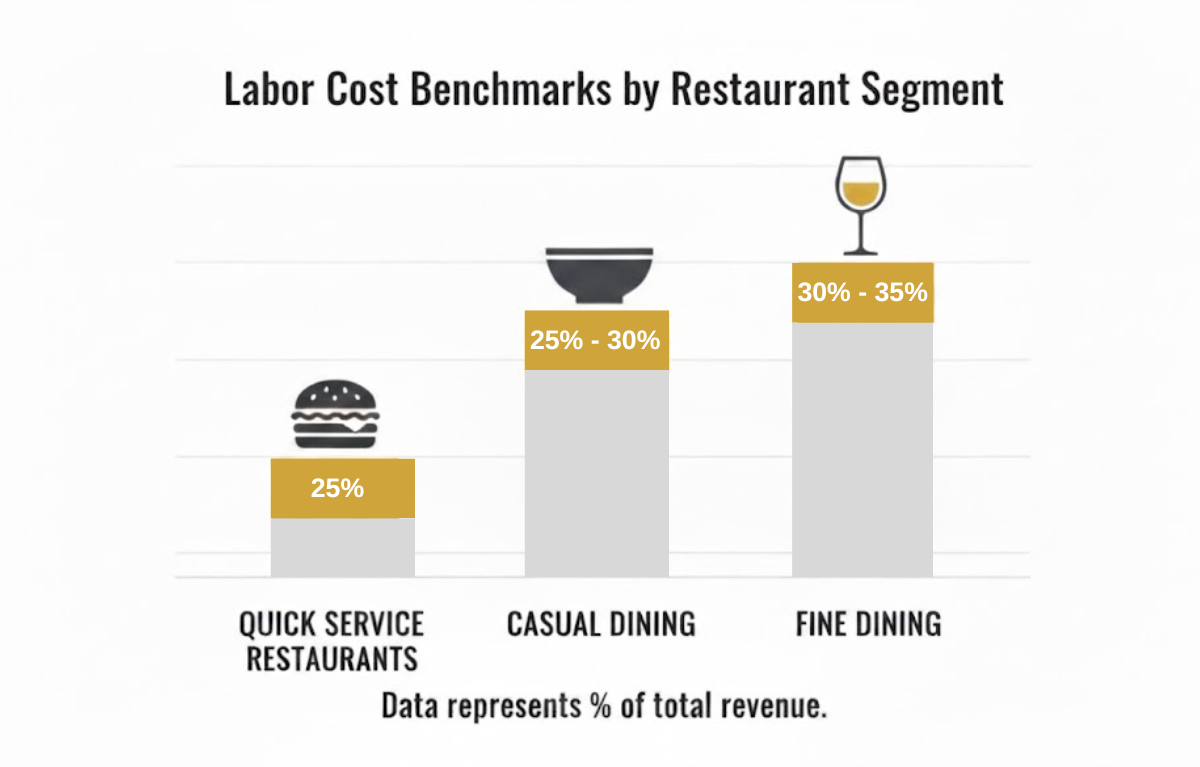
Everyone wants a magic number, but the truth is, it depends on your business model. While a healthy labor cost percentage usually lands between 25% and 35% of total sales, that target shifts depending on your restaurant industry segment:
-
25%: Typical for Quick Service Restaurants (QSR) with streamlined menus, less specialized labor, and faster transactions.
-
25% – 30%: Common for Casual Dining, where the percentage varies based on menu complexity and service methods.
-
30% – 35%: Standard for Fine Dining, due to high-touch service and extensive in-house food production.
Instead of chasing a universal benchmark, focus on your own trends. The real win is finding the “sweet spot” where your team delivers killer service and maintains a high-quality guest experience without blowing up your budget.
How can I reduce labor costs without cutting staff hours?
This is the million-dollar question, and thankfully, it has nothing to do with slashing the schedule. The smartest moves are all about efficiency and keeping the great people you already have.
Start by cross-training your crew. When your host can jump on expo, or a line cook can handle inventory, you can run leaner, more agile shifts without sacrificing service. Next, get some tech to do the heavy lifting. Things like QR code ordering or a Kitchen Display System (KDS) automate repetitive tasks, freeing up your team to focus on things that actually require a human touch.
But the big one is this: make employee retention your obsession. High turnover is a silent killer, bleeding you dry on recruiting, hiring, and training costs. Keeping your seasoned pros on the floor is one of the most powerful things you can do to keep labor costs in check long-term.
Ready to build a smarter, more profitable hospitality business? At MAJC✨, we provide the tools, community, and expert guidance you need to hire better, retain longer, and run more efficiently. From operator-tested templates to live coaching, we are here to help you turn your biggest challenges into your greatest strengths. Start building a more resilient team today.