


Starting a small restaurant is a journey that begins long before the first dish hits the table. It starts with an idea, but the real work lies in turning that idea into a rock-solid plan. The entire process boils down to three critical phases: nailing your concept, doing your research, and building a bulletproof business plan.
Getting these first steps right is the single most important factor in whether your restaurant thrives or just survives.
Laying the Groundwork for Your Restaurant Dream
Every great restaurant started with a blueprint. This is not just about paperwork; it is about defining the very soul of your business before you spend a single dollar on rent or equipment. This is where you transform a daydream into a concept with real legs. The dream is the fun part, but the details make it real.
Let’s be clear: you are stepping into a massive and competitive field. According to Market Research Future, the global food service market was valued at just over $3 trillion in 2024 and is projected to grow significantly over the next decade. But success in this industry is a game of inches. The best-run places might see profit margins of 10% or more, but the average is a much tighter 2% to 6%. That razor-thin margin means you have zero room for error. A meticulous plan is not optional; it is everything.
Defining Your Restaurant Concept
Your concept is your restaurant’s DNA. It is the story you tell through your food, decor, service style, and price point. Are you picturing a cozy, farm-to-table spot focused on what is fresh from the local market? Or is it a high-energy, fast-casual noodle bar with a clean, modern vibe?
Get specific. “An Italian restaurant” is a recipe for getting lost in the noise. “A Roman-style pizzeria specializing in single-portion, gourmet pizzas for the lunch crowd,” now that is a concept. That kind of clarity is a magnet for your ideal customer and makes every other decision, from menu design to marketing, much easier.
Researching Your Market and Competition
Once you have a sharp concept, you need to pressure-test it against reality. That means getting out there and doing your homework on your potential customers and the lay of the land. Who lives in the neighborhood you are eyeing? What is their income, what are their dining habits, and most importantly, what are they missing?
Spend serious time analyzing other local restaurants. Figure out who your direct competitors are (the ones doing something similar) and your indirect competitors (any other place people might go to eat). This is not about copying anyone; it is about finding your unique angle and avoiding the mistake of opening the fifth taco joint on a block that can only support two.
This simple flow chart breaks it down. You start with a great idea, back it up with hard data from your research, and only then do you build the plan.
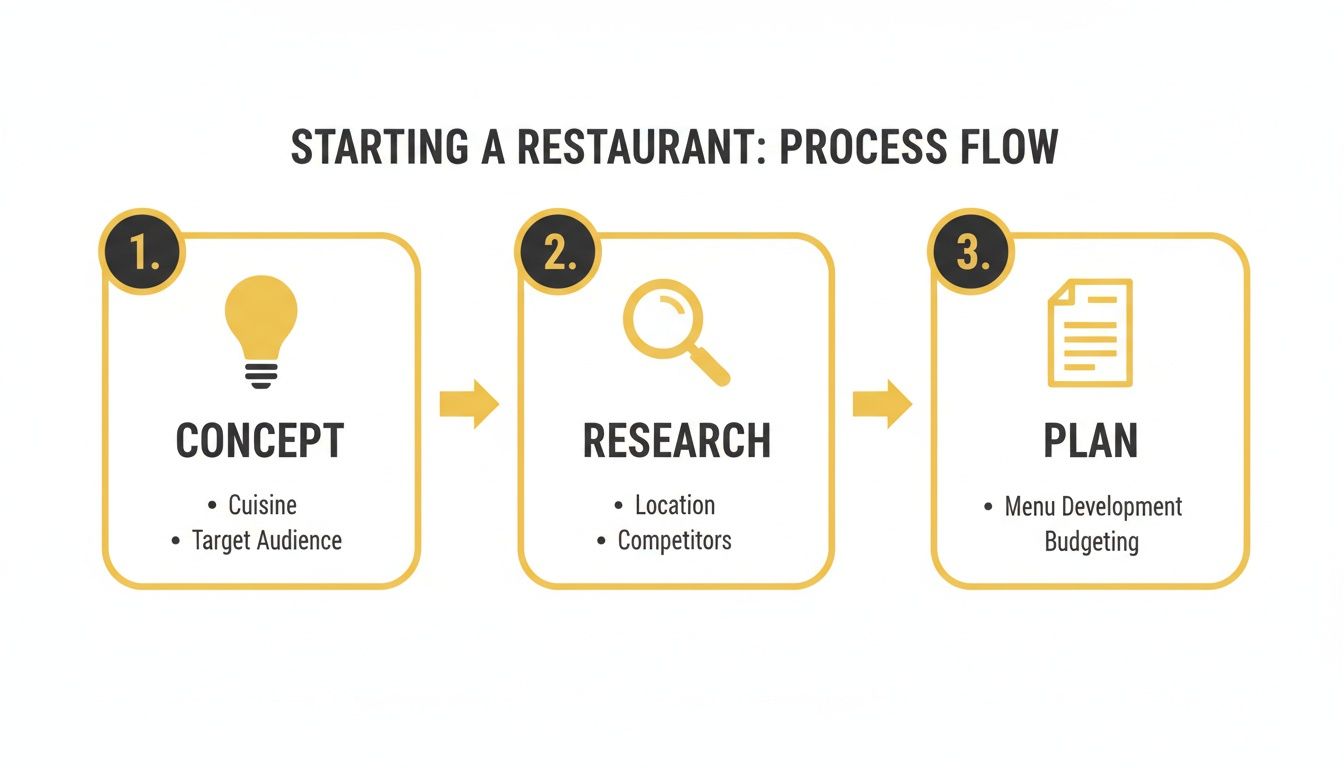
A killer concept is just the starting line. It has to be validated by solid research before you can turn it into a plan that investors will take seriously.
Creating a Powerful Business Plan
Think of your business plan as the operating manual for your restaurant. Yes, it is the document you will need to get a loan or attract investors, but its real value is for you. It forces you to think through every single piece of the puzzle, from operations and marketing to the nitty-gritty financials, before you are in too deep.
A strong plan does not have to be a novel, but it does need to cover the essentials. It is your roadmap for turning your vision into a profitable business, and it holds you accountable to your own goals.
Here is a breakdown of the core components every solid restaurant business plan needs.
| Section | Key Questions to Answer |
|---|---|
| Executive Summary | What is the big idea in a nutshell? Why will this work, and what do you need? |
| Company Description | What is your mission? What is your legal structure? What makes you unique? |
| Market Analysis | Who is your ideal customer? Who are your competitors, and what is your edge? |
| Menu and Pricing | What does your sample menu look like? How have you costed each dish? |
| Marketing and Sales | How will you get the word out and keep people coming back? |
| Management Team | Who is on your team? What experience do they bring to the table? |
| Financial Projections | What are your startup costs? What do your profit and loss projections look like? |
This table covers the fundamentals, but remember, the numbers and strategies within it are what truly matter.
Your business plan should be a living document. It will evolve as you learn more, but starting with a detailed and realistic plan is the single best thing you can do to turn your restaurant dream into a reality.
The operational details in your plan are just as critical. Figuring out who does what and when is the key to consistency. It is never too early to start thinking about how to create standard operating procedures that will make your day-one service feel like you have been open for years.
Securing Funding and Navigating Legal Hurdles
You have a killer concept and a solid business plan. Now for the hard part: turning that dream into a financial and legal reality. This is where your detailed planning gets put to the test, facing the real world of capital, regulations, and endless paperwork.
Successfully funding a restaurant is not just about having a great idea; it is about proving you have a viable, profitable business on paper before you ever serve a single dish. At the same time, missing one permit or miscalculating your cash runway can derail your opening by months, burning through the very capital you worked so hard to secure.
Building Your Startup Budget
Before you can ask anyone for money, you need to know exactly how much you need and where every last dollar is going. The single biggest rookie mistake is underestimating startup costs, which leaves you scrambling for cash before the doors even open.
Your budget needs to cover two distinct categories of expenses:
- One-Time Costs: This is all the big-ticket stuff you buy upfront. Think security deposits, kitchen equipment, dining room furniture, your POS system, and that first big inventory order.
- Recurring Costs: You absolutely must have enough operating capital to cover at least your first three to six months of expenses. This includes rent, payroll, utilities, insurance, and marketing, all the bills that come due before your revenue stream is consistent.
An essential piece of this is projecting your income, which you can stress-test with our restaurant profit margin calculator to make sure your financial model is sound.
Finding the Right Funding Source
With your budget dialed in, it is time to chase the capital. There are a few well-trodden paths for funding a new restaurant, and each comes with its own pros, cons, and hoops to jump through.
- SBA Loans: Backed by the Small Business Administration, these loans often have better terms than what you would get from a conventional bank. The SBA 7(a) loan is a popular pick for restaurant startups, but be warned: the application process is notoriously rigorous and requires a bulletproof business plan and strong personal credit.
- Traditional Bank Loans: Banks are a common source, but they can be skittish when it comes to new, unproven restaurants. You will strengthen your application significantly if you have a detailed financial forecast and are putting a good amount of your own skin in the game.
- Investors or Partners: Bringing on a partner with deep pockets can feel like a great shortcut, but it means giving up a slice of your equity and control. If you go this route, make sure you have a legally airtight partnership agreement that clearly outlines roles, responsibilities, and, most importantly, the exit strategy.
No matter which door you knock on, your pitch has to be confident and packed with data. Show them your market research, your unique concept, and your clear path to profitability.
Your Essential Legal Checklist
While you are chasing the money, you have to tackle the mountain of legal paperwork in parallel. The specific requirements will vary by city and state, but pretty much every restaurant is going to need this core list of permits and licenses.
Do not treat licensing as an afterthought. Start the application process as early as possible. Some permits, especially liquor licenses, can take a year or more to get approved. Delays here are incredibly expensive.
Here is a foundational checklist to get you started:
- Business License: This is the basic permit you need to operate any business in your city or county.
- Food Service License: Your local health department issues this, and it proves you meet all the required food safety standards.
- Food Handler’s Permits: Many states require food safety certification for employees who handle food, and often a manager-level certification for supervisors. Exact requirements vary by jurisdiction.
- Liquor License: If you plan to serve any alcohol, this is a nonnegotiable. The process is often complex, expensive, and slow, so start immediately.
- Certificate of Occupancy: This certificate confirms that your building is safe for the public and complies with all local building and zoning codes.
Getting these documents in order is tedious, but it is the bedrock of your business. It protects you, your staff, and your customers, ensuring you are building your restaurant on a firm, legal foundation.
Choosing a Location and Designing Your Space
Your location is more than just an address; it is the silent partner that works around the clock to attract guests and define your brand. The physical space itself, from the kitchen workflow to the dining room vibe, dictates the entire experience long before the first plate of food ever hits the table.
Getting these two things right is a huge step toward building a restaurant with real staying power.
Finding the Perfect Spot
Selecting the right spot is a blend of art and science. It is easy to fall in love with a charming brick building in a historic district, but let’s be real: charm does not pay the bills. You have to analyze any potential location with a cold, hard look at the data.
When you are out scouting, you are looking for a place that not only fits your concept but gives you the best possible shot at success. Visibility and foot traffic are massive, especially if you are relying on walk-in business. A corner spot with big windows is infinitely more valuable than a mid-block location hidden behind a bus stop.
Drill down on these critical factors during your search:
- Demographics: Does the local population match your ideal customer? A high-end tasting menu concept is going to have a hard time in a college town, just as a quick-service burrito shop might not take off in an affluent retirement community.
- Accessibility and Parking: Be honest about how easy it is for people to get to you. In a car-dependent suburb, a lack of convenient parking can be a complete deal-breaker. In a dense city, on the other hand, being close to public transit is everything.
- Competition: Take a long, hard look at the other restaurants nearby. Are they direct competitors, or do they complement what you are doing? Being near a popular bar could be a goldmine for late-night foot traffic, but opening next door to an established spot with a similar menu is a risky, uphill battle.
Beyond what is happening outside, you have to rigorously inspect the physical space itself. A gorgeous dining room can hide a host of expensive problems out back. Make sure the building has adequate electrical capacity for your equipment, proper HVAC, and, most importantly, the existing infrastructure for a commercial kitchen hood and ventilation system.
Retrofitting those systems can cost tens of thousands of dollars you did not budget for.
Designing a Smart and Functional Layout
Once your location is locked in, your focus shifts to designing a space that actually works.
One of the most common mistakes is prioritizing the dining room at the expense of the kitchen. A beautiful front-of-house means nothing if service breaks down behind the scenes. Your kitchen layout should be built around your menu, supporting a clear flow from delivery and prep to cooking, plating, and service. Principles like the kitchen work triangle help minimize unnecessary movement, reduce ticket times, and keep your team efficient during peak hours.
A well-designed kitchen directly impacts profitability. It improves consistency, reduces staff fatigue, and allows your operation to handle volume without chaos.
Your dining room, on the other hand, should clearly reflect your brand. Lighting, seating, and music all shape the guest experience. A high-energy casual concept will feel very different from an intimate fine-dining room. Plan seating strategically with a mix of table sizes to accommodate different party types and maximize flexibility.
Finally, pay attention to the details that guests feel immediately. Good lighting enhances food presentation, and thoughtful acoustics prevent the space from becoming uncomfortably loud. Every design decision should support your concept, your service flow, and the experience you want guests to remember.
Building Your Menu and Your Opening Team
Figuring out how to engineer a profitable menu and how to assemble a killer team are two of the most critical hurdles to clear when you are learning how to start a small restaurant. Let’s dig in.
Engineering a Profitable Menu
A strong menu is not just about great food. It is a strategic sales tool designed to drive profitability. Every item must be priced to cover its costs, contribute to margin, and still feel like a strong value to the guest. That starts with disciplined food costing.
Food costing means breaking down each dish to its exact ingredient cost, down to oils, seasonings, and garnishes. The industry benchmark is a food cost percentage between 28% and 35%. In simple terms, a dish that costs $4.00 to make should land around $11.50 to $14.50 on the menu. Without this clarity, you are guessing, not managing.
Pricing without food costing is risky. Popular dishes that are not profitable can quietly drain your margins.
Beyond pricing, menu design has to match your brand and your kitchen’s real capacity. A tighter, more focused menu is usually more profitable. It improves consistency, reduces waste, simplifies inventory, and helps your team execute at a higher level during service.
A profitable menu is intentional, cost-aware, and built to support both your concept and your operations.
Forging Strong Supplier Relationships
Your ingredients are the literal building blocks of your menu, and their quality depends entirely on your suppliers. Building solid, reliable relationships with your vendors is a mission-critical task. You are looking for partners, not just order-takers, people who are invested in your success.
A great supplier will offer:
- Consistent Quality: The produce, meat, and dry goods you get should meet your standards every single time. No surprises.
- Reliable Delivery: Late or missed deliveries can cripple a service. You need partners you can count on.
- Fair Pricing and Terms: While cost is a factor, the cheapest option is rarely the best. Look for fair value and payment terms that work with your cash flow.
Start by sourcing local farmers, butchers, and bakers. These relationships do not just give you fresh, high-quality products; they give your restaurant a compelling story to share with your customers.
Assembling Your Opening Team
Once your menu starts taking shape, your focus has to shift to finding the right people to execute it. Hiring for skill is obviously important, but hiring for attitude and a genuine alignment with your values is what builds a positive work environment that lasts.
First, identify your key roles. For most small restaurants, this usually means:
- Head Chef or Kitchen Manager: This is your culinary leader. They are responsible for executing the menu, managing the kitchen crew, and keeping food costs in check.
- Front-of-House Manager: This person owns the entire guest experience, manages the service staff, and handles the day-to-day operational grind.
- Core Cooks, Servers, and Bartenders: These are your front-line soldiers, the people actually making the food and interacting with your guests every single day.
When you start recruiting, write job descriptions that are clear and compelling, sell your vision! Do not just list responsibilities; talk about the culture you are building and the kind of person who will thrive in it. As you start interviewing, look for candidates who are passionate, reliable, and have a true sense of hospitality.
Your chef and your front-of-house leader are the two most important hires you will make, so invest the time to get them right.
Choosing Your Tech and Marketing Your Grand Opening
Modern restaurants do not just run on passion; they run on smart technology and even smarter marketing.
First up, let’s get your restaurant’s nervous system in place: the tech. This is not about chasing shiny objects. It is about choosing systems that cut down on chaos, minimize errors, and give you the numbers you need to make good decisions.
Selecting Your Core Technology
Your Point of Sale (POS) system is the single most important tech decision you will make. Think of it as more than a digital cash register; a good POS is a command center that ties together your sales, inventory, and customer data. The right choice depends entirely on your concept. A bustling fast-casual spot needs a system built for speed, while a full-service dining room will want features like table management and integrated reservations.
Beyond the POS, a few other tools can save you from operational headaches. Employee scheduling software can give your managers hours back each week, and a solid reservation system helps manage guest flow so you are not overwhelmed on a busy Friday night. Getting the right tools from the start is a game-changer.
Crafting Your Pre-Launch Marketing Buzz
Your marketing efforts cannot wait until opening day; they need to start weeks, even months, ahead of time to make sure you have a line out the door. A great pre-launch campaign turns a simple opening into a must-attend local event.
First things first, build your digital storefront. Snag your social media handles on the platforms your ideal customers use. Instagram is nonnegotiable for showing off beautiful food. Get a clean, simple website up with your address, hours, and a sneak peek of the menu. Most importantly, start sharing your story. Post behind-the-scenes shots of the build-out, introduce your chef, and give a shout-out to your local suppliers.
Do not wait for perfection to start marketing. Documenting the journey of building your restaurant is an authentic and powerful way to connect with your community before you even serve your first customer.
As you get closer to launch day, shift your focus to local connections.
- Engage with Local Influencers: Find the local food bloggers and Instagrammers and invite them in for a preview. A single post from the right person can generate a massive wave of interest.
- Connect with Neighboring Businesses: Walk around and introduce yourself to the other shop owners on your block. They can become your biggest advocates and a great source for referrals.
- Get on Google Maps: This is critical. Claim and completely fill out your Google Business Profile with great photos, your menu, and correct hours. It is how people will find you.
The final step before the big day is the soft opening. This is not your grand opening; it is a series of invite-only trial runs with friends, family, and other friendlies. It is your chance to pressure-test the kitchen, work out service kinks, and fix any issues in a low-stakes setting. Think of it as a final dress rehearsal. A few successful soft openings will give your team the confidence they need to absolutely crush it on day one.
Questions We Hear All the Time
We have pulled together the most common questions from aspiring owners to give you some direct advice. Think of this as your go-to guide for those tough moments that can make or break a new spot.
How much does it really cost to start a small restaurant?
This is the big one, and the honest answer is: it depends. A lot. Your concept, your city, and whether you are leasing or buying will send that number swinging. That said, for a small, leased restaurant space, you should be prepared for a budget somewhere between $100,000 and $350,000.
So what is behind that number? It almost always boils down to the same big-ticket items:
- Lease Deposits and Renovations: Just getting the keys and making the space feel like yours.
- Kitchen Equipment: The heart of your operation. Ovens, coolers, and prep tables add up fast, though buying used equipment is a smart way to slash this cost.
- Licenses and Permits: The fees for these can be a real shock, especially if you are going for a liquor license.
- Initial Inventory: Your first big stock-up of all the food and booze to get you through opening week.
- Operating Capital: This is nonnegotiable. You absolutely need at least three to six months of cash on hand to cover payroll, rent, and utilities before you can expect to be consistently in the black.
The only way to nail down a truly accurate number for your dream is to build a line-by-line business plan. No shortcuts here.
What are the most common mistakes new restaurant owners make?
If you want to know what sinks a new restaurant, it is usually one of three things: being undercapitalized, having a weak or fuzzy concept, or just poor management. Running out of cash is the number one killer, which is why that financial cushion we just talked about is so critical. A blurry concept is a close second; if customers do not know what you are about, they have no reason to come back.
Finally, a lack of real experience managing people, inventory, and the day-to-day books will create chaos faster than you can imagine. Solid funding, a crystal-clear identity, and strong, in-the-weeds leadership are the foundation for survival.
How do I create a menu that is both creative and profitable?
Building a menu that people crave and that makes you money is an art, but it is an art grounded in some straightforward math. The whole game is a practice called menu engineering. It all starts by costing out every single ingredient in every single dish. You have to know your exact plate cost.
The industry-standard target for your total food cost is between 28% and 35% of your menu price. If you do not know these numbers, you are flying blind and just hoping your best-selling dishes are also your most profitable ones.
Once your costs are dialed in, you can pinpoint your “stars”, the dishes that are popular and have great margins. Those are the items you feature. You strategically balance them with higher-cost showstoppers by getting creative with high-margin items like pastas or unique vegetarian plates. A tight, focused, and well-costed menu will outperform a massive, sloppy one every single time. And make sure you use the data from your POS to see what is actually selling, then adjust accordingly.
What is the single most important factor for long-term success?
Great food will get people through the door once. But the one thing that will keep them coming back for years is consistency.
Customers are creatures of habit. They come back because they trust the experience you are going to give them. They want their favorite burger to taste the same every time, the service to be just as sharp on a Tuesday as it is on a Saturday, and the whole place to feel clean and welcoming, no matter what.
This does not happen by magic. It is the direct result of having clear, written-down standard operating procedures (SOPs) for everything, from the recipes in the kitchen and the steps of service out front to the cleaning checklists for every corner of the building. Consistency is what builds the kind of loyalty that will carry your business through anything.
Building a restaurant that lasts is a marathon, not a sprint, and you do not have to run it alone. At MAJC✨, we provide the tools, training, and community to help you run a smarter, more profitable operation. From hiring templates to expert coaching, we are here to guide you at every step. Discover how MAJC can help you build the restaurant of your dreams.