

A great line cook job description does more than just list duties it is a marketing tool for your kitchen. It has to lay out the job clearly while selling your restaurant’s culture to bring in the right kind of talent.
What Makes a Line Cook Job Description Effective
Writing a solid job description is a balancing act. You need to be specific enough to set clear expectations, but compelling enough to cut through the noise in a tough hiring market. The goal is simple: attract cooks who not only have the skills, but also fit the energy and values of your crew.
Think of it as the first handshake with a potential hire. It should nail down the core parts of the job—from daily tasks to qualifications—all while sounding like it came from your restaurant, not a template. For a deeper dive on structuring the post itself, our guide on how to write a job description covers the fundamentals.
Core Components of a Strong Description
To build a post that gets read and brings you the right applicants, make sure you hit these key points:
- A Compelling Job Summary: This is your hook. Give a quick, punchy overview of the role and what your restaurant is all about.
- Detailed Responsibilities: Do not be vague. List the day-to-day duties, from station prep to plating, so there are no surprises.
- Clear Qualifications: Separate the must-haves from the nice-to-haves. This widens your pool of candidates without lowering your standards.
- Competitive Compensation: Be upfront about the pay and benefits. It shows you respect the work and value your team.
To give you a quick snapshot, here is a look at what the line cook role generally entails from an industry perspective.
Line Cook Role At a Glance
In the United States, line cook pay varies widely by location, experience, and type of restaurant, but most national salary surveys place typical annual earnings in the low-to-mid $30,000 range. In fine dining kitchens or high-cost cities, total compensation can rise quickly with overtime, tips, and specialized skills
At the end of the day, a well-written job post saves you a ton of time by filtering for the right people from the very beginning.
Defining Core Responsibilities and Daily Duties
A good line cook job description goes way beyond a generic checklist. It paints a clear picture of the daily grind and what it actually takes to succeed in your kitchen. Get this right, and you will attract pros who know what they are getting into and are ready for the heat.
Every line cook’s day boils down to three things: prep, execution, and breakdown. These are the universal pillars of any kitchen, whether you are slinging burgers or plating tasting menus. Laying them out clearly ensures you cover the absolute nonnegotiables of the role.
Foundational Daily Responsibilities
No matter the station, every line cook is expected to own a core set of responsibilities. These are the fundamentals that keep service consistent, safe, and efficient. Think of them as the building blocks for every single shift.
Here are the essential duties you need to include:
- Station Setup and Mise en Place: This is ground zero. It means getting all ingredients, sauces, and equipment prepped and organized for service. We are talking chopping vegetables, portioning proteins, and setting up the station for a seamless flow.
- Food Preparation and Execution: Cooking and plating dishes exactly to spec, every time. This takes precision, speed, and the ability to keep your cool when the tickets start flying.
- Adherence to Safety and Sanitation Standards: Upholding all health codes is not optional. This means proper food handling, temperature control, and top-notch personal hygiene. A clean, organized station is a must.
- Communication and Teamwork: Talking effectively with other cooks, the chef, and the front-of-house team to time orders correctly and make sure everything hits the pass perfectly.
- Station Breakdown and Cleaning: At the end of the night, the station needs a full breakdown. That means thoroughly cleaning and sanitizing the workstation, equipment, and tools, plus properly storing leftovers to cut down on waste.
Station-Specific Duties
While the daily fundamentals are the same for everyone, different stations demand very different skills. A line cook is just one of several crucial back-of-the-house positions that keep a restaurant humming. Customizing your job description with station-specific tasks will help you find candidates with the exact expertise you need.
A Grill Cook, for example, needs to be a master of temperature control, while a Sauté Cook lives and dies by their pan skills. Tailoring the duties shows you actually get what each role entails.
Your job description needs to reflect the reality of your kitchen. If your grill station is a high-volume beast, you better emphasize speed and temperature management. If your garde manger station demands an artist’s touch, highlight plating, and cold prep skills.
Here are a few examples of specialized duties for common stations you can adapt for your own posting:
- Grill Cook: Runs the grill, broiler, and sometimes the fryer. They are responsible for cooking proteins to precise temperatures, juggling multiple orders at once, and keeping the grill surfaces immaculate.
- Sauté Cook: The master of the pan. This cook handles all sautéed and pan-fried dishes, which involves building sauces, cooking vegetables and proteins with finesse, and plating with speed and accuracy.
- Garde Manger (Pantry Cook): In charge of all cold food prep. This station covers everything from salads and appetizers to pâtés and charcuterie, often requiring a sharp eye for presentation.
- Fry Cook: Owns the deep fryers. This role is all about monitoring oil temperatures, cooking items to a perfect golden-brown, and managing the daily maintenance and filtering of the fryers.
Identifying Essential Skills and Qualifications
When you are writing a line cook job description, it is crucial to separate the nonnegotiables from the nice-to-haves. This is not just about making a list; it is about casting a wider net while still making it dead simple to spot your top candidates. Getting this right means you attract people who can actually do the job and fit into your kitchen’s culture.
This strategy also keeps you from accidentally passing on a great cook who might be missing one specific skill but nails nine other things you need. By being clear about what is a deal-breaker versus what is a bonus, you set the right expectations from the jump.
Required Skills and Qualifications
These are the absolute must-haves. The foundation. If a candidate does not have these, they will struggle to keep up, no matter how much hustle they have. Think of this as the baseline for safety, consistency, and keeping the wheels on during a busy service.
- Foundational Cooking Techniques: They need a solid grip on the basics, sautéing, grilling, frying, and roasting. No exceptions.
- Food Safety Knowledge: Strong food safety fundamentals are nonnegotiable. Line cooks may be required to hold a Food Handler Card depending on state or local regulations, while manager-level certifications (such as ServSafe Manager/CFPM equivalents) usually apply to supervisors or the person in charge.
- Physical Stamina and Strength: The reality of the job is standing for an entire shift in a hot kitchen and being able to lift at least 30 pounds.
A high school diploma is often plenty, especially with one to two years of real-world experience coming up as a prep cook or dishwasher. You can also attract sharper candidates by offering a 3–5% pay incentive for advanced certifications like ServSafe.
Preferred Skills and Attributes
Okay, this is where you paint a picture of your ideal candidate. These are the skills that separate a good cook from a great one, the ones who have the potential to grow into a future leader on your team.
Listing preferred skills shows ambitious cooks what it takes to really crush it in the role. It gives them a roadmap for growth. For operators, understanding how to train restaurant staff quickly and effectively is how you turn that potential into reality.
A required skill gets a cook in the door. A preferred skill is what helps them thrive and grow into a future leader in your kitchen.
Here are a few examples of what to look for:
- Specific Culinary Training: A degree or certificate from a culinary school often means they have a deeper grasp of the “why” behind the techniques.
- Experience with Inventory Systems: Anyone who knows their way around managing stock or using ordering software is a huge plus, especially if you see leadership potential in them.
- Specialized Station Expertise: If you need a killer garde manger or saucier, previous experience on that specific station is a massive advantage.
Structuring Competitive Compensation and Benefits
Let’s get straight to it: your compensation package is one of the most critical parts of the job description. While the hourly rate is what gets a line cook’s attention, the benefits are often what convince them to take your job over another’s. A strong package shows you are serious about building a professional team, not just filling a spot on the line.
To get the pay right, you have to know your local market. A line cook’s salary is not a one-size-fits-all number; it shifts based on a few key factors that can create big swings from one city, or even one neighborhood, to the next.
Researching Market Pay Rates
Figuring out a fair wage starts with a little homework. If you just guess, you will either overpay and wreck your budget or underpay and wonder why you cannot find good people. The first step is to see what similar restaurants in your area are offering for similar roles.
When you are setting your pay scale, keep these variables in mind:
- Geographic Location: A cook in New York City or San Francisco is going to command a much higher wage than one in a small town, purely due to the cost of living.
- Restaurant Type: Fine dining kitchens demand a higher level of precision and skill, so they typically pay more than a casual diner or a quick-service spot.
- Experience Level: A seasoned cook who can jump on any station without hand-holding is worth more than a green cook who still needs significant training. That should be reflected in their pay.
Check out job postings in your area and use online salary tools to get a baseline. This will help you land on a competitive range that attracts the talent you need without breaking the bank.
Building an Attractive Benefits Package
The restaurant industry has lagged behind in this area for years, so offering a solid package will make you stand out immediately.
A thoughtful benefits package tells your cooks you see them as long-term professionals, not just temporary hires. It is a direct investment in stability and loyalty that pays off with lower turnover.
Beyond the base salary, think about perks that actually matter to kitchen staff. These are the things that can turn a standard offer into one they cannot refuse.
- Health Insurance: Offering medical, dental, and vision coverage is a game-changer. It is a clear sign of a stable, supportive workplace.
- Paid Time Off (PTO): Kitchen burnout is real. Giving your team paid vacation and sick days helps them rest and recharge, which means they will perform better when they are on the clock.
- Shift Meals: This is a simple but deeply valued perk. It saves your cooks money and makes sure they are properly fed during a long, demanding shift.
- Professional Development: Sponsoring certifications or offering a stipend for culinary classes shows you are invested in their career, not just the job they do for you today.
Ready-to-Use Line Cook Job Description Templates
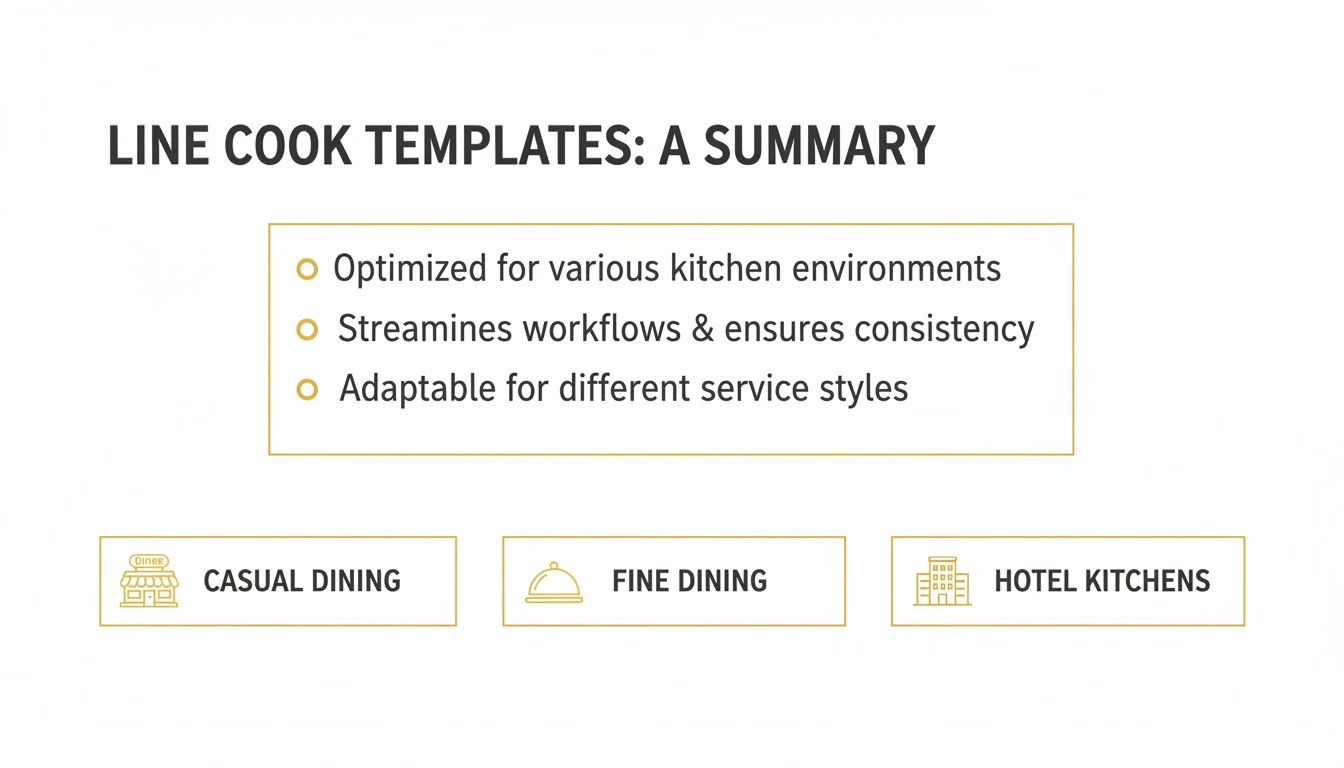
Writing a line cook job description from scratch is a pain, especially when you are already short-staffed and need to hire someone yesterday. So, let’s get right to it. We have built out three distinct, ready-to-use templates you can copy, paste, and tweak for your exact needs.
Think of these as more than just a starting point. Each one is designed to attract the right kind of cook for a specific kitchen culture, whether you are running a slammed casual spot, a focused fine dining room, or a versatile hotel kitchen. A good job description sets clear expectations from day one, saving you the headache of sifting through a mountain of mismatched resumes.
Let’s be honest, finding skilled cooks is not getting any easier. The Bureau of Labor Statistics projects that cook employment will grow 5% by 2034, which is faster than average. According to their data, this translates to about 432,200 openings every single year from cooks switching jobs or retiring. A clear, compelling job post is your first and best tool for standing out. You can dig into the full restaurant employment trends from the BLS if you want the details.
Template 1: Casual Dining Restaurant
Use this one for high-volume, fast-paced kitchens where speed, consistency, and a good attitude are everything. It is perfect for gastropubs, busy bistros, and family-style restaurants.
Job Title: Line Cook
Job Summary:
[Your Restaurant Name] is looking for a reliable and energetic Line Cook to join our tight-knit kitchen crew. We are a popular, high-energy spot known for our [mention a signature dish or style, e.g., killer burgers and craft beer list]. The right person for this job thrives under pressure, is a true team player, and is obsessed with putting out consistently great food for our regulars.
Core Responsibilities:
- Own the grill, fry, or sauté station, executing menu items with speed and consistency during our busiest services.
- Set up and break down your station like a pro, making sure all mise en place is fresh and ready to go.
- Keep your workspace clean and organized, following all food safety and sanitation guidelines without fail.
- Communicate clearly with other cooks and FOH to keep service flowing and ticket times tight.
- Jump in on inventory and daily prep tasks as directed by the Kitchen Manager.
Qualifications:
- Required: One+ years of experience as a line cook in a fast-paced kitchen.
- Required: A current Food Handler’s Permit.
- Preferred: Experience working multiple stations (grill, fry, sauté).
- Preferred: A positive attitude and a genuine love for teamwork. No egos here.
Template 2: Fine Dining Restaurant
This template is all about precision, technique, and a deep respect for ingredients. It is built for upscale restaurants where the details and the plating are just as crucial as the flavor.
Job Title: Line Cook / Cuisinier
Job Summary:
[Your Restaurant Name], an [mention accolade, e.g., award-winning] farm-to-table restaurant, is seeking a focused and detail-oriented Line Cook. We are driven by our passion for [mention your philosophy, e.g., seasonal cuisine] and need a professional who shares our commitment to excellence. You will work directly with Chef [Chef’s Last Name] to execute dishes with precision, artistry, and absolute consistency.
Core Responsibilities:
- Execute complex recipes with meticulous attention to detail on your assigned station (e.g., saucier, entremetier).
- Demonstrate mastery of advanced cooking techniques, including sous-vide, whole-animal butchery, and delicate sauce work.
- Contribute to plating dishes with an artistic, refined presentation.
- Maintain an immaculate station and uphold the highest standards of food safety and hygiene.
- Foster a collaborative and respectful kitchen environment where everyone is focused on learning and pushing themselves.
Qualifications:
- Required: A minimum of two years of experience in a fine dining or upscale kitchen.
- Required: A strong, practical understanding of both classic and modern cooking techniques.
- Preferred: Formal culinary arts education.
- Preferred: Experience with menu development or a specialized station like pastry or garde manger.
Template 3: Hotel Restaurant
This template is built for the dynamic, ever-changing world of a hotel kitchen that juggles multiple outlets and events. It is for the cook who is versatile, organized, and can switch gears without missing a beat.
Job Title: Hotel Line Cook
Job Summary:
The kitchen at [Your Hotel Name] needs a versatile and organized Line Cook to support our diverse culinary operations, including our restaurant [Restaurant Name], room service, and banquet events. We are looking for a proactive team player who can handle the demands of breakfast, lunch, and dinner service while maintaining our high standards of quality and efficiency.
Core Responsibilities:
- Prepare and cook menu items for our à la carte restaurant, room service, and large-scale banquets.
- Flex between different stations as needed to support the demands of each service or event.
- Follow standardized recipes to the letter, ensuring consistency across all our food outlets.
- Manage strict timelines for both event and room service orders.
- Assist with large-batch prep for banquets while simultaneously managing the daily needs of the restaurant.
Qualifications:
- Required: At least two years of professional cooking experience.
- Required: Ability to work a flexible schedule, including early mornings, nights, weekends, and holidays.
- Preferred: Previous experience in a hotel or banquet kitchen is a huge plus.
- Preferred: Strong organizational skills and the ability to multitask effectively when things get hectic.
After the Job Description Comes the Real Test
A strong line cook job description gets the right candidates in the door. The next phase is making sure they can actually perform under pressure and work well within your kitchen culture. That’s where thoughtful interviews and clear expectations matter. Once your role is clearly defined on paper, hiring becomes about confirming fit, not guessing potential.
Got Questions About Hiring Line Cooks?
Here are some of the questions that come up all the time.
How much experience should a line cook have?
This really comes down to your kitchen. If you are running a high-volume, fast-casual spot, a cook with one or two years of experience on a busy line might be exactly what you need. They know the pace. But for an upscale restaurant with complex, technical stations, you will probably need someone with three to five years under their belt, maybe even with some specialized training.
Is culinary school better than on-the-job training?
Neither one is “better.” They just build different muscles. Culinary school gives a cook a solid foundation in technique and theory, which can be a huge advantage. But nothing beats on-the-job training for building pure speed, the ability to adapt on the fly, and the real-world grit you need to survive a busy service.
The best candidates I have ever hired usually had a mix of both; they had the formal training, but also knew how to handle the pressure of a real kitchen.
What is the best way to keep good line cooks?
Hanging onto good cooks starts with the basics: a positive work environment, competitive pay, and showing them there is a real path for growth. If they cannot see a future, they will find one somewhere else.
Beyond that, it is the little things that make a huge difference. A consistent, predictable schedule is gold. So are opportunities to learn new skills and genuine recognition for their hard work. A cook who feels valued and respected is a cook who is far more likely to stick around for the long haul.
Ready to build a stronger team? At MAJC✨, we provide the tools, training, and community support to help you hire smarter and retain longer. Explore our resources and join the community to start running a more efficient and profitable restaurant.