


Hiring in hospitality often comes down to gut instinct. You interview two great candidates with similar experience, but only one will stay calm during a slammed service or handle a frustrated guest with grace. That uncertainty is costly.
Personality assessments for hiring help remove that guesswork. They give you a clearer picture of how a candidate’s natural traits align with the real demands of the role, beyond what a resume or interview can reveal.
The goal isn’t to find a “perfect” personality, but the right fit. A high-energy bartender, a detail-focused line cook, and a guest-facing manager all require different strengths. As more hospitality operators move toward data-informed hiring, personality assessments have become a practical tool for predicting performance, reducing bad hires, and building stronger teams.
What Are These Tests Actually Measuring?
Most scientifically-backed assessments are built on frameworks that measure core personality dimensions. The most respected and widely used is the Big Five model, which looks at five key traits that give you a surprisingly clear picture of a person.
Think of these traits as sliders, not on/off switches:
- Openness: Is someone curious and imaginative, or more practical and conventional?
- Conscientiousness: Are they organized and disciplined, or easy-going and spontaneous?
- Extraversion: Do they get their energy from being around people, or do they recharge with quiet time?
- Agreeableness: Is their default setting to be cooperative and compassionate, or more analytical and detached?
- Neuroticism (often called Emotional Stability): How do they handle stress? Are they generally calm and secure, or more anxious and sensitive?
For a front-of-house role, you might look for someone high in Agreeableness and Emotional Stability, someone who can stay warm and collected under pressure. By making hiring a more informed process, you can build teams that click, elevate the guest experience, and dramatically improve retention.
Choosing the Right Assessment for Your Team
Navigating the world of personality assessments for hiring can feel like a maze, but most options fall into two main camps. Getting a handle on the difference is the first real step to picking the right tool for your restaurant. It is less about finding one “best” test and more about matching the assessment to the actual job you are trying to fill.
Think of it this way: one tool gives you a personality blueprint, while the other is more like a virtual job preview. Both are incredibly useful, but they tell you very different things about a candidate.
Trait-Based Assessments: The Personality Blueprint
Trait-based assessments, like the well-respected Big Five model, get at the core of who someone is. They measure stable, foundational characteristics, things like how conscientious, agreeable, or emotionally steady a person tends to be.
This kind of assessment is great for predicting long-term behavior and general job performance. For instance, study after study shows that conscientiousness is one of the strongest predictors of success in almost any role, a finding confirmed in an analysis from the Journal of Applied Psychology. It is a solid way to figure out if a candidate has the underlying disposition to be reliable, organized, and diligent day in and day out.
A trait-based assessment tells you how a person is naturally wired. It is most powerful when you need to understand a candidate’s fundamental work style and how they will likely approach their job on a consistent basis.
Situational Judgment Tests: The Virtual Job Preview
The other main category is Situational Judgment Tests, or SJTs. Instead of measuring core traits, these tests drop candidates right into realistic workplace scenarios and ask, “What would you do?” An SJT is basically a flight simulator for the job.
For a hospitality role, an SJT might throw these kinds of curveballs at a candidate:
- A guest is upset about their long wait time. How do you handle it?
- Two servers are arguing in the middle of a slammed dinner service. What’s your move?
- The phone is ringing off the hook, and a line is forming at the host stand. What do you tackle first?
These tests are fantastic for seeing a candidate’s problem-solving skills, customer service instincts, and ability to think on their feet in situations unique to your restaurant. They measure applied skills, not just underlying personality. The trick is making sure the scenarios are dead-on reflections of the job’s real challenges, which all start with a crystal-clear job description. If you need to sharpen your role outlines, check out our guide on how to write a job description that pulls in the right people. When you align your SJT scenarios with the duties you have already defined, you create a screening tool that is both relevant and incredibly powerful.
Trait-Based vs. Situational Judgment Assessments
So, which one is right for you? It depends entirely on what you need to know. This table breaks down the key differences to help you decide.
| Feature | Trait-Based Assessments (e.g., Big Five) | Situational Judgment Tests (SJTs) |
|---|---|---|
| What It Measures | Core personality traits (e.g., conscientiousness, agreeableness). | How a candidate would handle specific job-related situations. |
| Best For | Predicting long-term fit, reliability, and general work style. | Evaluating practical skills like problem-solving and customer service. |
| Analogy | A personality blueprint. | A virtual job preview. |
| Example | Asks if a candidate is generally organized and detail-oriented. | Presents a scenario with a disorganized storeroom and asks how to fix it. |
| When to Use | To understand a candidate’s underlying disposition and cultural fit. | To see if a candidate can actually perform the critical tasks of the job. |
Ultimately, there is no wrong answer here. Trait-based tests give you the “who,” while SJTs give you the “how.” The strongest hiring processes often use a mix of both to get a complete picture of a candidate before they ever step behind the line or onto the floor.
Matching Key Personality Traits to Hospitality Roles
This is where the rubber meets the road. Abstract assessment results are interesting, but they are useless until you connect them to the real-world demands of a hospitality job. Knowing a candidate is “conscientious” is one thing. Knowing how that translates to a flawlessly executed dinner service is everything.
Think about the controlled chaos of a Saturday night rush. For your host and servers on the floor, high scores in agreeableness and stress tolerance are not just nice-to-haves. They are survival skills. These traits directly predict a calm, warm presence that can de-escalate tension with a waiting crowd and keep the vibe positive, even when the pressure is on.
Now, flip to the back of house. For a line cook, conscientiousness is king. It is the trait that fuels the consistency, obsessive attention to detail, and reliability needed to plate perfect dishes, every single time. Their ability to follow a process down to the letter is what ensures quality and safety, which are non-negotiable in the kitchen.
Building Your Role’s Success Profile
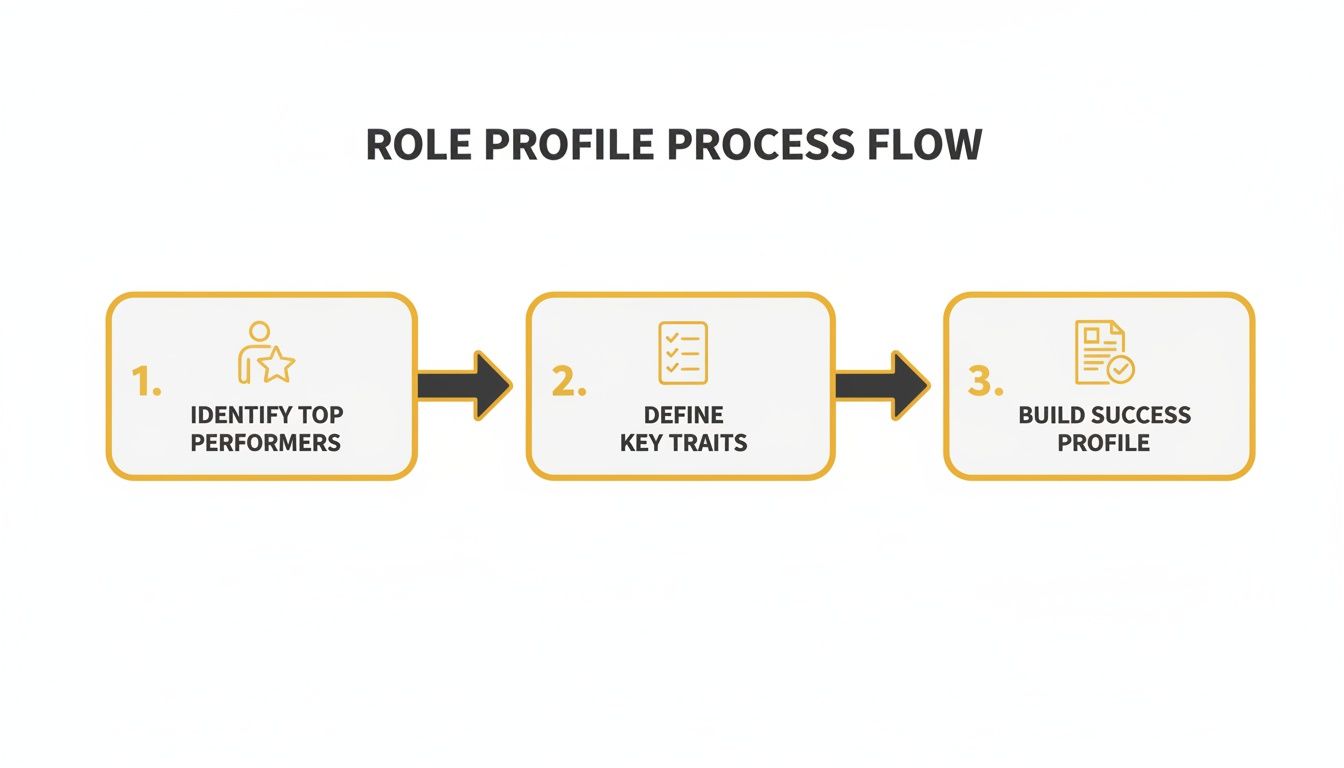
The smartest way to use personality assessments for hiring is to build a “success profile” for each key role in your restaurant. This is not about creating a cookie-cutter employee. It is about building a blueprint for what works in your operation, based on your current top performers. When you identify the common traits among your best people, you create a benchmark for what excellence actually looks like.
A success profile is a data-informed model of the three to five core personality traits that best predict a candidate’s fit and performance in a specific role. It turns hiring from a guessing game into a strategic matching process.
This process lets you look past the resume and ask better, more targeted questions. For instance, if your success profile for a bartender flags high extraversion and emotional stability, you can use assessment data to pinpoint candidates who are naturally energized by social interaction and will not get rattled by a three-deep bar.
Front of House vs. Back of House Needs
The ideal personality for a guest-facing role can be wildly different from what you need in the kitchen. That is why creating distinct success profiles for each department is critical for building a team that clicks.
Here is a simple breakdown of how to think about it:
- Front-of-House Roles: Success out front is almost always about interpersonal skills. Traits like extraversion, agreeableness, and emotional stability are gold. These are the people who represent your brand, and these traits help them create those memorable guest experiences, even when things get hectic. For a deeper dive, you can explore what it takes to be an outstanding front-of-house team member in our dedicated guide.
- Back-of-House Roles: The kitchen runs on precision, process, and grit. Key traits here are high conscientiousness for organization and quality control, and serious stress tolerance to handle the relentless pace. They might not be visible to guests, but these personalities are the engine driving your consistency and operational excellence.
By defining these profiles, you are not just hiring for a job description. You are equipping your managers to predict how a candidate will fit into the unique culture and pressures of their specific department. It is a tailored approach that leads to smarter hires, better team chemistry, and people who stick around longer.
Implementing Assessments Fairly and Legally
Personality tests can be a powerful tool in hiring, but they come with some serious ethical and legal weight. Get it right, and these assessments can open up your talent pool and fight unconscious bias. Get it wrong, and you could be facing legal risks and shutting the door on fantastic candidates.
Here is the most important rule: an assessment should only ever be one part of your hiring process. It is a conversation starter, not the final word. The Equal Employment Opportunity Commission (EEOC) is crystal clear on this: any tool you use to screen candidates must be directly relevant to the job and cannot discriminate against protected groups. In plain English, you have to prove that the traits you are measuring are actually needed to succeed on the floor.
Ensuring Job Relevance and Validity
To stay compliant, assessments need to be valid and reliable, meaning they measure real, job-relevant traits and produce consistent results. Casual online quizzes have no place in a professional hiring process.
A practical safeguard is to define a clear success profile before hiring. Identify the behaviors and traits that truly matter for the role, then use assessments only to evaluate those specific needs. This creates a defensible link between the test and on-the-job performance.
Avoiding Bias and Promoting Fairness
Assessments should help you build balanced teams, not filter for one personality type. Train managers to treat results as conversation starters, not deal breakers. A lower score in one area should prompt better interview questions, not automatic rejection.
Document your approach and apply it consistently. When candidates feel the process is fair, relevant, and respectful, it strengthens your employer brand even if they are not hired.
Used correctly, assessments support smarter hiring and a better candidate experience, which is exactly what strong hospitality teams are built on.
Connecting Better Hires to Your Bottom Line
It is one thing to talk about finding the “right” people, but it is another to see it reflected in your P&L. This is where personality assessments for hiring move beyond HR theory and become a strategic business tool.
When you hire people whose natural traits align with the role, engagement improves. Engaged employees deliver more consistent service, which leads to happier guests, stronger reviews, and repeat business. Over time, this creates a flywheel effect where better hiring decisions reinforce brand reputation and revenue.
In practical terms, assessments help operators identify candidates who are naturally wired for the demands of hospitality, whether that is attention to detail, emotional control under pressure, or collaborative teamwork. By making these traits visible early in the hiring process, you reduce costly mis-hires and build teams that are better equipped to perform from day one.
Building a Stronger Leadership Pipeline from Within
The real value of personality assessments extends well beyond the hiring stage. Over time, the insights they provide can become a powerful tool for identifying and developing future leaders already on your team.
When you look at assessment patterns across your staff, high-potential employees often stand out more clearly. Traits like reliability, emotional steadiness, and collaboration tend to show up consistently in people who excel at leading others. These insights help operators spot leadership potential earlier, even in team members who may not naturally seek the spotlight.
Research from Harvard Business Review shows that identifying leadership potential requires looking beyond past performance and focusing on observable behaviors that predict growth and adaptability over time.
Instead of forcing everyone into the same management mold, assessments allow you to coach people toward roles that match their strengths. Someone who thrives on structure and follow-through may be better suited for operational leadership, while others may shine in guest-facing or training-focused roles. Used this way, assessments shift from a one-time hiring filter into a long-term development tool that supports internal growth and cultural consistency.
Building leaders from within is one of the most effective ways to create stable teams and reduce disruption. Personality data helps ensure those promotions are intentional, not reactive.
Common Questions About Personality Assessments
Let’s dig into some of the most common concerns from hospitality managers.
Can candidates fake their answers?
This is the big one, and it is a fair question. Could someone try to game the system and present a perfect version of themselves? Sure. But modern assessments are built to spot that. They often have internal consistency checks, asking similar questions in different ways to see if the answers line up.
More importantly, though, the goal is not to “pass” the test. When you frame the assessment as a tool to find a great mutual fit, candidates are far more likely to be honest. They want a job where their natural strengths will let them succeed and feel good about their work, not a role where they have to pretend to be someone they are not.
Are these assessments too expensive?
The price of assessments can vary, but it is a mistake to see it as just another expense. It is an investment. Think about the real cost of a bad hire. Industry research consistently shows that replacing an employee can cost roughly 20% to 30% of their annual salary once you factor in recruiting, training, lost productivity, and the ripple effect on team morale. That is a massive drain on your resources.
When an assessment helps you reduce turnover by even a small margin, the return on that investment is almost immediate. Most providers offer flexible pricing, making these tools accessible for everyone from a single-unit restaurant to a large hotel group.
The cost of an assessment is a fraction of the cost of replacing a team member who was not the right fit. It is a proactive investment in stability and service quality.
How can I start without overhauling my whole process?
You do not need to rip and replace your entire hiring system overnight. The smartest way to start is to start small and be strategic.
Pick one or two key roles where turnover is a headache or where soft skills are everything, think front desk agents or servers. Pilot the assessments there. Use the results to help you build a stronger interview shortlist, but do not use them to automatically disqualify people. Instead, let the insights guide you to ask better, more targeted behavioral questions during the interview.
This approach lets you ease into the process, see the impact for yourself, and prove the value before committing to a full rollout.
Ready to build a stronger, more resilient team? MAJC✨ provides the tools, training, and community support to help you hire better and retain longer. Discover how MAJC can help you make smarter hiring decisions.