

Running a successful restaurant is like conducting a symphony; every section must play its part perfectly and in harmony. The conductor’s score in this scenario is a robust set of Standard Operating Procedures (SOPs). These documents are more than just rules; they are the foundational blueprints for consistency, quality, and efficiency. They ensure that every guest receives the same excellent experience, whether it’s a busy Saturday night or a quiet Tuesday afternoon.
A staggering 60% of restaurants fail within their first year, with operational inefficiency being a major contributor. A well-defined collection of SOPs can be the critical difference between thriving and just surviving. These detailed guidelines empower your team by removing guesswork, standardizing quality, and creating a safe, predictable work environment. From ensuring food safety compliance to handling customer complaints with grace, clear procedures are the backbone of a resilient and profitable operation.
In this guide, we break down eight crucial restaurant standard operating procedures examples, providing actionable insights and replicable strategies you can implement immediately. We will explore everything from front-of-house finesse, like guest seating and order taking, to back-of-house precision, including kitchen communication and sanitation schedules. You will gain the tools to create a seamless operational flow that enhances both the employee and guest experience, ultimately building a stronger business.
1. Food Safety and Hygiene Protocol
A Food Safety and Hygiene Protocol is the bedrock of any successful restaurant, acting as the comprehensive set of standard operating procedures (SOPs) that govern every aspect of food handling. This protocol is non-negotiable, ensuring that from the moment ingredients arrive until a dish is served, every step meets or exceeds health and safety regulations. These procedures are designed to mitigate risks like foodborne illness, cross-contamination, and allergen exposure, protecting both your customers and your restaurant’s reputation.
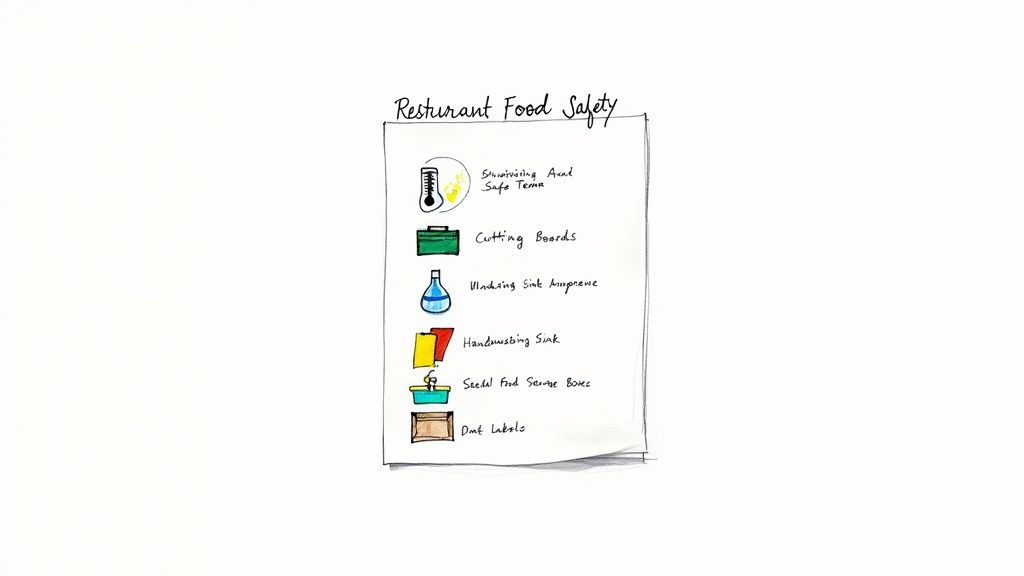
This is one of the most critical restaurant standard operating procedures examples because it directly impacts public health and is heavily regulated by bodies like the FDA and local health departments. A robust protocol covers temperature control for storage and cooking, stringent handwashing rules, sanitization schedules for surfaces and equipment, and meticulous allergen management systems.
Strategic Breakdown and Examples
Effective food safety SOPs go beyond simple compliance; they build a true culture of safety.
After several high-profile foodborne illness outbreaks beginning in 2015, Chipotle overhauled its food safety strategy, introducing high-resolution DNA-based testing of ingredients and enhanced HACCP-based controls across its operations. These initiatives demonstrate a clear commitment to rebuilding consumer trust through transparent, science-driven processes.
Similarly, fine-dining establishments such as Chef Thomas Keller’s The French Laundry integrate HACCP-informed systems and rigorous hazard controls into their kitchen workflows to ensure consistency and safety at every stage.
Actionable Takeaways for Your Restaurant
Implementing a world-class food safety protocol doesn’t have to be overly complex. Start with clear, actionable steps that your team can easily follow and integrate into their daily routines.
- Implement Color-Coded Systems: Use different colored cutting boards and utensils for raw meat, poultry, seafood, and produce to visually enforce cross-contamination prevention.
- Mandate Temperature Logs: Require staff to log temperatures for refrigerators, freezers, and hot-holding units at the start and end of each shift. A signature beside each entry increases accountability.
- Develop Allergen Protocols: Create a clear system for flagging orders with allergens, using designated prep areas, and using separate utensils to prevent contact.
- Post Visual Guides: Place laminated, easy-to-read charts and infographics in key kitchen areas. These should cover handwashing techniques, safe cooking temperatures, and sanitizing solution concentrations for quick reference.
- Schedule Regular Training: Conduct mandatory food safety training for all new hires and hold quarterly refresher courses for existing staff to cover updated regulations and best practices.
2. Guest Seating and Table Management
A Guest Seating and Table Management protocol is the command center for a restaurant’s front-of-house, dictating the flow of customers from the moment they arrive to their departure. These standard operating procedures are designed to optimize capacity, minimize wait times, and create a smooth, efficient dining experience. A well-executed system coordinates the host stand, servers, and kitchen to manage table turnover effectively, ensuring that every seat generates revenue without rushing guests or overwhelming the staff.
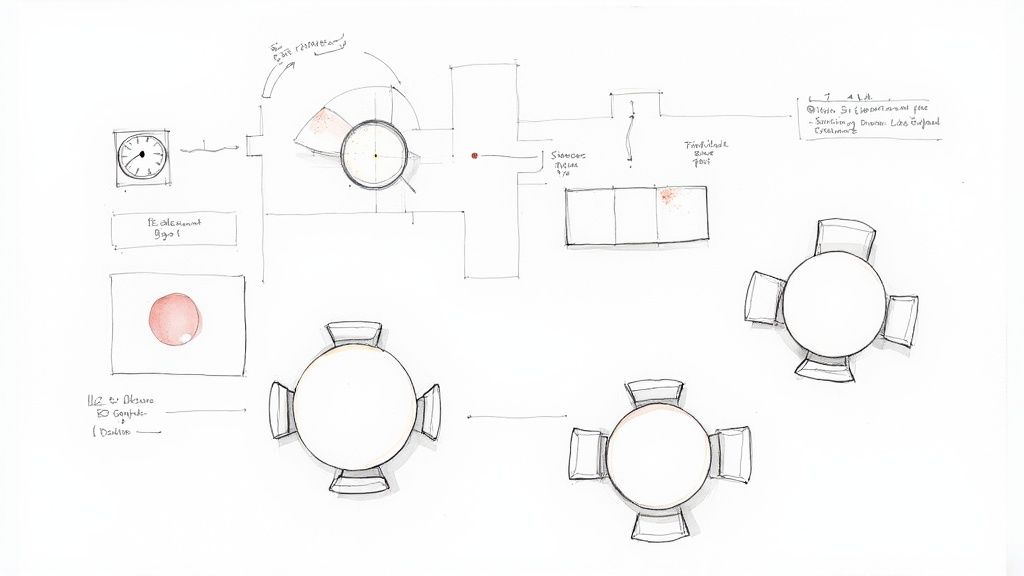
This is one of the most vital restaurant standard operating procedures examples because it directly impacts both customer satisfaction and profitability. An effective seating SOP balances guest expectations with operational capacity, preventing server burnout from being double-sat and ensuring the kitchen can handle the order flow. It is the key to turning tables efficiently while maintaining a high standard of service.
Strategic Breakdown and Examples
Great table management creates a controlled, predictable environment even during the busiest rushes. The Cheesecake Factory, known for its massive seating capacity and consistently long wait times, uses a sophisticated system to manage its high volume. Its hosts use technology to provide accurate wait time quotes and page guests, while strategically seating sections to prevent overwhelming any single server or kitchen station. This systematic approach ensures operational consistency across its many locations. In contrast, fine-dining restaurants often stagger reservation times and seating to ensure each table receives meticulous, unhurried service, proving that table management isn’t just about speed but also about curating a specific guest experience.
Actionable Takeaways for Your Restaurant
Implementing a streamlined guest seating and table management protocol is crucial for maximizing your dining room’s potential. Start with these clear, tactical steps to improve your front-of-house efficiency.
- Utilize a Table Management System: Invest in reservation software like OpenTable or Resy that provides a digital floor map, tracks table statuses in real-time, and manages a digital waitlist.
- Establish Clear Communication Signals: Create simple, non-verbal cues or use handheld devices for hosts and servers to communicate table status (e.g., “check dropped,” “bussing needed,” or “ready to seat”).
- Define Standard Turn Times: Calculate average turn times for different party sizes (two-tops, four-tops, and large parties) and use this data to provide more accurate wait time quotes.
- Create a Seating Rotation Policy: Implement a strict server rotation for seating to ensure workloads are distributed evenly. Clearly define rules for skipping a server in the rotation if they are backed up.
- Train Hosts on Managing Expectations: Your host is a critical role in setting the tone for the entire dining experience. Provide scripts and training on how to graciously handle long waits, manage guest expectations, and communicate potential delays. For more insights, explore these interview questions for a hostess to ensure you hire the right person.
3. Employee Uniform and Appearance Standards
Employee Uniform and Appearance Standards are a set of clear, documented guidelines defining the expected dress code and grooming for all staff members. This protocol goes beyond telling employees what to wear; it establishes a consistent, professional brand image, reinforces hygiene practices, and ensures the team represents the restaurant’s values and concept. From the host who provides the first impression to the line cook working behind the scenes, these standards unify the team and communicate a commitment to quality and detail.
This is one of the essential restaurant standard operating procedures examples because it directly influences customer perception and brand identity. A well-defined policy covers everything from the specifics of the uniform, like aprons and headwear, to grooming requirements for hair, nails, and facial hair, as well as rules on jewelry and visible tattoos. A consistent appearance reassures guests that they are in a professional and hygienic environment.
Strategic Breakdown and Examples
Effective appearance standards are an extension of a restaurant’s brand story. For instance, Disney’s stringent and world-renowned appearance guidelines, known as the “Disney Look,” are meticulously designed to maintain the immersive, family-friendly experience across all its dining venues. Every detail is purposeful, ensuring that cast members (employees) are part of the show, not a distraction from it. In a different context, Starbucks uses its iconic green apron to create a uniform yet approachable look for its baristas, allowing for a degree of personal expression underneath that aligns with its community-focused brand. These examples show how a dress code can be a powerful tool for brand reinforcement.
Actionable Takeaways for Your Restaurant
Implementing a clear and fair appearance policy requires proactive communication and consistent enforcement. Use these steps to build standards that protect your brand while respecting your team.
- Provide a Visual Guide: During onboarding, provide new hires with a one-page document that includes photos of employees correctly wearing the uniform and adhering to grooming standards. Visuals eliminate ambiguity.
- Define Standards in Job Postings: Include a brief mention of your uniform and appearance policy in job descriptions. This sets expectations early and helps attract candidates who are comfortable with your brand’s standards.
- Establish Clear Accommodation Protocols: Create a documented process for handling requests for accommodations based on religious beliefs or disabilities. This ensures you can address requests fairly, consistently, and in compliance with legal requirements.
- Train Managers on Enforcement: Equip managers with scripts and training on how to address violations respectfully and privately. Consistent, tactful enforcement is key to maintaining morale and fairness.
- Offer a Uniform Stipend or Program: To reduce the financial burden on employees, consider providing essential uniform items for free or offering a stipend or reimbursement program. This gesture can significantly improve employee buy-in.
4. Cash Handling and Financial Reconciliation
A Cash Handling and Financial Reconciliation protocol is the central nervous system for a restaurant’s financial health, detailing the standard operating procedures for every dollar that enters or leaves the business. These SOPs govern everything from a cashier accepting payment to the final deposit at the bank, creating a secure and accountable financial workflow. The primary goal is to minimize risk, prevent theft, reduce errors, and ensure that all revenue is accurately recorded and secured, safeguarding your profits and maintaining operational integrity.
This is one of the most vital restaurant standard operating procedures examples because it directly protects the restaurant’s assets. A failure in this area can lead to significant financial losses, employee mistrust, and legal complications. A strong protocol covers point-of-sale (POS) operations, cash drawer limits, secure drop procedures, shift-end reconciliation, and fraud detection for both cash and digital payments.
Strategic Breakdown and Examples
Effective cash-handling SOPs create accountability and transparency at every level. Major chains like McDonald’s enforce rigorous cash-control practices across their franchises, including register reconciliation and manager verification of voids and returns. These measures help ensure consistency and security across thousands of locations, minimizing opportunities for internal theft.
Similarly, high-volume bars and casual dining chains such as Applebee’s rely on their POS systems as the foundation of their end-of-shift reconciliation process. Servers’ sales reports are matched against the payments turned in, cash, credit, and others, with any discrepancies reviewed by a manager. This process creates a clear audit trail and reinforces employee accountability.
Actionable Takeaways for Your Restaurant
Implementing a secure financial protocol is about creating layers of verification and clear responsibilities. Start by integrating these actionable steps to protect your cash flow and improve your financial habits. For a deeper dive into financial management, explore these essential financial habits for restaurant operators on majc.ai.
- Establish a Two-Person Rule: Require that two employees, typically a cashier or server and a manager, are present during cash drawer counts at both the beginning and end of a shift. Both must sign the reconciliation sheet.
- Implement Secure Cash Drops: Use a locked drop box for depositing cash sums exceeding a predetermined amount in the register. Only a manager or designated key holder should have access to this box.
- Conduct Random Audits: Perform unannounced cash drawer audits during shifts. This practice discourages theft and helps identify training gaps in real time.
- Utilize Modern POS Technology: Invest in a POS system that provides detailed, user-specific reports. This allows you to track sales, voids, discounts, and no-sale transactions by employee, quickly highlighting unusual patterns.
- Create Clear Documentation: Maintain a daily cash log that tracks all money movement, from opening till counts and mid-shift drops to final bank deposits. This paper trail is invaluable for troubleshooting discrepancies.
5. Order Taking and Kitchen Communication
An Order Taking and Kitchen Communication protocol is the central nervous system of a restaurant, ensuring the seamless flow of information from the customer to the culinary team. These SOPs are designed to translate customer requests into perfectly executed dishes with maximum accuracy and efficiency. This system bridges the gap between the front-of-house (FOH) and back-of-house (BOH), minimizing errors, reducing ticket times, and ultimately enhancing the guest experience.
This is one of the most vital restaurant standard operating procedures examples because it directly impacts operational efficiency and customer satisfaction. A breakdown in this communication chain can lead to incorrect orders, long waits, and frustrated guests. A well-defined protocol includes everything from standardized abbreviations for modifications to the use of technology like Kitchen Display Systems (KDS) and verbal confirmation checkpoints.
Strategic Breakdown and Examples
Effective order-taking SOPs create a standardized language that both FOH and BOH teams understand instinctively. Starbucks provides a world-class example with its cup-labeling system. The series of boxes for drink type, milk, syrup, and custom requests creates a visual, error-proof instruction manual for the barista, ensuring consistency across thousands of locations. This simple but brilliant system translates complex orders into a clear, linear process. Similarly, many fine-dining establishments use an “expo” window where a manager or lead chef inspects every dish against the ticket, serving as a final quality control checkpoint before it reaches the guest. This guarantees that communication was successful from start to finish.
Actionable Takeaways for Your Restaurant
Implementing a robust communication system is about creating clarity and eliminating ambiguity. Start with simple, consistent procedures that reduce the margin for error during the busiest services.
- Standardize Abbreviations: Create and post a list of approved abbreviations for common dishes and modifications (e.g., “NS” for no sauce, or “Sub FF” for substitute french fries) to ensure all tickets are written in the same language.
- Utilize a POS with KDS Integration: A modern Point of Sale (POS) system that sends orders directly to a Kitchen Display System (KDS) eliminates handwriting errors and provides real-time tracking of ticket times.
- Implement an Allergen and Modification Flag System: Use color-coded flags or prominent symbols on digital or physical tickets to immediately alert the kitchen to severe allergies, dietary restrictions, or significant modifications.
- Establish Verbal Confirmation Protocols: For complex or allergy-sensitive orders, train servers to verbally confirm the details with the guest upon ordering and require the kitchen to have a designated person confirm back to the FOH team.
- Conduct Daily Pre-Shift Huddles: Use daily meetings to review menu specials, 86’d items, and potential modification challenges. For more insights, you can learn more about the art of the pre-shift to streamline team communication.
6. Cleaning and Sanitation Schedule
A Cleaning and Sanitation Schedule is a foundational SOP that provides a detailed roadmap for all cleaning tasks within a restaurant. This is more than a simple to-do list; it’s a systematic approach that dictates who cleans what, when, and how, ensuring every corner of the establishment meets rigorous hygiene standards. These procedures are vital for preventing foodborne illnesses, complying with health codes, extending the life of expensive equipment, and creating a welcoming atmosphere for both guests and staff.
This entry is one of the most practical restaurant standard operating procedures examples because it visibly demonstrates a commitment to excellence. A well-executed schedule covers everything from hourly front-of-house touch-ups to daily kitchen deep cleans and monthly maintenance tasks. It transforms cleaning from a reactive chore into a proactive, integral part of the restaurant’s daily operations, directly impacting customer perception and employee morale.
Strategic Breakdown and Examples
Effective cleaning SOPs are built on consistency and accountability. For instance, Five Guys emphasizes a clean, well-organized working environment across its dining and kitchen areas. Their operations manual highlights the importance of routine cleaning and strategic layout of dining, kitchen, walk-in, and storage zones. On the luxury end of the spectrum, The Ritz-Carlton integrates service values that include “uncompromising levels of cleanliness” and leverages daily and weekly cleaning checklists in both front- and back-of-house areas as part of its service excellence training. These schedules leave little room for ambiguity and underpin the brand’s promise of flawless guest experiences.
Actionable Takeaways for Your Restaurant
Implementing a robust cleaning and sanitation schedule requires clear communication, proper tools, and consistent follow-through. Here are actionable steps to build your own program.
- Create Laminated Station Checklists: Develop and post waterproof, easy-to-read checklists for daily, weekly, and monthly tasks at each relevant station (e.g., fry station, dish pit, or host stand). This provides a constant, visible reminder of expectations.
- Assign Specific Responsibilities: Instead of general tasks, assign specific duties to specific roles or individuals for each shift. This creates clear ownership and accountability, ensuring nothing is overlooked.
- Use a Color-Coded System: Designate different colored rags, buckets, and brushes for specific areas like restrooms, dining areas, and food-prep surfaces to prevent cross-contamination.
- Schedule Deep Cleaning During Off-Hours: Plan major tasks like degreasing hoods, deep cleaning floors, and sanitizing walk-in coolers for times when the restaurant is closed to avoid disrupting service and ensure staff safety.
- Implement Digital Tracking: Use a digital logbook or app where staff can check off completed tasks. This creates a time-stamped record for management, verifies completion, and helps identify recurring issues.
7. Customer Complaint Resolution and Service Recovery
A Customer Complaint Resolution and Service Recovery SOP is a restaurant’s strategic playbook for turning a negative guest experience into a positive one. It provides staff with clear, standardized steps for addressing complaints, resolving issues, and implementing service recovery tactics. These protocols are crucial for empowering staff to act decisively, maintain customer satisfaction, and prevent negative word-of-mouth or damaging online reviews from taking root.
This is one of the most important restaurant standard operating procedures examples because it directly influences guest loyalty and brand perception. A well-executed service recovery can transform a disappointed customer into a lifelong advocate. It’s about more than just fixing a mistake; it’s a system for demonstrating empathy, taking ownership, and reinforcing your commitment to an excellent guest experience, which is far more cost-effective than acquiring a new customer.
Strategic Breakdown and Examples
Effective service recovery SOPs empower employees and prioritize guest satisfaction above all. A legendary example is The Ritz-Carlton, which famously empowers every employee to spend up to US $2,000 per incident to resolve an issue, no managerial approval required. This policy isn’t about the money; it’s about entrusting staff to make immediate, impactful decisions without bureaucratic delays, ensuring the guest feels valued and heard right away.
Another powerful model is Chick-fil-A with its “Second Mile Service” philosophy. Their procedure, often called the L.A.S.T. method (Listen, Apologize, Solve, and Thank), provides a simple yet effective framework for any employee to follow. When a customer has a complaint, the staff member is trained to listen without interruption, offer a sincere apology, take action to solve the problem (like remaking an order), and thank the customer for bringing the issue to their attention. This turns a complaint into a valuable feedback opportunity.
Actionable Takeaways for Your Restaurant
Implementing an effective complaint resolution system is about creating a culture of empowerment and accountability. Start with clear guidelines that give your team confidence to handle difficult situations gracefully.
- Empower with a Budget: Give your front-of-house managers and lead servers a small, pre-approved budget (e.g., $25) to use for service recovery, such as comping a dessert or an appetizer, without needing senior approval.
- Implement a Three-Step Process: Train all staff on a simple, memorable process like “Apologize, Act, and Amend.” Apologize sincerely for the issue, act immediately to correct it, and amend the situation with a small gesture of goodwill.
- Document Every Complaint: Use a digital log or a simple notebook to record all customer complaints, noting the date, issue, and resolution. Review this log weekly to identify recurring problems with food, service, or facility maintenance.
- Conduct De-escalation Role-Playing: During pre-shift meetings, run short role-playing scenarios where staff practice responding to common complaints. This builds muscle memory for handling real-life situations with empathy and professionalism.
- Follow Up Proactively: For more significant issues, ask for the customer’s contact information and have a manager follow up with a phone call or email the next day to ensure they are satisfied with the resolution.
8. Staff Training and Development Program
A Staff Training and Development Program is the foundational SOP for cultivating a skilled, consistent, and motivated team. It’s a comprehensive framework that governs everything from a new hire’s first day to a veteran employee’s career advancement. These procedures ensure every team member, from the kitchen to the dining room, understands their role, embodies the restaurant’s values, and executes tasks to a uniform standard of excellence. This system is crucial for reducing costly employee turnover, enhancing service quality, and building a strong internal culture.
This is one of the most impactful restaurant standard operating procedures examples because it directly influences both the customer experience and the business’s bottom line. A well-designed program covers onboarding, position-specific skills, menu knowledge, service standards, and compliance training, creating a clear path for professional growth and ensuring operational consistency across all shifts.
Strategic Breakdown and Examples
Effective training programs transform employees into true brand ambassadors. At Starbucks, the “Barista Basics” program provides new partners with foundational training through a mix of classroom and in-store learning, coffee knowledge, customer service philosophy and company culture. Similarly, at Ruth’s Chris Steak House, team members undergo hospitality training designed to support fine-dining service standards and deliver consistently exceptional experiences. These examples show that investing in comprehensive training builds empowered experts who can excel in guest-facing roles.
Actionable Takeaways for Your Restaurant
Building a robust training program is an investment in your restaurant’s future success. Start by creating structured, repeatable processes that empower your team to thrive and grow.
- Develop Detailed Training Manuals: Create clear, visually-rich manuals for each role, including photos, checklists, and step-by-step instructions for key tasks.
- Use a Blended Learning Approach: Combine different methods like classroom instruction for theory, hands-on shadowing for practical skills, and online modules for compliance. Explore how to train restaurant staff quickly and effectively to optimize your approach.
- Implement a Mentor Program: Assign an experienced team member or “buddy” to each new hire to provide guidance, answer questions, and facilitate integration into the team culture.
- Conduct Regular Assessments and Role-Playing: Use regular quizzes on menu knowledge and role-playing scenarios for difficult customer interactions to keep skills sharp and build confidence.
- Incentivize Skill Development: Offer clear career paths, pay raises, or bonuses for employees who complete advanced training modules, earn certifications (like a sommelier course), or master new skills.
8-Point Restaurant SOP Comparison
| SOP / Program | Complexity | Resources / Efficiency | Effectiveness | Expected Outcomes / Impact | Ideal Use Cases | Key Tip |
|---|---|---|---|---|---|---|
| Food Safety and Hygiene Protocol | High: Detailed regulatory procedures and monitoring | HighTemperature equipment, sanitizers, continual training | ⭐⭐⭐⭐Critical for safety & compliance | Fewer foodborne incidents; avoided fines; stronger trust | Full-service kitchens; establishments handling high‑risk foods | Use color‑coded boards and daily temperature logs |
| Guest Seating and Table Management | Medium: Workflow rules plus reservation integration | MediumPOS/reservation tools, trained hosts | ⭐⭐⭐Improves throughput and guest flow | Increased table turnover and revenue; balanced workloads | High‑volume casual & fine dining during peaks | Use reservation software and clear host‑server communication |
| Employee Uniform and Appearance Standards | Low–Medium: Policy creation and enforcement | LowUniforms, occasional subsidies or purchases | ⭐⭐⭐Consistent brand image and hygiene | Improved customer perception; reduced ambiguity in expectations | Branded chains, fine dining, themed venues | Provide/subsidize uniforms and document standards in onboarding |
| Cash Handling and Financial Reconciliation | Medium–High: Controls, reconciliations, fraud measures | MediumSecure POS, safes, audit processes | ⭐⭐⭐⭐Protects revenue and ensures accurate records | Reduced theft/loss; reliable financial reporting; audit readiness | Any cash‑handling outlet, especially bars and busy venues | Implement two‑person counts and automated POS tracking |
| Order Taking and Kitchen Communication | Medium: Procedures + tech integration (KDS/POS) | MediumPOS/KDS, training, clear ticketing | ⭐⭐⭐Reduces errors; improves kitchen flow | Faster service, fewer mistakes, safer allergy handling | High‑pace kitchens and complex menus | Use KDS, flag allergies, and read back complex orders |
| Cleaning and Sanitation Schedule | Medium–High: Recurring checklists and deep‑clean planning | HighLabor, cleaning supplies, specialized equipment | ⭐⭐⭐⭐Essential for compliance and longevity | Fewer pests/inspections, longer equipment life, better customer perception | All food venues, especially high-traffic or regulatory‑sensitive sites | Use laminated/digital checklists and color‑coded cleaning tools |
| Customer Complaint Resolution and Service Recovery | Medium: Authority tiers and documentation workflows | Low–MediumStaff training, tracking system, comp budget | ⭐⭐⭐Converts issues into loyalty when handled well | Improved retention; reduced negative reviews; process improvements | Customer‑facing restaurants active on review platforms | Empower staff with clear limits and document every complaint |
| Staff Training and Development Program | High: Structured, multi‑phase curricula and assessments | HighTraining time, materials, mentors, platforms | ⭐⭐⭐⭐Reduces turnover; raises service consistency | Higher staff competence, internal promotions, and stable operations | Growing chains, high‑service or technical concepts | Combine classroom, hands‑on training and assign mentors |
Turn Your Procedures into Your Power
The journey through these comprehensive restaurant standard operating procedures examples reveals a foundational truth: consistency is not the enemy of creativity, but rather its most reliable launchpad. From the meticulous steps of a food safety protocol to the empathetic script of a customer complaint resolution plan, each SOP serves a singular, powerful purpose. It is about transforming operational chaos into predictable excellence.
These procedures are far more than just rules on a page; they are the architectural blueprints for a resilient, profitable, and respected restaurant. By documenting and standardizing processes for everything from guest seating and kitchen communication to cash handling and staff development, you are building a system that protects your brand, empowers your team, and delights your guests. You are creating an environment where employees are not left guessing, but are instead equipped with the knowledge and confidence to execute their roles flawlessly. This clarity is the bedrock of a positive and efficient workplace culture.
The True Value of SOPs: Beyond the Checklist
The real power of a well-crafted SOP lies in its ability to replicate success. Think of it this way: a perfectly executed dish, a seamless service experience, or an impeccably clean dining room should not be happy accidents. They should be the direct, repeatable outcomes of a deliberate system. When every team member knows the what, why, and how behind their tasks, you achieve a level of operational harmony that customers can feel.
This consistency fosters profound trust. Guests who know they can expect the same high-quality food and service with every visit become loyal advocates for your brand. This reliability is a significant competitive advantage in a crowded marketplace, where a single negative experience can deter a customer for life. Furthermore, robust SOPs are essential for scalable growth. Whether you are considering opening a second location or expanding into a franchise model, these documented procedures ensure your brand’s standards can be faithfully reproduced anywhere.
Your Action Plan for Implementation
Moving from theory to practice can feel daunting, but the key is to start small and build momentum. Do not attempt to overhaul your entire operation overnight. Instead, select one critical area identified in this article, such as your closing sanitation schedule or your order-taking process, and focus on perfecting it.
Follow these actionable steps to begin:
- Observe and Document: Watch your team perform the task. Write down every step, no matter how small.
- Collaborate and Refine: Involve your key team members in reviewing the draft. Their hands-on insights are invaluable for creating procedures that are practical, not just theoretical.
- Train and Test: Once the SOP is finalized, conduct dedicated training sessions. Role-play scenarios and run drills to ensure everyone understands the new standard.
- Measure and Adapt: Use checklists to monitor compliance and gather feedback. Be prepared to revise the SOP as you discover more efficient or effective methods.
By tackling one procedure at a time, you make the process manageable and create a series of small wins that build confidence across your organization. Each perfected SOP becomes another solid brick in the foundation of your business, making it stronger and more prepared for whatever challenges lie ahead. The detailed restaurant standard operating procedures examples we have explored are not just templates; they are a strategic roadmap to operational mastery.
Ready to stop building from scratch and start implementing proven systems? MAJC offers an extensive library of operator-tested templates, training resources, and expert-led sessions designed to help you build world-class SOPs faster. Explore our platform at MAJC and gain the tools to turn your restaurant’s procedures into your greatest competitive advantage.