

A restaurant soft opening is a final dress rehearsal before the main event. It’s an invite-only trial run where you test everything, your menu, your staff, and your systems, on a friendly, limited audience. This controlled setting is your chance to find and fix all the little problems before you officially open your doors to the public.
The Final Dress Rehearsal for Your Restaurant
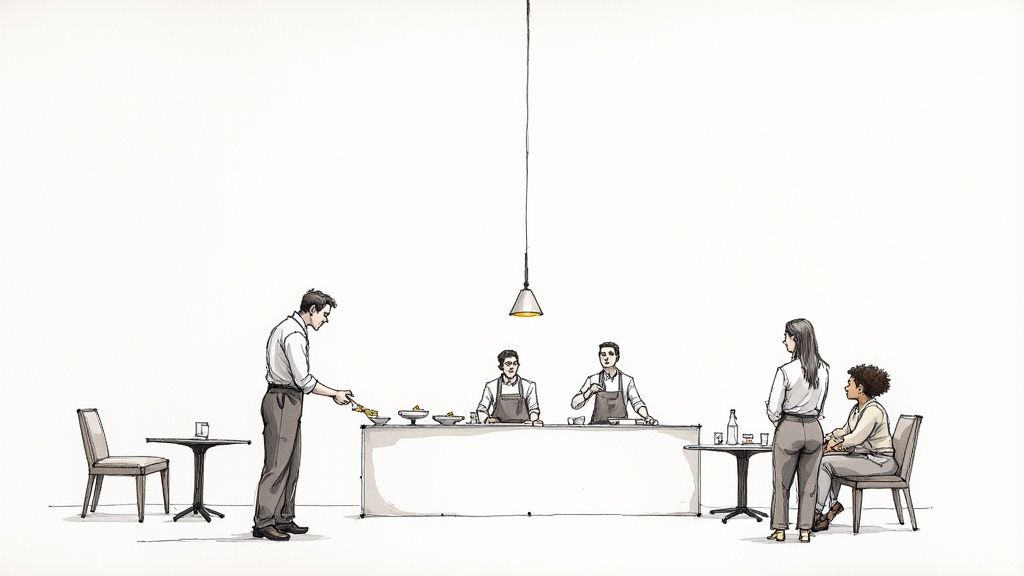
Think about opening night for a Broadway show. The cast does not just show up and perform for a paying audience without practice. They go through dress rehearsals to nail their lines, timing, and stage movements. A restaurant soft opening is exactly that; it’s your most important practice session.
It’s a strategic move that lets you operate under real-world conditions but with much lower stakes. Instead of welcoming the whole world, you invite a select group of guests, usually friends, family, and other local contacts, to be the first to experience your restaurant. This gives your kitchen and front-of-house teams the space to build real muscle memory, from getting dish timing down to mastering the point-of-sale system.
A Controlled Environment for Kicking the Tires
The point of a soft opening is to create a low-pressure environment to work out all the kinks. It’s an invaluable chance to see how your operational plans hold up when the heat is on. During this trial run, you can test every piece of the dining experience:
- Kitchen Workflow: Can your line cooks execute the menu efficiently when the tickets start rolling in?
- Service Timing: How smoothly are plates moving from the kitchen to the tables? Are there bottlenecks?
- Staff Performance: Does your front-of-house team seem confident and knowledgeable, or are they still fumbling?
- Guest Experience: What is the vibe in the dining room? Is the flow working, or is it chaotic?
This controlled test is a go-to strategy for a reason. With the restaurant industry’s thin profit margins and high failure rates, a soft opening acts as a critical buffer against expensive mistakes during your first official weeks. Most seasoned operators will tell you it’s a nonnegotiable step for ensuring long-term success. If you want to dive deeper, you can discover more about the critical statistics shaping the restaurant industry and see just how important this prep work is.
Why a Soft Opening Is Your Most Important Rehearsal
Trying to skip a soft opening is like an actor walking onto the stage for opening night without ever running their lines. In a business where first impressions are everything, it’s a gamble you cannot afford to take. This trial run is the ultimate stress test for your entire operation, and it’s designed to expose the weak spots before paying guests do.
Think of it as setting the foundation. You’re giving your team the space to build the muscle memory and confidence they need to polish every single process. From the moment a guest is greeted to the final credit card swipe, every step gets a real-world practice run.
Training Your Team in a Live Environment
Anyone can read a training manual. Performing under pressure is a different game entirely. A soft opening is where training moves from theory to practice. It’s the first time your front-of-house and back-of-house teams will work together during a live service, turning all those carefully planned workflows into a living, breathing system.
This is not just about reps; it’s about building cohesion and confidence. Servers learn the real-world nuances of the menu, hosts master the flow of the reservation system, and the kitchen crew gets their timing down to a science. This is where you can refine your restaurant standard operating procedures and make sure every person on the floor knows their role and can execute it flawlessly when the pressure is on.
Validating Your Systems and Technology
Modern restaurants are powered by tech. Your POS system, kitchen display screens, and online booking platforms are the central nervous system of your business. A soft opening is your only real chance to make sure they all talk to each other seamlessly before you have a full house of hungry guests waiting.
A soft opening reveals weak spots in your operations before you fully open. This is the best time to test-run restaurant technology tools and systems, ensuring everything from your POS to your reservation software is running smoothly.
During this trial period, you get answers to the real questions:
- Is the POS intuitive for the staff, or is it clunky?
- Are orders firing correctly from the server’s tablet to the kitchen printer?
- Does the payment system work every single time, without a glitch?
Finding and fixing a tech hiccup during a controlled soft opening is a minor headache. Discovering that same issue on a slammed Friday night is a full-blown catastrophe.
Perfecting the Menu and Kitchen Workflow
Finally, a soft opening lets you put your menu to the test. You get to see if the dishes you perfected not only taste great but can also be executed consistently and efficiently when the tickets start flying.
It’s the perfect time to get a feel for dish timing, check plating consistency from cook to cook, and even gut-check the profitability of each item. This is your last, best chance to gather real feedback, make those final tweaks, and ensure every plate that leaves your kitchen is ready for its debut.
Crafting Your Strategic Soft Opening Plan
A great soft opening does not just happen. It’s the result of a deliberate, well-thought-out plan, not a stroke of luck. This is not just a trial run; it’s the launchpad for your entire business, turning a dress rehearsal into a powerful first impression.
Your plan is your roadmap. It guides every decision you make, from who gets an invite to which dishes make the final menu. Without it, a soft opening can spiral into chaos instead of providing the constructive feedback you need.
Define Your Core Objectives
First things first: what are you trying to learn? Do not just open the doors and hope for the best. You need to know exactly what success looks like for this trial run.
Are you worried about the kitchen’s speed and ticket times? Or is your main focus on how the front-of-house team handles guest interactions during a busy service? Get specific. Instead of a vague goal like “test the kitchen,” aim for something measurable, like “achieve a consistent ticket time of under 15 minutes for appetizers.”
Your objectives should be crystal clear. They might include:
- Staff Performance: Gauging how well your FOH team knows the menu and executes service steps.
- Kitchen Workflow: Pinpointing any bottlenecks in the food prep and plating process before you’re at full volume.
- Systems Check: Making sure your POS, reservation platform, and payment systems run smoothly under real-world pressure.
- Guest Feedback: Collecting direct, honest input on specific menu items, the dining room’s vibe, and the quality of service.
Think of these elements as interconnected gears. When they all work together, the whole machine runs smoothly.
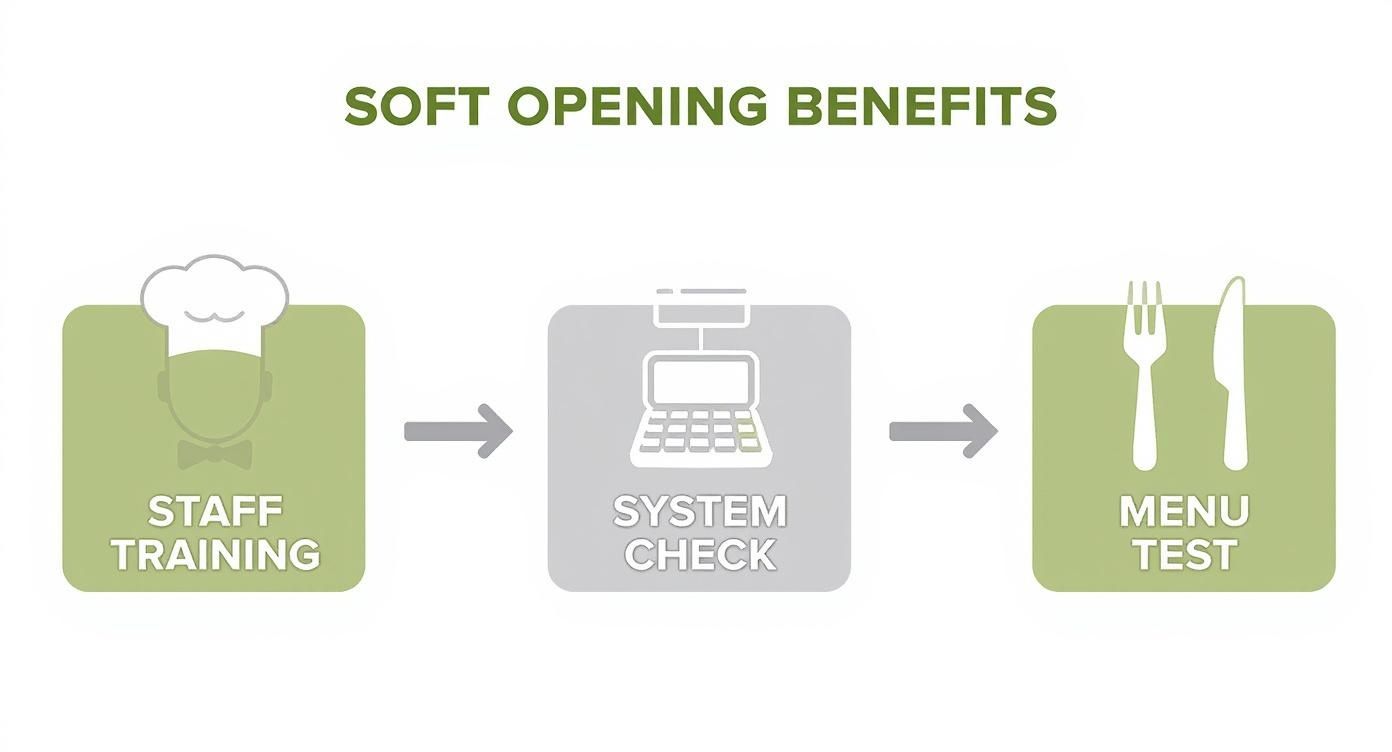
As you can see, staff training, system checks, and menu refinement are not separate tasks, they’re the pillars that support a strong opening night.
Build a Strategic Guest List
The people you invite will make or break your soft opening. The quality of your feedback depends entirely on who is in the room. This is not the time for a random free-for-all; you need a curated list that helps you meet your objectives. Part of this involves smart digital marketing strategies for restaurants to build a little buzz and attract the right kind of attention from the start.
I recommend thinking about your guest list in tiers:
- Friends and Family: This is your inner circle, your safest audience. Invite them on the very first night. It’s a low-stakes way for your team to build confidence in a forgiving environment.
- Local Business Owners and Vendors: These folks have a vested interest in your success. They can offer honest, valuable feedback and are likely to become your biggest advocates in the community.
- Food Bloggers and Influencers: Once your team has a night or two under their belts, invite a small, handpicked group of local foodies. Their early posts can generate the perfect wave of excitement leading up to your grand opening.
Design a Limited and Focused Menu
It’s tempting to show off everything you can do, but resist the urge to roll out your full menu. A limited menu is a strategic move. It allows your kitchen to nail a smaller set of dishes, ensuring every plate that goes out is consistent and high-quality.
Choose dishes that truly represent your restaurant’s soul and play to your culinary strengths. This focus keeps the kitchen from getting buried and gives you much clearer feedback on your most important offerings.
This approach also lets you pressure-test your most complex or signature dishes under live fire. You will get a real feel for prep times, ingredient flow, and station organization. A tight, focused menu is a core part of a successful event. For more on how this fits into your bigger picture, check out our guide on building a complete restaurant marketing plan that aligns with your launch.
How to Measure Success and Gather Actionable Feedback
So, how do you know if your practice run was a win? It all boils down to data and honest feedback. A soft opening is not just about getting through the night; it’s about mining for the insights that will make every service from here on out better.
This means you have to look past the smiles and pats on the back and dig into the real numbers and candid opinions.
This is not about collecting compliments. It’s about finding the weak spots, doubling down on what works, and making smart, data-driven calls that will build a loyal following right out of the gate. You need both the hard numbers and the human stories to see the full picture.
Key Performance Indicators to Track
Numbers do not lie. During your soft opening, your POS system is an absolute goldmine of information. Paying close attention to a few specific key performance indicators (KPIs) will show you exactly where your operation is humming and where it needs a tune-up.
Here are the core metrics to watch:
- Ticket Times: How long does it take for an order to get from the POS to the guest’s table? This number is a direct measure of your kitchen’s efficiency and how well it communicates with the FOH.
- Order Accuracy: Count every dish that needs to be remade or corrected. A high accuracy rate means your communication is clear and your training is sticking.
- Table Turn Rate: How long are guests sitting at each table? This helps you get a feel for the rhythm of service and start forecasting your real-world capacity for a slammed Saturday night.
- Menu Item Popularity: Which dishes are flying out of the kitchen, and which ones are getting crickets? This data is gold for tightening up your menu and getting your inventory dialed in before the grand opening.
Tracking these numbers gives you a baseline you can work from. For a deeper dive, check out our guide on the top restaurant KPIs every restaurant manager should track to understand what data moves the needle.
Gathering Honest and Actionable Guest Feedback
While data tells you what is happening, your guests are the only ones who can tell you why. You have to create simple, low-friction ways for them to share their real thoughts. To really get a handle on what went right and wrong, you need to learn how to gather customer feedback that grows your business.
Do not just ask, “How was everything?” Instead, ask specific, open-ended questions like, “What was your favorite part of the meal?” or “Is there one thing we could do to make your next visit even better?”
Think about using simple, one-page feedback cards with just a few pointed questions. Or, even better, a QR code that links to a quick digital survey. Encourage your managers to have real, candid conversations with tables, letting them know their honest opinion is the most valuable thing they can give you.
You’re hunting for patterns, both the good and the bad, that you can jump on right away.
Ultimately, the information you collect during a soft opening has a massive impact on your long-term health. In fact, many restaurants use guest feedback and early behavioral data to refine their service, shape promotions, and strengthen loyalty efforts, a powerful lever for building early customer retention.
Common Soft Opening Mistakes and How to Avoid Them
Even the best-laid plans can go sideways during a soft opening. While the point is to find the cracks in your system, a few common mistakes can turn a valuable dress rehearsal into a chaotic mess. Knowing what to watch for ahead of time is the difference between gathering clean, actionable feedback and just putting out fires all night.
The goal is not perfection; it’s progress. Here’s how to sidestep the pitfalls that trip up even seasoned operators.
Mistake #1: Inviting Too Many People
It’s tempting. You want to see the dining room full and feel the buzz you have been dreaming of. But packing the house on night one is one of the most common and costly mistakes you can make. It completely defeats the purpose of a controlled test.
When your kitchen is slammed, and your new servers are flustered, you cannot get an honest read on anything. You’re not testing your systems; you’re stress-testing your people.
How to Avoid It: Stagger your guest list over a few nights. Start small with a tight-knit group of trusted friends and family, the ones who will be honest but forgiving. Then, gradually ramp up the numbers. This gives your team a chance to build confidence and lets you spot bottlenecks before they turn into a full-blown service disaster.
Mistake #2: Failing to Set Clear Expectations
Your soft opening guests are not regular customers, and treating them like they are is a huge misstep. They are your test audience, your friendly critics, and they need to know what their role is. Without that context, you will get confused guests and feedback that does not help you improve.
How to Avoid It: Be completely upfront from the moment you send the invitation. Make it clear:
- This is a practice run. Let them know the team is green and the main goal is training and testing.
- Service might be slow (or weird). Give them a heads-up that there might be delays or hiccups as everyone learns the ropes.
- Their honest feedback is the price of admission. Emphasize that you invited them for their candid thoughts on the food, the service, and the vibe, everything.
Setting expectations turns guests into partners. They will be more patient, understanding, and ultimately give you the kind of detailed feedback that is pure gold.
Mistake #3: Neglecting Pre- and Post-Shift Briefings
Another critical error is skipping the huddles. It’s easy to get caught up in the rush, but failing to treat the soft opening like a real service day, complete with team meetings, is a massive missed opportunity. The time before and after service is your best chance to align the team, set goals, and review what happened.
Hold a tight pre-shift meeting to walk through the night’s goals. Then, no matter how tired everyone is, do a post-shift debrief to talk about what worked and what broke. This creates a powerful feedback loop that lets you make adjustments on the fly.
These meetings are nonnegotiable. They ensure every mistake becomes a lesson for the entire staff, not just a one-off problem. By steering clear of these common blunders, you will be able to tell a story of strategic success, not a tale of preventable chaos.
Even with the best prep, things will go wrong. That’s the point. The key is to anticipate the most common issues so you can have a plan ready. This checklist covers the frequent offenders trip up operators during their first few services.
Soft Opening Troubleshooting Checklist
| Potential Problem | Preventative Measure | Solution If It Happens |
|---|---|---|
| Kitchen gets weeded | Stagger reservations by 15-minute intervals. Limit the menu to 75% of the full offering to reduce complexity. | The manager or chef should immediately identify the bottleneck (e.g., grill station). Pull a server to help plate, or have the manager jump on expo to control the pace. |
| POS system glitches | Run multiple mock orders for every menu item before service. Have tech support’s number programmed into your phone. | Have a backup plan. Use paper tickets and a calculator. Comp the affected items and apologize to the guest for the delay. |
| Servers do not know the menu | Hold a pre-opening tasting for the entire FOH team. Create cheat sheets with ingredients, allergens, and talking points for each dish. | Pull the server aside for a quick two-minute coaching session. If they are swamped, have a manager or lead server take the table’s order to keep things moving. |
| Guests give vague feedback | Provide structured feedback forms (digital or paper) with specific questions about dish flavor, portion size, service attentiveness, and ambiance. | Follow up with guests who gave unclear feedback. Ask clarifying questions like, “When you said the fish was ‘good,’ what specifically did you like about the preparation?” |
| Running out of a key ingredient | Base your initial order on 50% of your max capacity for the first night. Have a list of nearby stores for emergency runs. | Immediately 86 the item in the POS. Huddle with servers to inform them and suggest two alternative dishes to recommend. |
This is not about being perfect; it’s about being prepared. When your team sees you have a plan for when things go wrong, it builds their confidence and keeps a minor issue from spiraling into a service-wide meltdown.
Transitioning from Soft Opening to Grand Success
The soft opening is done. You have taken a punch or two, collected some brutally honest feedback, and watched your team find their rhythm. Now it is time to channel that hard-won momentum into a grand opening that feels grand.
The lessons learned are not just about fixing what’s broken; they’re about building a resilient, guest-focused culture from the first service. This is where the dress rehearsal becomes a polished performance. Use the data and insights you have gathered to make those final tweaks to the menu, sharpen your service standards, and solidify workflows that felt clunky a week ago.
A well-executed soft opening builds a strong foundation. The team’s newfound cohesion and operational fluency are the launchpad for a grand opening that feels professional, seamless, and ready to impress the world.
The confidence your team gained is your single greatest asset. It creates an environment where everyone feels prepared and empowered, which is essential for keeping your best people, a massive challenge in this industry. For more on that, you can learn how to reduce staff turnover in our detailed guide.
With a practiced team and a fine-tuned operation, your restaurant is not just practicing anymore. You are ready for a standing ovation.
Your Soft Opening Questions, Answered
Even the best-laid plans come with questions. When you’re in the weeds of planning a soft opening, a few common “what ifs” always seem to surface. Here are the straight answers to some of those questions from operators.
How long should a soft opening last?
There is no magic number here, but most soft openings run somewhere between three days and two weeks. The right timeline boils down to your concept’s complexity and what you need to learn.
A quick, weekend-long event is perfect for shaking out the initial jitters and making sure your core systems do not buckle under pressure. A longer run, say for a week or two, gives you a much richer data set. You get to see how the team handles a slow Tuesday versus a slammed Friday, test different day parts, and gather more thoughtful feedback before you officially open the doors.
Should we charge guests during a soft opening?
This is the big one, and there’s a bit of a debate in the industry. Many restaurants land on a significant discount, like 50% off the food bill, or comp the meal entirely. It is a way of saying “thank you” for being our guinea pigs while we work out the kinks.
Charging something, even a reduced price, is smart. It helps offset your food cost and, more importantly, it forces you to run real transactions through your POS system. You want to find out if your credit card readers are glitchy before you have a line of paying customers out the door.
A word of caution: a completely free event can sometimes attract a crowd that is not your target demographic. One popular compromise is to charge for alcohol but offer the food at a steep discount or for free.
Whatever you decide, just be crystal clear about it. Your invitation should spell out exactly what’s covered and what is not, so there are no awkward moments when the check arrives.
Who are the best people to invite?
Do not just throw the doors open. A strategic guest list is your best tool for learning without getting overwhelmed. Think about it in waves.
- Friends & Family: Kick things off with the people who love you most. This is your lowest-stakes service.
- Community Insiders: Next up, invite local business owners, your key vendors, and other neighborhood figures.
- Local Influencers: Once the team has a couple of services under their belt and you’ve smoothed out the major wrinkles, consider a controlled “preview” for a handful of trusted local food bloggers or media.
And one final piece of advice: hold off on inviting any serious food critics. Let them come when your restaurant is running like a well-oiled machine, not when the gears are still grinding into place.
Ready to build a team that can execute a flawless soft opening and beyond? MAJC is the all-in-one platform for hospitality operators, offering the tools, training, and community you need to hire smarter and retain longer. From expert-led workshops to practical templates for every aspect of your operation, we help you build a profitable, sustainable business. Join our community of hospitality leaders at majc.ai.