


Let’s be honest: no one likes getting a customer complaint. That initial sting can feel like a direct hit on all your hard work. But what if we flipped the script on that feeling?
Think of a complaint not as a problem, but as a consultant walking through your door and telling you exactly where your business is falling short, for free. That’s what negative feedback really is: a raw, unfiltered roadmap for getting better before a small issue becomes a massive one.
Why Customer Complaints Are Your Greatest Opportunity
Positive reviews feel good, but they rarely tell you how to improve. A complaint, on the other hand, shines a bright spotlight on a specific friction point. It might be a confusing menu item, a bug in your online booking system, or a gap in your team’s training.
This is the most direct way you will ever understand your customers’ real-world experiences. It is a gift, even if it does not feel like one in the moment.
The True Cost of Ignoring Feedback
Pushing complaints aside or handling them poorly does not just cost you one customer. It starts a ripple effect with some seriously scary financial consequences.
The numbers don’t lie. Research from PwC shows that one-third of customers would leave a brand they love after just one bad interaction. And according to Sprout Social, 76% of consumers place equal value on brands that prioritize customer support and respond quickly to their needs on social media. When a complaint is ignored or handled slowly, you’re falling short of those expectations, and a single issue can quickly turn into a public problem.
Turning Problems Into Brand Loyalty
Here is the paradox of hospitality: solving a problem with genuine care can create more loyalty than if the problem had never happened in the first place.
When a customer has an issue, and you resolve it with empathy and speed, they often become your biggest fans. Why? Because you proved you listen, you care, and you are reliable when things go wrong.
A customer with a perfectly fine, forgettable experience might come back. But a customer whose problem you solved with real humanity? They do not just return, they tell their friends. They post about it. That kind of word-of-mouth is priceless.
By embracing complaints as opportunities, you actively learn how to increase repeat business with proven strategies that build a resilient and beloved brand. Each piece of feedback, when you handle it right, becomes another brick in the foundation of a stronger, more guest-focused business.
Mastering the A.C.T.I.V.E. Resolution Method
Instead of handing your team a rigid script, what if you gave them a reliable framework to navigate any customer issue with confidence? A structured approach creates consistency and empowers your staff to solve problems on the spot.
That is where the A.C.T.I.V.E. method comes in. It is a six-part playbook for turning customer friction into a positive, memorable outcome.
Think of it as Acknowledge, Clarify, Thank, Investigate, Validate, and Empower. Each step is designed to de-escalate tension and move toward a genuine, effective resolution. It is not about memorizing lines; it is about understanding the psychology of a complaint and responding with intention.
Acknowledge and Clarify the Issue
The first move, Acknowledge, is arguably the most critical. Before you do anything else, you have to validate the customer’s feelings. This is not about admitting fault immediately, but showing that you hear their frustration and you are on their side.
Simple phrases like “I can see how frustrating that must be” or “Thank you for bringing this to my attention; I understand why you’re upset,” can instantly change the tone of the conversation. It signals empathy and shifts the dynamic from adversarial to collaborative.
Next, you need to clarify to get to the heart of the matter. This means asking smart, open-ended questions that help you understand the full scope of the problem without making the guest feel interrogated.
- “Could you walk me through what happened from the beginning?”
- “To make sure I understand correctly, the issue is…”
- “What was your expectation for how this should have worked?”
This step stops you from solving the wrong problem and proves to the customer that you are genuinely invested in getting it right.
Thank and Investigate the Root Cause
Thanking the customer may feel counterintuitive, but it is a critical step. A simple “Thanks for letting us know about this” reframes the complaint as constructive feedback rather than conflict. It also immediately lowers tension and builds goodwill.
Once you understand the complaint, investigate what actually caused it. Was it a one-off mistake, a breakdown in process, or a miscommunication? Digging into the “why” allows you to fix the real issue, not just put a bandage on it.
For example, if a guest reports a cold entree, your investigation should reveal whether it was a kitchen delay, a server oversight, or an equipment problem. Identifying the root cause prevents repeated mistakes, which is the entire point of effective complaint handling.
Validate and Empower for a Lasting Solution
After investigating, you must validate the solution with the customer. This means proposing a fix and confirming that it meets their expectations. Do not assume you know what they want; ask them directly.
A great way to do this is by offering a clear plan and asking for their agreement. For example, “To make this right, I would like to offer you a replacement dish on the house and a dessert for the table. Does that sound fair to you?” This collaborative approach gives the guest a sense of control and ensures the solution will actually satisfy them.
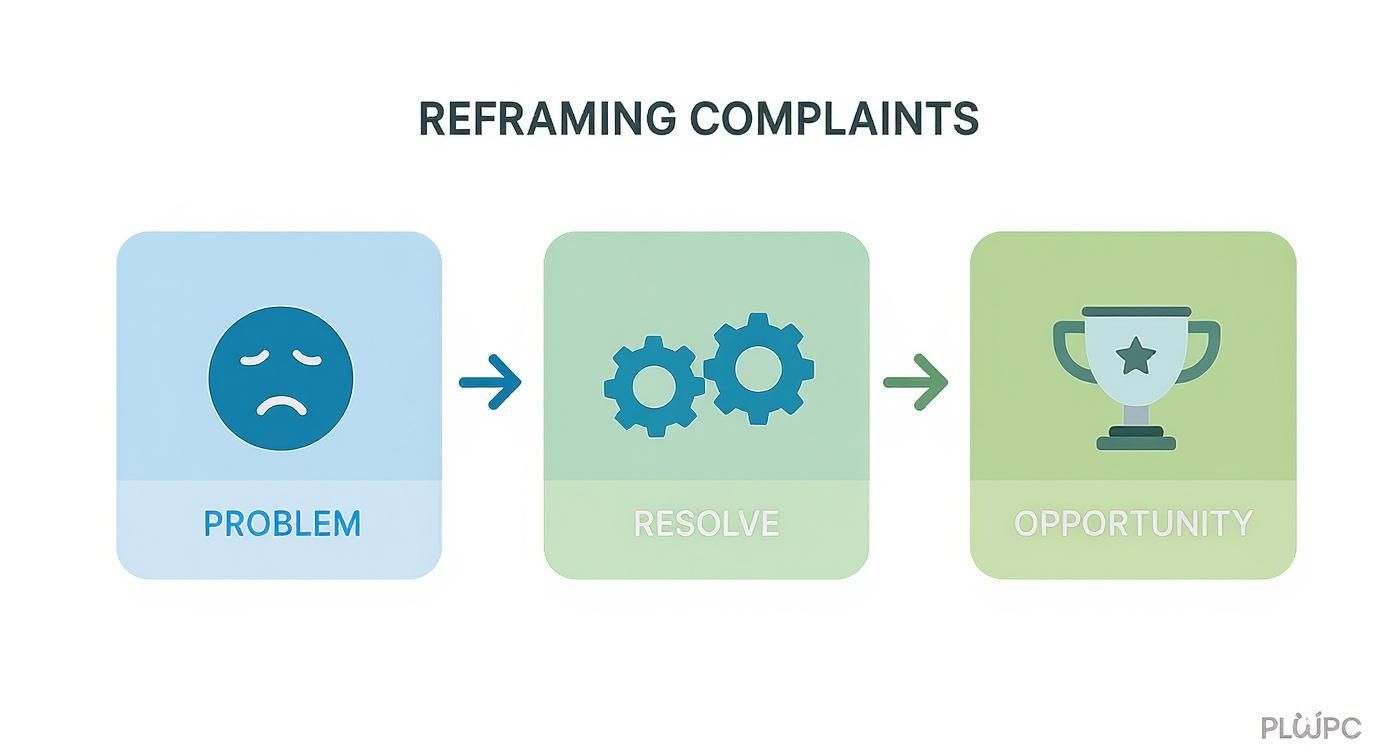
This is what it looks like in practice: transforming a complaint (Problem) through a structured process (Resolve) into a chance to build loyalty (Opportunity).
Finally, the entire method is held together by Empowerment. Your team needs the authority to act. If a server has to constantly run to a manager for approval, it just drags out the process and amplifies the guest’s frustration.
Give your team the power to offer a complimentary item, apply a discount, or find another appropriate solution without delay. It is one of the most effective ways to turn a bad situation around, building employee confidence and showing customers you trust your staff to do the right thing.
The A.C.T.I.V.E. Method In Action
Here is a quick cheat sheet you can share with your team to put this framework into practice during any service. These are not scripts to be memorized, but guides to help them respond with confidence and empathy.
| Step | Objective | Example Phrase |
|---|---|---|
| Acknowledge | Validate the guest’s feelings. | “I can see why you’re frustrated, and I’m so sorry this happened.” |
| Clarify | Understand the core problem. | “So I can get this right, could you tell me a bit more about…?” |
| Thank | Reframe the complaint as helpful feedback. | “Thank you for bringing this to our attention. We need to know.” |
| Investigate | Find the root cause of the issue. | “Let me go find out exactly what went wrong here.” |
| Validate | Propose a solution and get buy-in. | “To make this right for you, how does this sound…?” |
| Empower | Take ownership and resolve it quickly. | “I can absolutely take care of that for you right now.” |
Building a System for Complaint Management
Putting out a fire with skill is good. Building a restaurant that is fire-resistant is better. The same goes for complaints. A single heroic effort from a server can save one customer relationship, but a consistent, documented process can safeguard your entire brand reputation.
Without a system, feedback gets lost in the shuffle of a busy service. One manager hears about a recurring issue with wait times but forgets to pass it on. A server on the floor reinvents the wheel trying to solve a problem that was already handled last week. This is how small cracks in your operation turn into major fractures.
Choose Your Complaint Logging Tool
Start by choosing a single place where every complaint gets recorded. It doesn’t need to be fancy; the goal is simple: make sure no issue slips through the cracks.
For smaller operations, a shared Google Sheet works great. Track the date, customer name, issue, who handled it, the resolution, and the outcome. Even this basic log gives you instant visibility into recurring problems.
As your business grows, consider more integrated tools. Many POS and CRM systems now include complaint-tracking features, letting you tie feedback directly to a customer profile. This creates a clear history and helps your team deliver more personalized service over time.
Design Clear Escalation Paths
Not every complaint should be handled at the frontline. A strong system gives your team a clear escalation path, so they know exactly when to loop in a manager and prevent a guest’s frustration from escalating.
A solid escalation path removes guesswork. It empowers staff to act confidently while ensuring serious issues are handled by someone with the right authority.
Here are practical escalation triggers:
-
Guest Asks for a Manager: Always escalate immediately—no hesitation, no questions.
-
Refund Exceeds a Set Amount: Empower staff up to a specific threshold (e.g., $50). Anything higher requires approval.
-
Allegations of Misconduct or Safety Concerns: These must go straight to senior leadership for proper documentation and investigation.
-
Guest Still Unhappy After Two Attempts: At this point, a manager needs to step in with a new approach.
A fundamental component of any effective complaint management system is the ability to not just collect, but also respond to and act on customer input.
Create a Standard Operating Procedure (SOP)
Consistency builds trust. Every guest should receive the same level of care, whether they’re talking to your newest host or your most seasoned bartender. The easiest way to guarantee that is with a clear Standard Operating Procedure (SOP) for handling customer complaints.
Think of it as your team’s playbook. It lays out every step, from the first greeting to the final follow-up, so everyone responds the same way under pressure. And it doesn’t need to be a long manual; a sharp, one-page guide is often the most effective.
Your Complaint Handling SOP should include:
- Initial Response: A quick guide on acknowledging the customer, pulling phrases from the A.C.T.I.V.E. method.
- Information Gathering: Key questions to ask to understand the full scope of the problem without making it feel like an interrogation.
- Logging Protocol: Simple instructions on where and how to document the complaint in your chosen system (spreadsheet, CRM, etc.).
- Empowerment Guidelines: A clear list of solutions staff can offer on their own (e.g., a complimentary dessert, a 10% discount on the bill).
- Escalation Triggers: The specific scenarios that require manager intervention, just like we outlined above.
- Follow-Up Process: A simple step for checking in with the customer after the issue has been resolved to ensure they left happy.
For more guidance, you can explore detailed restaurant standard operating procedures examples to adapt for your own operation.
Training Your Team for Real-World Scenarios
A well-trained team is the critical link between a process on paper and a guest who feels genuinely heard. We have to move beyond theory. Practical, hands-on training is what builds the confidence your staff needs to navigate those tough conversations with grace.
This is where you prepare your team for the beautiful, unpredictable mess of customer service. You cannot script every interaction, but you can absolutely equip them with the tools to handle whatever comes their way.
From Scripts to Skills with Role-Playing
Nobody wants to talk to a robot. Memorizing scripts usually backfires, leading to stiff, impersonal conversations that only make things worse. Instead, the real work is in building core skills through role-playing. It is one of the most effective ways to prep your staff for the pressure of a real-life complaint.
Start by creating scenarios based on actual issues you have faced in your own restaurant. This makes the practice relevant and immediately useful.
Role-Playing Scenarios to Practice:
- The Vague Complaint: A guest just says their experience was “bad.” The goal here is to train staff to ask clarifying questions that get to the root of the problem without making the guest more frustrated.
- The Justifiably Angry Customer: The kitchen completely botched an order, and the guest is furious. This scenario is all about de-escalation, active listening, and taking immediate ownership of the mistake.
- The Weird, Out-of-the-Blue Problem: A situation you have never seen before. This one tests your team’s ability to think on their feet, stay cool, and follow the escalation path you have laid out.
When your team acts out these situations in a safe environment, they build muscle memory for empathy and problem-solving. For more ideas on structuring these sessions, check out our guide on how to train restaurant staff quickly and effectively.
Turning Feedback Into Proactive Business Improvements
This is all about closing the feedback loop. It is the simple process of taking individual complaints, stepping back to see the bigger picture, and using that insight to make meaningful changes to how you operate. When you do this, your customer service process stops being a reactive cost center and becomes a powerful engine for growth.
From Individual Complaints to Actionable Insights
A single complaint might just be a one-off issue. A server having a bad night, or a steak that got away from the line cook. But when you start tracking them, patterns emerge that are impossible to ignore. A simple system for categorizing feedback is the first step.
You do not need a complicated system. Just start with a few broad categories. You can always get more specific as you collect more data.
- Product/Service Issues: This is anything related to the quality of your food, drinks, or other offerings. Think “Steak was overcooked,” or “Coffee was lukewarm.”
- Staff/Service Issues: All feedback about interactions with your team goes here. “Server was inattentive,” “Host was rude.”
- Process/Policy Issues: These are problems that come from your operational systems. Maybe the “Online ordering was confusing,” or the “Wait time was longer than quoted.”
- Facility/Ambiance Issues: Comments about the physical environment fall into this bucket. “Music was too loud,” “Restroom was messy.”
By tagging each complaint, you can quickly see where the real friction is. Are 20% of your complaints related to long wait times? That is not a single bad night; that is a signal to take a hard look at your staffing levels or your seating process.
Driving Meaningful Change with Feedback
Once you have spotted a trend, it is time to act. This is where the real value is unlocked. The insights you gather should directly inform your business decisions and lead to tangible improvements that customers will actually notice.
This whole process creates a virtuous cycle. You get feedback, you analyze it for patterns, you implement a change, and then you monitor new feedback to see if the fix actually worked. Every time you complete that loop, your operation gets smoother, your team gets sharper, and your customers get happier. This is how you handle customer complaints, not just as problems to be solved, but as opportunities to be seized.
Common Questions About Handling Customer Complaints
Even with the best playbook, you are going to run into weird situations. Handling complaints well often means knowing how to navigate the gray areas with confidence. Here are some of the most common questions on this topic.
What if the customer is wrong?
This one is tough. The old line, “the customer is always right,” is not about facts. It is about feelings.
Even if a guest completely misunderstands a policy or makes an honest mistake, their frustration is real. Your first job is to validate their feeling, not their version of events.
Start with empathy, not correction. Try something like, “I can absolutely see how that would be confusing, and I’m sorry for the frustration it’s caused.” This acknowledges their experience without admitting you did anything wrong.
From there, you can gently clarify the situation without making them feel stupid. The goal is not to win the argument; it is to save the relationship.
How should we handle public complaints on social media?
A public complaint demands a public response. When someone leaves a negative comment on Instagram, X, or a review site, the first rule is to act fast. A quick reply shows everyone else watching that you are paying attention.
Keep the public response short, professional, and empathetic. Acknowledge their feedback and immediately offer to take the conversation offline to a private channel like DMs or email.
An example public response could be: “Hi [Customer Name], thank you for sharing this with us. We’re very sorry to hear about your experience, as this isn’t the standard we hold ourselves to. We want to learn more and make this right. Could you please send us a direct message with your contact info?”
This approach shows public accountability while letting you handle the messy details privately.
What’s the best way to say no to an unreasonable request?
Sometimes a customer asks for something you just cannot do. It might be against policy, impossible to execute, or just financially insane. When you have to say no, the trick is to do it with empathy and clarity, while offering an alternative path forward.
Do not just hit them with a blunt, “No, we can’t do that.” That is a dead end.
Frame it differently. Briefly and calmly explain the “why” behind the policy. Then, immediately pivot to what you can do for them. This shifts the conversation from rejection to resolution.
For instance, a guest ate their entire steak and then demanded a full refund because it was not perfect. You could say: “I understand you were disappointed, and I’m truly sorry for that. While our policy does not allow for a refund after a meal has been completely finished, what I can do right now is offer you a complimentary dessert and ensure your next visit is on us.”
This is the “positive no.” You acknowledge their request, explain the boundary, and provide a constructive alternative. The customer feels heard, not just shut down.
At MAJC✨, we provide the systems, training, and community support to help hospitality leaders turn these challenging moments into opportunities for growth. Our platform gives you the tools to build teams that can handle any situation with confidence and care. Learn more at majc.ai.