
If you’re aiming for the top job in the kitchen, you need to understand one thing right from the start: becoming an executive chef is a marathon, not a sprint. We’re talking at least a decade of grinding it out, mastering your craft, learning the business, and developing some serious leadership chops. This isn’t just a promotion from the line; it’s a complete shift into strategic management.
Success at this level is all about blending your culinary artistry with a sharp, operational mind.
Understanding the Modern Executive Chef Role
When you hear “Executive Chef,” it’s easy to picture someone in a tall toque, meticulously plating a work of art. And yes, creativity is a huge part of the job. But the reality of the modern role is far more complex and business-driven.
Think of the executive chef as the CEO of the kitchen. Your success isn’t just measured by glowing reviews and beautiful food; it’s measured by profitability, team morale, and the overall health of the business.
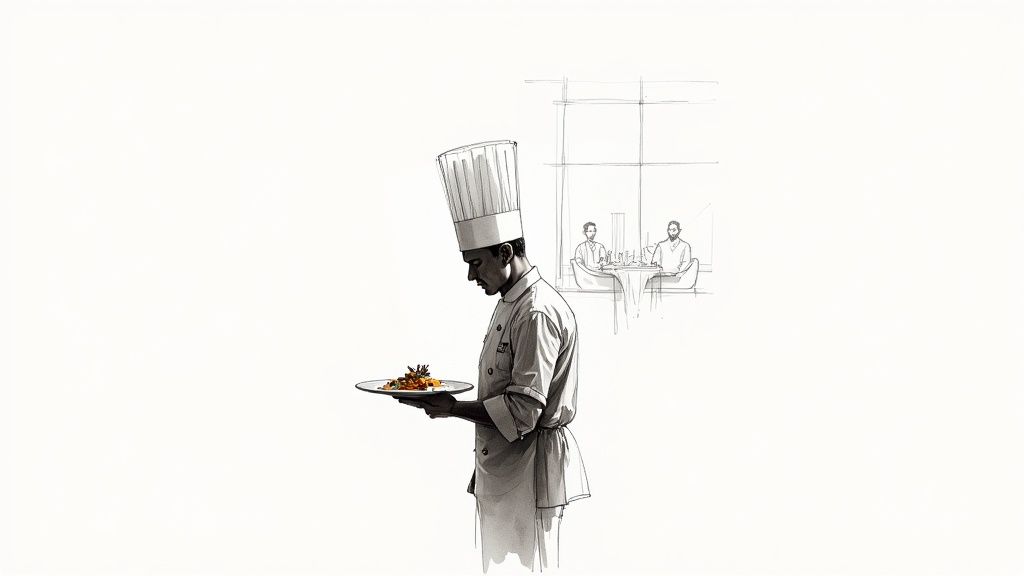
You’re the bridge connecting the culinary vision to the financial realities of the restaurant. You will shape the brand’s identity through your menus, but you will also be the one managing budgets, wrestling with suppliers for better pricing, and making sure every single dish that leaves the kitchen is perfect. It’s a massive responsibility.
More Than Just a Great Cook
Let’s be clear: The leap from being a hands-on cook to a strategic leader is probably the biggest jump you will make in your career. It’s not just about what happens on the stove anymore; it’s about steering the entire back-of-house operation.
This journey is a long one, typically taking nine to 10 years of working your way up the ladder. You start at the bottom and climb through every key position, learning the ropes until you’re ready to lead. As an executive chef, you’re not just cooking—you’re planning menus, hiring and mentoring your crew, managing the P&L, and often serving as the public face of the restaurant.
Core Areas of Responsibility
The role really breaks down into a few key domains. To be a truly effective executive chef, you have to find a way to balance them all, every single day.
Here’s a quick look at the core responsibilities that separate an executive chef from every other cook in the kitchen.
Executive Chef Responsibilities At a Glance
| Area of Responsibility | Key Duties and Skills |
|---|---|
| Culinary Vision & Menu Development | Designing innovative, profitable menus that define the restaurant’s brand. |
| Financial Management & Acumen | Mastering food costs, managing labor budgets, and controlling inventory to keep the kitchen profitable. |
| Team Leadership & Mentorship | Hiring, training, scheduling, and developing a diverse kitchen staff to build a positive, efficient culture. |
| Operational Excellence & Quality Control | Enforcing health and safety regulations while maintaining the absolute highest standards for every plate. |
Mastering these areas is what the job is all about. It’s about moving from doing the work to leading the work.
Ultimately, the job demands a rare mix of artistry and analytics. To get a better feel for the team you’ll eventually lead, take a look at our guide on back-of-the-house positions. It will give you a solid foundation for understanding the entire kitchen ecosystem.
Building Your Culinary and Leadership Foundation
There is no single path for how to become an executive chef. Most careers follow one of two routes: a formal culinary education or a hands-on climb through the kitchen ranks. Both lead to the same destination, and neither is inherently better.
The Two Paths to Culinary Mastery
Choosing between culinary school and on-the-job training really comes down to your learning style, finances, and long-term goals. Let’s break down what each path looks like on the ground.
Formal Culinary Education:
- Structured Learning: You get a comprehensive curriculum covering classic techniques, pastry, butchery, and the principles of kitchen management.
- Networking Opportunities: It connects you with instructors, alumni, and peers who can become career-long contacts and open doors down the road.
- Accelerated Knowledge: It compresses years of foundational learning into a focused one- to four-year program.
On-the-Job Experience:
- Practical Application: From day one, you learn how to work with speed, efficiency, and grit in a real, high-pressure environment.
- Earning While Learning: You can avoid the significant debt that comes with culinary school while bringing in a steady paycheck.
- Direct Mentorship: It’s a chance to learn directly from seasoned chefs, watching how they solve problems and lead their teams every single day.
Truth is, the most successful careers usually blend both. A culinary school grad still has to put in the years on the line to earn respect. And a chef who rises through the ranks has to be disciplined about learning the business principles they might have missed in a formal setting.
Mastering the Essential Hard and Soft Skills
No matter where you start, becoming an executive chef demands a balanced skill set. Your technical chops get you in the door, but it’s your leadership that lets you climb the ladder.
From fundamental cooking methods to advanced prep, learning how to cook like a chef with proven techniques is everything. This means going way beyond just following recipes; it’s about truly understanding the science and art behind the food.
These are the nonnegotiable skills you have to develop:
- Advanced Culinary Techniques: This is the whole package, expert butchery, fish fabrication, sophisticated sauce work, and modern plating.
- Menu Engineering: You need the ability to design menus that are creative, delicious, and most importantly, profitable, all while fitting the restaurant’s brand and kitchen capacity.
- Food Safety and Sanitation: An uncompromising commitment to hygiene protocols. This is about protecting both your staff and your guests, period.
- Clear Communication: The skill to give precise instructions during a chaotic service, offer constructive feedback, and communicate clearly with the front-of-house and management.
- Grace Under Pressure: Staying calm and composed when the tickets are flooding in, a key piece of equipment goes down, or a VIP walks in unannounced.
The Role of Professional Certifications
As you rack up experience, professional certifications act as powerful proof of your skills and dedication. They send a clear signal to employers that you’re serious about your craft and committed to the highest industry standards.
Certifications can give your career a real boost. According to the U.S. Bureau of Labor Statistics, employment for chefs and head cooks is projected to grow 7% from 2024 to 2034, faster than the average for all occupations. While opportunities are expanding, competition for top executive chef roles in fine dining, hotels, and resorts remains intense. Certifications help you stand out by validating your skills, leadership readiness, and professionalism in a crowded field.
From Line Cook to Sous Chef: Earning Your Stripes
The road to the executive chef’s office runs straight through the fire of the line. Advancement isn’t about seniority; it’s earned by mastering every station, proving you’re unshakable under pressure, and showing you’re hungry for more. This climb, from Commis or Line Cook to the crucial Sous Chef role, is where you forge the foundation of your entire career.
It all starts with owning your station. Whether you’re on Garde Manger, Saucier, or Grill, your mission is to become the undisputed expert. That means flawless consistency, efficient speed, and a deep knowledge of every single component that leaves your cutting board.
When the senior chefs see you crushing it night after night, they start to trust you. In a professional kitchen, trust is the currency of your career.
Mastering Your Station and Looking Beyond
Nailing your assigned duties is just the price of admission. To really get noticed, you have to show initiative that proves you see the kitchen as a whole, not just your little corner of it.
A simple way to do this? Volunteer for the jobs no one else wants. Offer to help with the end-of-night inventory. Ask the Sous Chef if you can shadow them while they write the weekly schedule. These are the moments where you get a peek behind the curtain at the management skills essential for any leadership role.
This path often blends formal education with the hard knocks of kitchen life, all validated by professional certifications.
As you can see, a solid career isn’t built on just one thing, it’s the combination of learning, doing, and proving your skills that sets you apart.
The First Big Step: Chef de Partie
Your first major promotion is usually to Chef de Partie, or station chef. Suddenly, you’re in charge of a whole section, maybe with a Commis Chef or two looking to you for direction. This is your first real taste of management, and the responsibility jumps significantly.
As a Chef de Partie, you’re expected to:
- Run Your Section: You own all prep, ordering, and execution for your entire station.
- Mentor Junior Cooks: You will be teaching techniques and making sure the new cooks meet the kitchen’s high standards.
- Uphold Quality: You are the final gatekeeper. Nothing leaves your station unless it’s perfect.
This is also where your communication skills get a serious workout. During a slammed service, you have to coordinate perfectly with other station chefs, calling out times and needs with calm, clear precision.
The Critical Leap to Sous Chef
Moving up to Sous Chef is the single most important jump you will make on your way to running a kitchen. You’re now the Executive Chef’s right hand, the person responsible for executing their vision day in and day out. You run the line, you manage the crew, and you step up anytime the head chef is away.
Your world expands to cover the entire kitchen operation. You’re handling schedules, dealing with discipline, managing inventory, and keeping a close eye on food costs. You will also get more involved in menu development, testing recipes, and helping the Executive Chef bring new dishes to life.
One of the best ways to navigate this move is by finding a great mentor. A strong relationship with your Executive Chef is nonnegotiable. Ask for their guidance, listen to their feedback, and soak up every lesson they offer on leadership and the business of food. Digging into the power of mentorship in hospitality can show you just how much these relationships can fast-track your growth.
The role is a constant balancing act. You need the respect of the cooks you used to work beside, but you also have to enforce the standards set by management. It’s a tough spot that will test your diplomacy, your patience, and your ability to lead when things get hot.
Ultimately, getting that promotion isn’t just about time served. It’s about being proactive, staying curious, and proving you have the skills, the temperament, and the business mind to lead a team. How you perform as a Sous Chef is the final audition for the top job.
Thinking Like a Business Owner, Not Just a Chef
The moment you decide to go for an executive chef role, your whole world has to change. It stops being just about the food. Suddenly, your success isn’t just measured by a beautiful plate, it’s measured by the kitchen’s bottom line. This is where a great cook becomes a true culinary leader, learning to balance the art with cold, hard business strategy.
This mental switch can feel jarring, but it’s the single most important step you will take.
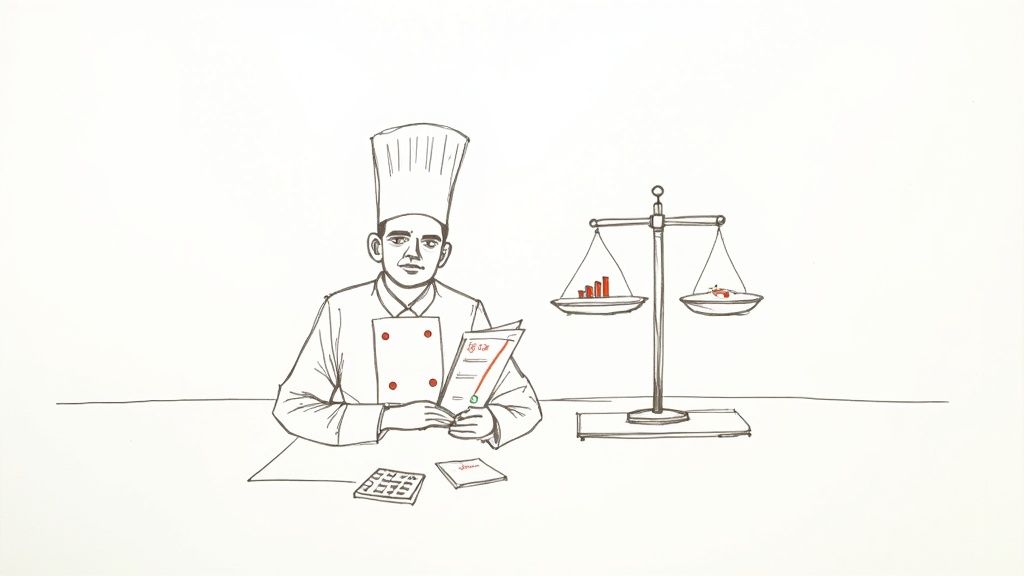
At the end of the day, this is what separates a great Sous Chef from an Executive Chef. You’re responsible for the profitability that keeps the lights on, not just the food that goes on the plates.
Mastering Kitchen Finances
You don’t need an accounting degree, but you absolutely have to speak the language of business. Terms like food cost, labor percentage, and P&L statements are about to become your new best friends.
Think of it this way: every ingredient has a price tag, every cook has a wage, and every dish has a menu price. Your job is to manage the delicate dance between these three numbers to make sure the restaurant actually makes money.
Let’s break down the key financial dials you will need to control.
- Food Cost Percentage: This is the lifeblood of your kitchen. It’s the cost of your ingredients divided by the sales they generate. A healthy food cost, usually between 28% and 35%, is a sign of a well-run operation.
- Labor Cost Management: Your crew is your biggest asset, but they’re also one of your biggest expenses. This means scheduling smart, knowing your peak and slow times, and cross-training your cooks so they can wear multiple hats.
- Reading a P&L Statement: Think of the Profit and Loss statement as your kitchen’s report card. It shows you exactly where money is coming in and where it’s going out. It’s the tool you will use to spot waste, trim spending, and make smart decisions.
To truly drive a restaurant’s success, an executive chef also has to think about getting people in the door. Understanding effective local restaurant marketing strategies extends your influence beyond the kitchen and into the entire business.
From Recipe to Revenue: A Practical Example
Let’s put this into practice. Say you want to run a pan-seared salmon special with roasted asparagus and a lemon-caper sauce.
- Cost Out the Dish: First, you have to calculate the exact cost of every single thing on that plate. Break down the price of the salmon filet, each spear of asparagus, the butter, lemons, capers, even the pinch of salt. Let’s say your total plate cost comes out to $7.50.
- Determine the Price: Now, you use your target food cost percentage to set the price. If the restaurant aims for a 30% food cost, you would divide your plate cost by that target ($7.50 / 0.30). That gives you a menu price of $25.00.
- Analyze and Adjust: Finally, you look around. Is $25.00 a fair price for a salmon dish in your neighborhood? Does it match the restaurant’s vibe? You might tweak it up or down, but you’re making that call based on data, not just a gut feeling.
Building and Leading a Resilient Team
The numbers are only half the battle. Your other core job as a business leader is managing people. A toxic or disorganized kitchen leads to high turnover, sloppy food, and bad service, all things that will bleed your profits dry.
Building a team you can trust is absolutely essential, both for the restaurant’s success and your own sanity. Your mission is to build a culture where people feel respected and want to stick around.
Building Your Brand and Landing the Top Job
After years on the line, the final step is positioning. Becoming an executive chef isn’t just about talent; it’s about presenting yourself as a leader with vision, discipline, and business sense. At this level, owners are hiring someone who can run a kitchen, manage costs, and shape the guest experience.
This is where you turn experience into a clear, compelling story.
Crafting a Standout Resume and Portfolio
Your resume should read like a growth narrative, not a task list. Show progression from line cook to leadership roles, and focus on outcomes, not duties.
Instead of listing responsibilities, highlight impact:
-
Reduced food costs
-
Led or trained high-performing teams
-
Opened menus, concepts, or new locations
-
Improved consistency or kitchen culture
A digital portfolio is equally important. In a visual industry, showing your work matters.
Include:
-
High-quality dish photos that reflect your style and consistency
-
Menus you’ve developed, with brief notes on pricing logic or concept thinking
-
Press mentions or awards, if applicable, as social proof
This gives employers a clear sense of how you think, not just how you cook.
Networking Your Way to the Top
Many executive chef roles are never publicly posted. They move through relationships.
Treat your professional network as part of the job:
-
Keep a sharp, current LinkedIn profile
-
Connect with restaurateurs, recruiters, and peers you respect
-
Show up at industry events, festivals, and supplier tastings
Visibility builds trust. Trust opens doors. These are prime opportunities to meet the decision-makers in your city and build a reputation as a serious, ambitious professional. For a masterclass on this, check out our conversation with Katie Flannery on building a brand that chefs trust.
Acing the Interview and Cooking Trial
At this level, interviews are rarely one-and-done. Expect conversations followed by a cooking trial or stage.
Preparation is critical. Ask about:
-
Equipment and ingredients
-
Expectations for the dish
-
Kitchen workflow and team structure
During the trial, you’re being evaluated on more than flavor. Cleanliness, organization, communication, and leadership under pressure all matter. Be ready to discuss food costs, team management, and how you build a positive kitchen culture.
They’re hiring a leader, not just a technician.
Understanding Your Worth and Negotiating Salary
Understanding your market value is essential. Executive chef compensation varies widely by concept and location, but top roles can command six figures in competitive markets.
With steady industry growth projected through 2034 and consistent demand for experienced culinary leaders, strong candidates who can balance creativity with operational discipline are well-positioned to negotiate from a place of confidence.
Common Questions on the Path to Executive Chef
We have pulled together some of the most common questions from aspiring chefs to give you a clearer view of the path ahead.
Think of this as the final check on your roadmap, a chance to clarify the journey so you can tackle the challenges and opportunities with confidence.
How long does it really take to become an executive chef?
There’s no magic number, but a realistic timeline is somewhere between nine and 10 years of serious, hands-on experience. This isn’t just about clocking in; it’s about mastering every station and every role, from the intensity of the line to the leadership of a sous chef.
A culinary degree can absolutely give you a leg up, but it’s no substitute for the hard-earned lessons you only learn in the heat of service. The real key is constant, deliberate growth. Every step up the ladder needs to add a new layer of skill, not just in cooking, but in management, too. That’s what prepares you for the top job.
Is a culinary degree necessary to become an executive chef?
Honestly? No. A culinary degree isn’t a golden ticket to the executive chef’s office. Plenty of legendary chefs came up entirely through the ranks, their skills forged on the line, not in a classroom. At the end of the day, a professional kitchen respects one thing above all else: your ability to execute under pressure.
That said, formal training provides a solid foundation in fundamentals, food safety, and the business side of things that can definitely give you an edge. The connections you make in culinary school don’t hurt, either. But ultimately, what gets you hired is a proven track record of skill, leadership, and high-level experience, no matter how you got it.
What is the biggest challenge in this transition?
The jump from sous chef to executive chef is less about cooking and more about a complete shift in perspective. As a sous chef, your world is the line. Your job is to execute the chef’s vision perfectly and keep service running like a well-oiled machine. It’s all about immediate quality and efficiency.
Once you become the executive chef, your responsibilities explode. You’re no longer just running a service; you’re running a business. Suddenly, you’re accountable for the kitchen’s profitability. Your days are spent engineering menus, battling food and labor costs, hiring and mentoring your team, and shaping a long-term vision. It forces you to step away from the line and lead from a much broader, more strategic place.
Ready to take the next step in your culinary leadership journey? MAJC✨ is the community-driven platform designed by hospitality operators to help you build the skills, find the opportunities, and connect with the mentors you need to succeed. Explore how MAJC can support your growth here.
