


Dealing with difficult employees is one of the toughest parts of a manager’s job, but it does not have to feel like you are always putting out fires. The key is shifting from a reactive mindset to a proactive one. This means spotting disruptive patterns early, having a direct conversation about the specific behavior, and working together on a clear path forward before one person’s actions drag down the entire team.
Proactively Managing Difficult Employee Behavior
Every manager knows the feeling. A single difficult employee can drain the team’s energy, kill morale, and sink productivity. It is a challenge that often forces you into a reactive cycle, where you are constantly dealing with the fallout instead of preventing the issue in the first place.
The most effective leaders learn to address these problems long before they escalate into a crisis. It all starts with recognizing the subtle but critical signs. We are not talking about someone having an off week; we are looking for patterns, like persistent negativity, missed prep tasks that create bottlenecks for others, or passive-aggressive comments during pre-shift.
This simple, three-step process is a great framework to keep in mind.
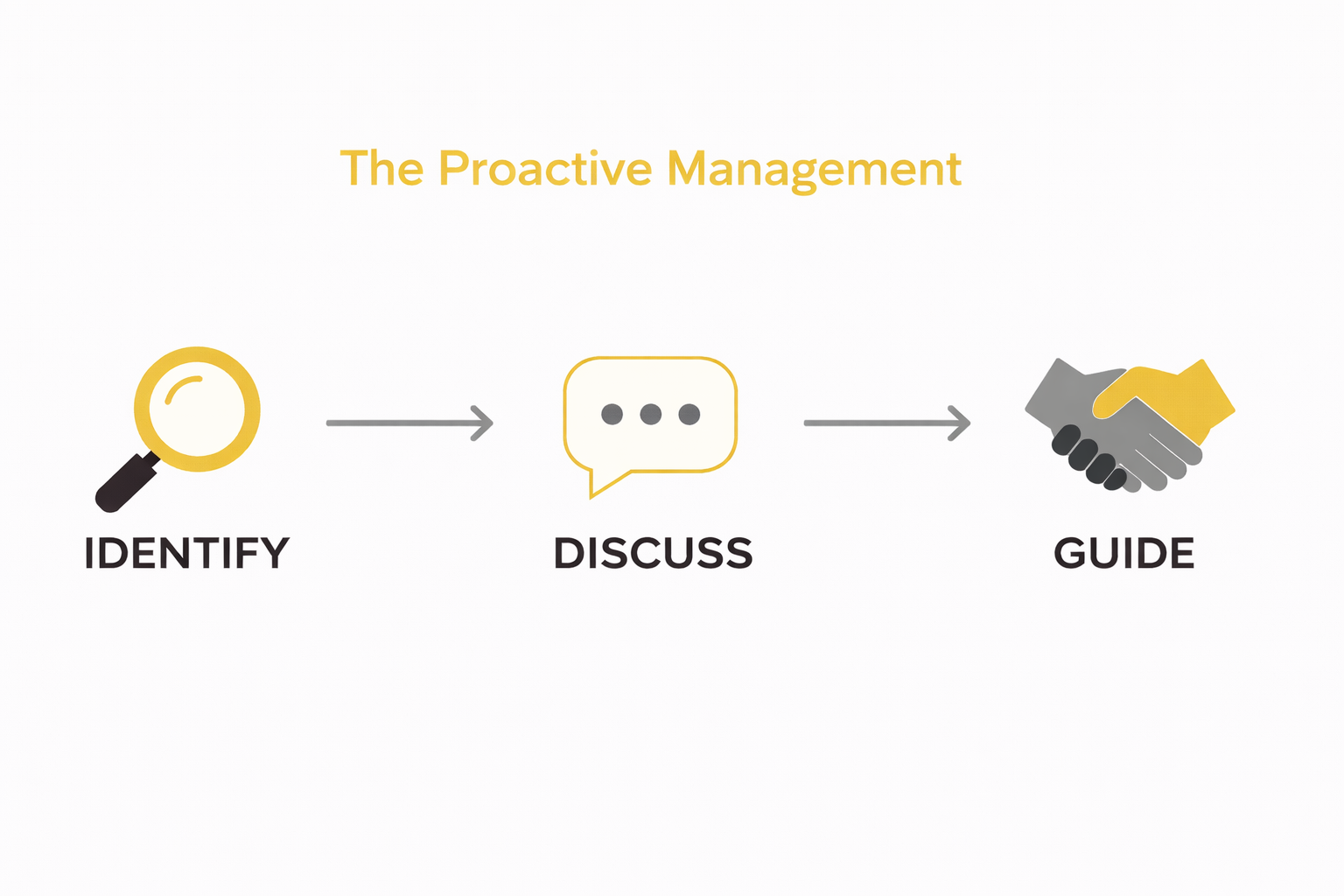
It is all about identifying the behavior, discussing it constructively, and guiding the employee toward a real resolution.
Differentiating Patterns from Bad Days
One of the hardest parts of managing people is telling the difference between a temporary slump and a real problem. Everyone has personal challenges that bleed into their work from time to time. A great manager offers support and understanding in those moments.
A pattern of disruptive behavior is different. It is a habit that repeats over time and directly harms team dynamics, guest service, or operational goals. Ignoring these patterns is one of the fastest ways to poison your team’s culture. It signals to everyone else that this behavior is acceptable, which can quickly lead to good people leaving.
In fact, learning to address these behaviors head-on is a huge part of learning how to reduce staff turnover.
Identifying the Root Cause
Before you jump in to correct a behavior, you need to understand where it is coming from. Sometimes, what looks like a “difficult employee” is actually just a person facing a hidden challenge.
Dig a little deeper and consider these potential root causes:
- Skill Gaps: Is the employee struggling because they lack the training or tools to do their job well? A new FOH hire who seems slow might just be overwhelmed by an unfamiliar POS system.
- Unclear Expectations: Have you clearly communicated what success looks like? Ambiguity leads to frustration and performance issues. “Work harder” is not a clear expectation.
- Personal Issues: Are challenges outside of work, like health or family problems, spilling over? A little empathy can go a long way.
- Workplace Environment: Is there a conflict with a coworker? Does the employee feel undervalued or unheard?
- Neurodiversity: Sometimes, certain behaviors can be related to conditions like ADHD or autism. Understanding and implementing effective accommodations for ADHD and autism in the workplace can make a world of difference for both the employee and the team.
Taking a moment to spot the behavior and consider the “why” allows you to intervene thoughtfully. Below is a table with a few common scenarios and some simple, proactive ways to get the conversation started.
Early Intervention Strategies for Common Behaviors
| Difficult Behavior | Initial Action | Goal of Intervention |
|---|---|---|
| Consistent Lateness | “Hey, I noticed you’ve been a few minutes late for the last few shifts. Is everything okay?” | Open a low-pressure dialogue to uncover the root cause (e.g., transportation, childcare) instead of immediately issuing a warning. |
| Negative Attitude/Gossip | “Can we chat for a minute? I’ve noticed a shift in your tone lately. I want to make sure you’re feeling supported here.” | Address the vibe directly but with empathy. This separates the person from the behavior and shows you care about their well-being. |
| Poor Sidework/Closing Duties | “Let’s review the closing checklist together. I want to make sure it’s clear and see if there are any roadblocks for you.” | Re-establish expectations without accusation. This approach focuses on process and clarity, not blame. |
| Ignoring Customer Requests | “I saw you had a tough interaction at table 12. Let’s talk about what happened so I can support you.” | Frame the conversation around a specific event. It makes the feedback actionable and less personal. |
These early, informal check-ins can often resolve an issue before it ever needs to become a formal disciplinary matter.
Leading a Constructive Feedback Conversation
Alright, you have spotted a pattern of behavior that needs to be addressed. The next move is a direct, private conversation. The whole point is to turn a potentially awkward chat into a productive one that gets to the root of the issue and lays out a clear path forward.
Handling these talks is a huge part of being a good leader. Always remember to focus on the behavior, not the person.
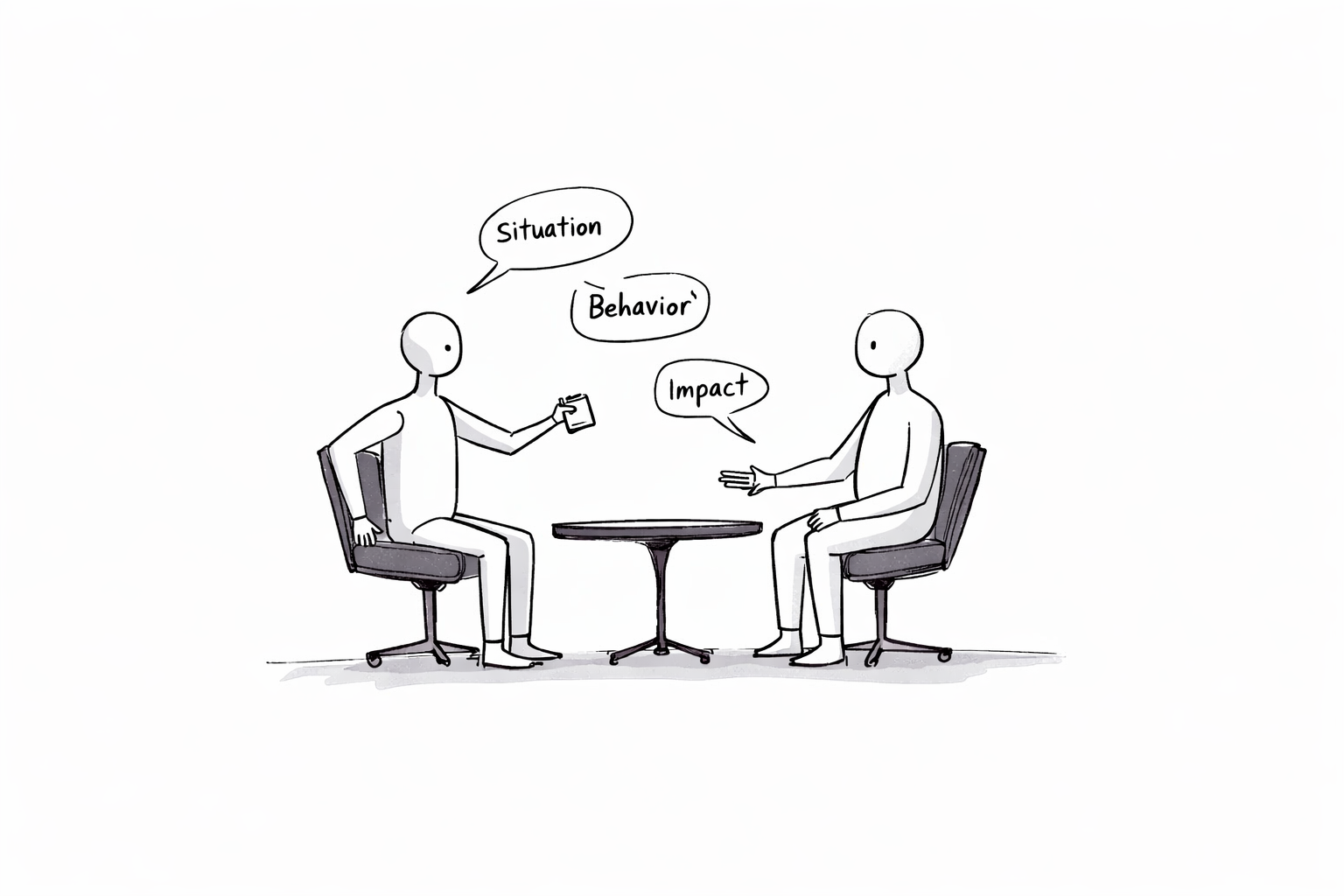
This keeps the conversation professional and centered on finding a solution together.
Use the SBI Model to Keep Feedback Clear and Factual
To keep things objective and avoid making anyone feel attacked, the Situation-Behavior-Impact (SBI) model is your best friend. It is a simple framework that structures your feedback around facts, taking emotion and personal judgment out of the picture.
Here is how it works:
- Situation: Pinpoint the specific “when and where” the behavior happened. This grounds the feedback in a real moment, not a general feeling.
- Behavior: Describe the exact, observable actions. Stick to what you literally saw or heard. No guesswork about their intentions.
- Impact: Explain how that behavior affected the team, the guests, or the flow of service. This connects their actions to a real consequence.
Let’s put it into practice. Instead of a vague accusation like, “You have a bad attitude with customers,” try SBI.
Situation: “During the dinner rush last night, when table seven asked for extra napkins…”
Behavior: “…I heard you sigh loudly and say, ‘I’m swamped with other tables right now.'”
Impact: “…This made the guests visibly uncomfortable, and another server had to step in. It also puts more pressure on the rest of the FOH team.”
See the difference? It is direct, factual, and focuses squarely on professional conduct. That makes it much easier for an employee to hear the feedback without getting defensive.
Open the Conversation and Actually Listen
How you kick things off sets the tone for the entire conversation. Do not just jump into the criticism. Find a calm, private space, state your intention, and then give them the floor.
A good opener could be something like: “Thanks for grabbing a minute with me. I wanted to check in about what happened during service last night, get your perspective, and figure out how we can move forward.”
After you have shared your feedback using the SBI model, the most critical part is to be quiet and listen. Active listening means genuinely trying to understand their side of the story, not just waiting for your turn to talk again. Ask open-ended questions to get them talking.
- “Can you walk me through what was happening from your point of view?”
- “What challenges are you running into in these moments?”
- “What kind of support from me would be helpful here?”
More often than not, a “difficult” employee is just someone who feels unheard or is struggling with something you cannot see. When you listen with genuine empathy, you shift the dynamic from a disciplinary meeting to a coaching opportunity. To really nail this part, check out these effective employee feedback strategies.
The conversation should wrap up with both of you on the same page about the problem and the agreed-upon next steps. The employee needs to walk away knowing exactly what has to change, but also feeling like you are in their corner, ready to help them succeed. This kind of dialogue is how you handle tough situations while building a stronger, more resilient team.
Mastering the Art of Objective Documentation
Okay, the tough conversation is over. But your work is not done. Now comes one of the most critical parts of managing people: documentation.
I know, it sounds like a bureaucratic headache. But trust me, clear, objective documentation is your single best tool as a manager. It creates a fair and transparent record that protects you, the employee, and the business if things escalate.
Think of it less as a chore and more as the official story of what is happening. This is not your personal diary or a place to vent. It is a professional log of behaviors, conversations, and the plans you have agreed on.
When you create a clean, unbiased paper trail, you are showing that you gave the employee every chance to improve. That is absolutely vital, both for effective coaching and for any potential disciplinary action down the road.
What to Document and How
The key here is to be factual, specific, and consistent. You are trying to create a record that anyone, an HR rep, another manager, or even your boss, could read and understand exactly what happened, without any of your personal bias coloring the story.
Here is what to include every single time:
- Date and Time: Get specific. When did the incident or conversation happen?
- Who Was Involved: List the names and roles of everyone present.
- Specific, Observable Behaviors: This is huge. Describe exactly what happened using neutral, factual language. Instead of writing, “Alex had a bad attitude,” you need to write, “Alex sighed loudly and told a guest, ‘I’m too busy for that right now.'”
- The Impact: Note the real-world effect of the behavior. For example, “Another server had to leave their section to get the item for the guest, which delayed service for their own tables.”
- Action Taken: Briefly summarize what you did. What were the key points of your conversation? How did the employee respond?
- Agreed-Upon Next Steps: Clearly outline the expectations for improvement and any follow-up dates you both settled on.
Getting this level of detail right is what separates solid management from guesswork. If your operational frameworks could use a refresh, our guide on restaurant standard operating procedures examples is a great place to start.
Common Documentation Mistakes to Avoid
Knowing what not to do is just as important. Sloppy documentation can completely undermine your efforts and even open you up to legal risk. The single biggest mistake managers make is letting emotion or personal opinion bleed into their notes.
Watch out for these common traps:
- Including Personal Opinions: Avoid phrases like “I think he is lazy” or “She clearly does not care.” Stick to the facts.
- Using Vague Language: Words like “always,” “never,” or “bad attitude” are subjective and impossible to prove. Get specific.
- Focusing on Personality: The issue is the behavior, not the person. Document what they do, not what you think they are.
- Inconsistent Records: If you only document issues for one employee, it can look like you are targeting them. Be fair and apply the same process to your whole team.
Your documentation should be so objective that the employee could read it and, while they might not like it, they could not argue with the facts of what happened.
A Simple Follow-Up Email Template
After any verbal coaching session, sending a quick follow-up email is a game-changer. It solidifies your conversation in writing, confirms you are both on the same page, and becomes part of that all-important paper trail.
Here is a simple, professional template you can adapt.
Subject: Following up on our conversation
Hi [Employee Name],
Thanks again for chatting with me today.
Just to recap, we talked about [briefly and factually describe the behavior, e.g., arriving late for your last three shifts]. We also discussed how this impacts the team by [describe the specific impact, e.g., delaying our pre-shift setup and putting pressure on the opening crew].
As we agreed, the expectation moving forward is [state the clear, positive expectation, e.g., to be on the floor and ready for service at your scheduled start time of 9:00 a.m.].
I am here to support you in hitting this goal. Let’s plan to check in again briefly on [Date] to see how things are going.
Best,
[Your Name]
This one simple step closes the loop professionally. It adds a crucial layer to your documentation and makes the entire process feel clear and fair for everyone involved.
Creating an Effective Performance Improvement Plan
When coaching conversations and clear feedback just are not landing, it is time for a more structured approach. This is where a Performance Improvement Plan, or PIP, comes into play. A lot of managers dread this step, treating it like the last stop before termination, but that is a mistake.
A good PIP is not a final warning; it is a formal, supportive tool designed to give an employee a clear, documented path back to success. It is about turning vague expectations into a concrete action plan, showing you are invested in their recovery and willing to give them the resources to get there.
The Anatomy of a Strong PIP
A PIP should be a collaborative document that leaves zero room for ambiguity. It needs to be clear, fair, and focused on specific, measurable outcomes.
Every solid PIP needs a few key components to work. These elements make sure both you and the employee understand the problem, the solution, and what is at stake.
Here are the absolute must-haves:
- A Clear Statement of the Performance Gap: Start by objectively describing the specific performance or behavioral issue. Pull the dates and details directly from your previous documentation.
- Specific, Measurable Goals (SMART Goals): This is the core of the plan. Outline exactly what success looks like using goals that are Specific, Measurable, Achievable, Relevant, and Time-bound.
- Defined Support and Resources: What are you going to do to help them succeed? This could be extra training, weekly check-ins, or access to new tools. Providing support shows the PIP is a coaching tool, not just a punishment.
- A Clear Timeline: A PIP has to have a start and end date, usually between 30 and 90 days. This creates a sense of urgency and a defined period for evaluation.
- Explicit Consequences: The plan must clearly state what happens if the goals are met and what happens if they are not. This ensures total transparency from day one.
Introducing the Plan Constructively
How you introduce a PIP matters as much as what it includes. This should be a private, respectful conversation framed as a collaborative effort to help the employee succeed.
Start by reaffirming their value to the team and explaining that the plan is meant to provide clarity, support, and a clear path forward. Walk through the goals, expectations, and resources available, and give them space to ask questions or share input.
The objective is simple: the employee should leave feeling clear and supported, not discouraged. Approach the conversation as a coach, using the PIP as a practical playbook for improvement.
Once aligned, provide them with a signed copy of the plan and keep the original on file.
Knowing When to Escalate Issues to HR
As a manager, you are on the front lines of team issues, but you are not expected to be a legal expert or therapist. One of the most important leadership skills is knowing when to handle a situation yourself and when to involve HR, or the person or partner responsible for HR matters in your operation.
Escalating an issue is not a failure; it is a sign of good judgment.
Some situations can quickly move from coaching moments to legal, safety, or compliance risks. Looping in HR at the right time (whether that’s an internal department, an external HR partner, or ownership) helps protect the employee, your team, and the business. They provide guidance on documentation, fairness, and policy, ensuring issues are handled correctly and consistently.
Your role is to identify and document the issue. HR helps resolve it the right way.
Red Flags That Demand Immediate Escalation
Some issues are too sensitive or high-risk to handle on your own. If any of the following come up, confidentially involve HR right away:
-
Harassment or discrimination claims: Any complaint tied to a protected characteristic (race, religion, gender, age, disability, etc.).
-
Threats or safety concerns: Aggressive behavior, threats, or anything that makes people feel unsafe.
-
Suspected illegal activity: Theft, fraud, or substance use on the clock.
-
Medical condition or disability disclosures: When an employee tells you about a health issue affecting their work, they might be entitled to formal accommodations under laws like the ADA. HR has to be involved to manage that official “interactive process” correctly.
-
Retaliation concerns: If an employee feels they are being punished for reporting an issue or taking part in an investigation, that is a huge red flag that requires immediate HR oversight.
In these moments, your role is to document what happened and escalate. Don’t investigate on your own, especially with harassment or retaliation, because it can create serious legal risk.
Preparing for a Productive HR Conversation
When it is time to talk to HR, how you frame the situation makes all the difference. You want to walk in prepared, professional, and focused on the facts. This is not about complaining; it is about presenting a documented business case for intervention. Before you even book the meeting, get your documentation in order. This means your notes on specific incidents, dates, times, observed behaviors, the impact on the business, and copies of any follow-up emails or a formal PIP.
Start with the initial problem, walk them through the steps you have already taken (your one-on-ones, the coaching, the PIP), and then explain why you have hit a wall and need their help. The goal is to give them a factual, unbiased overview so they can quickly grasp the history and seriousness of the issue. When you show up with a well-documented case, you are not just a manager with a problem; you are a proactive leader enabling HR to give you the most effective support possible.
Tricky Situations and “What Ifs”
Even the best frameworks run into tricky real-world situations. Let’s tackle some of the most common “what if” scenarios that managers bring up when dealing with difficult employees.
What if the difficult employee is also a top performer?
This is a classic trap. High results never justify toxic behavior. When you let it slide, you signal that performance matters more than respect.
Separate results from conduct. Acknowledge their strengths, then address the issue head-on:
-
Recognize the value they bring.
-
Clearly name the behavior that’s causing harm.
-
Set a firm boundary that the behavior must change.
The goal is to keep the performer, not the problem.
Should I involve the rest of the team?
Almost always, no. Discussing an individual’s performance with peers damages trust and invites legal risk.
Keep coaching private. If needed, address the team only at a general level, by reinforcing shared standards or values, without singling anyone out.
What role does training play in prevention?
Training is your most powerful proactive tool. Investing in skills like conflict resolution does more than support managers; it equips your entire team to handle disagreements constructively on their own.
When people know how to communicate clearly, address tension early, and resolve issues professionally, fewer problems escalate into formal performance issues. Training gives teams a shared framework for handling conflict with respect instead of emotion.
By equipping your staff with these skills, you create a culture where small issues are addressed at the peer level, long before they turn into distractions, morale problems, or situations that land back on your desk.
At MAJC✨, we believe great leadership is built on having the right tools, training, and community support. Our platform provides hospitality operators with expert-led workshops, practical templates, and a network of peers to help you handle challenges like these with confidence. Learn how MAJC✨ can help you build a smarter, stronger team at majc.ai.